RAW CREATREN POWER
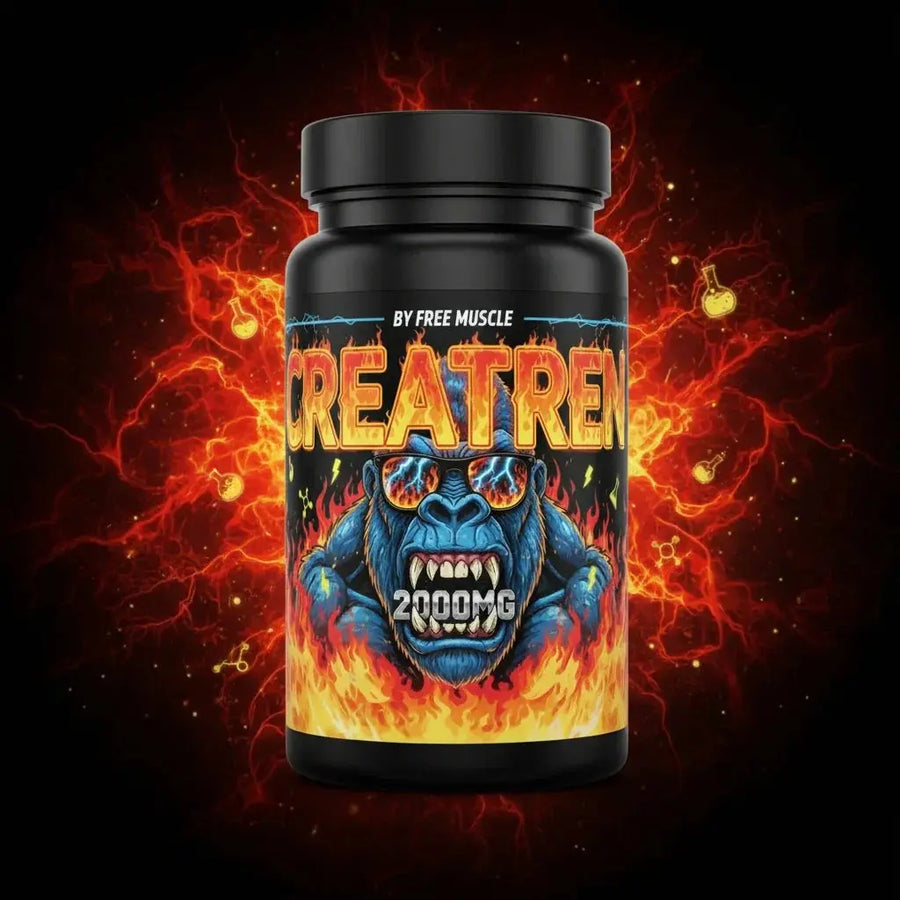
The most researched supplement in sport, plus one more ingredient. CREATREN is creatine monohydrate with taurine — two actives, nothing else in the tub. 300g, ~60 servings.
THE PROVEN
FOUNDATION
Creatine is the most-researched ergogenic aid there is. Taurine is along for hydration.
Strength & power
Creatine increases physical performance in successive bursts of short-term, high-intensity exercise.
Fuller-looking muscle
Creatine draws water into the muscle cell. Expect 1–2kg on the scale in the first fortnight — that is intracellular water, not fat.
Why the taurine
Taurine is an amino acid involved in cell hydration. It is here as a complement, not as the reason to buy.
No loading needed
5g daily saturates muscle stores in three to four weeks. Loading gets you there faster, with more stomach upset.
Not for everyone
A minority are genuine non-responders, usually people already eating a lot of red meat and fish. We would rather tell you now.
Mixes clean
Micronised, neutral tasting, no grit at the bottom of the shaker.
POWER STACK
Two ingredients. That is the whole label.
Creatine Monohydrate
The gold-standard form — the most studied and most replicated creatine there is.
Taurine
An amino acid involved in cell hydration, included as a complement to the creatine.
~60 servings
About two months of daily use from a single tub.
Nothing else in the tub
No fillers, no flavouring, no proprietary blend hiding the doses.
Suggested use: mix one serving with water or your shake daily. Timing does not matter much; consistency does. No loading phase required.
CREATREN 300G
Tax included · 300g · ~60 servings
WHAT WE CAN
PROVE
We don't have customer reviews to show you yet, and we're not going to invent any. Here is what we can actually put in front of you instead.
Assayed by a lab we don't own
Batches go to Janoshik Analytical, an independent testing laboratory. We don't choose the result.
Tested per batch, not per year
A certificate from a batch made two years ago says nothing about the pack in your hand.
Batch number on the pack
Email it to us with the product name and we'll send the Certificate of Analysis for that batch.
QUESTIONS, ANSWERED
Creatine monohydrate combined with taurine. Two ingredients, 300g, roughly 60 servings.
No. 5g a day saturates muscle stores in three to four weeks. Loading (20g a day for a week) gets you there faster but upsets some people's stomachs. Both end up in the same place.
Some, and it sits inside the muscle rather than under the skin. Expect one to two kilos on the scale in the first fortnight. That is the creatine working, not fat.
Whenever you will remember. Timing has a small effect; consistency has a large one.
A minority of people are genuine non-responders. Finish the tub — if your working sets have not moved, our 60-day guarantee covers you.
In-stock orders are dispatched the same or next working day, with tracked UK and EU delivery.
Food supplement. Do not exceed the recommended daily dose. A food supplement is not a substitute for a varied, balanced diet and healthy lifestyle. Drink plenty of water. Store out of reach of young children. Not suitable for those under 18.
COMPOUND MONOGRAPH
Creatine monohydrate in the UK: buying, legal status and what to check
Creatine is legal to buy and sell in the UK. Creatine monohydrate is regulated as a food supplement, not a medicine, and it is not a controlled substance. The authorised health claim we use for it in Great Britain and the EU is that creatine increases physical performance in successive bursts of short-term, high intensity exercise, and the beneficial effect is obtained with a daily intake of 3 g of creatine. Taurine, the second ingredient in CREATREN, is a permitted food ingredient with no authorised health claim, so we make none for it.
UK labelling law already requires the responsible business's name and address, an ingredients list, the amount of each active substance per recommended daily portion, a batch mark, a best before date and standard warnings. It does not require an independent assay of each batch, so that is the check worth asking any seller for: a certificate carrying the batch number on your tub.
CREATREN is sold by FreeMuscle LTD, a UK company in Scunthorpe, to adults aged 18 or over. Every batch is assayed by Janoshik Analytical, and the certificate for your batch is emailed on request. UK delivery is free, tracked and plain-packaged; orders before 2pm Monday to Friday are processed the same working day, EU delivery takes 3 to 7 working days, and unopened items can be returned within 30 days (see shipping and guarantee).
Powder compared with capsules, micronised and other creatine forms
Micronised creatine is creatine monohydrate milled to a finer particle size so it disperses more easily in liquid; the molecule and its creatine content by weight are unchanged. Monohydrate is 87.9 per cent creatine by mass, the highest of any form except anhydrous creatine, and it dissolves at only about 14 g per litre of water at 20 °C. Antonio and colleagues (2021) note that solubility has no influence on uptake into tissue.
Capsules hold the same powder in a gelatin or cellulose shell, which changes convenience and cost per gram rather than chemistry; gram quantities usually take several capsules. Liquids are different: creatine is not stable in solution, where it slowly converts to creatinine, and the same review reports that attempts to make stable creatine drinks have failed. That is why creatine is sold mainly as powder.
Hydrochloride, ethyl ester, buffered and nitrate forms are often marketed as better absorbed. Antonio and colleagues found no peer-reviewed study in which equal amounts raised muscle creatine more than monohydrate, and Kreider and colleagues (2022) concluded that monohydrate remains the only source of creatine with substantial evidence behind it.
Creatine compared with taurine, the second ingredient
The two share a tub, not a chemistry or a legal standing.
| Property | Creatine monohydrate | Taurine |
|---|---|---|
| Chemical name | 2-[carbamimidoyl(methyl)amino]acetic acid, hydrate | 2-aminoethanesulfonic acid |
| CAS number | 6020-87-7 (anhydrous creatine 57-00-1) | 107-35-7 |
| Formula and molar mass | C4H9N3O2·H2O, 149.15 g/mol | C2H7NO3S, 125.15 g/mol |
| Chemical class | Guanidino compound made in the body from arginine, glycine and methionine | Aminosulphonic acid, one of the few amino acids not built into proteins |
| Everyday sources | Meat and fish | Meat, fish and many energy drinks |
| Authorised health claim used | The one stated above | None |
| WADA Prohibited List | Not listed | Not listed |
Creatine monohydrate has been studied in controlled trials since the early 1990s; no taurine claim has passed the assessment needed for authorisation. Our article on creatine and taurine sets out what is and is not supported. Our other food supplement, the stimulant-free pre-workout NitraGlyc (pre-workout collection), contains Nitrosigine and glycerol, and neither carries an authorised claim.
Reading the certificate of analysis for CREATREN
Match the product name and batch number on the Janoshik certificate to your tub and note the test date. Then read the results.
- Identity: confirms the laboratory found creatine and taurine by the method named. It shows what is in the powder, not how much.
- Content: the measured amount, per gram or as a percentage. Check whether it is expressed as creatine or as monohydrate: pure monohydrate reads about 87.9 per cent when reported as creatine, which is not a shortfall. For a two-ingredient blend, compare the result with the label's per-serving amounts, not with 100 per cent.
- Related substances: Antonio and colleagues report creatine from some synthesis routes containing up to 5.4 per cent dicyandiamide, 0.09 per cent dihydrotriazine and 1.3 per cent creatinine. If a certificate lists no impurity results, they were not measured, which is not the same as absent. Ask us what your batch certificate covers.
A PDF without a batch number is not a batch certificate. See how we test and how to read a certificate of analysis.
Creatine, sport and testing
Neither creatine nor taurine is on the WADA Prohibited List, so neither is prohibited in or out of competition. The anti-doping risk with any supplement is contamination. Geyer and colleagues (2004) analysed 634 non-hormonal supplements bought in 13 countries and found undeclared anabolic androgenic steroids in 94 (14.8 per cent), including 18.8 per cent of products bought in the UK; a total intake of more than 1 microgram of nandrolone prohormones produced positive tests for norandrosterone for several hours. The samples date from 2000 and 2001, but the World Anti-Doping Code still holds athletes responsible for anything in their sample. A Janoshik certificate confirms identity and content; it is not an anti-doping screen, so athletes should check what their governing body requires.
Creatine also affects clinical tests. It can raise blood and urinary creatinine, the marker used to estimate kidney function, and Antonio and colleagues caution that estimated filtration rate needs careful interpretation in people taking creatine or eating a lot of meat.
Storage, stability and shelf life
Dry creatine monohydrate is very stable. Antonio and colleagues report no sign of breakdown to creatinine over years, even at elevated storage temperatures, and Uzzan and colleagues (2009) confirmed that crystalline creatine stays stable unless it reaches deliquescence, absorbing enough moisture to dissolve. In their glycerol and buffer solutions, creatine degraded to creatinine, which has no biological activity, and did so faster as temperature (tested at 4, 23 and 35 °C) and water activity rose.
- Keep the lid closed and the tub cool, dry and out of direct sunlight, not in a steamy kitchen, bathroom or hot car.
- Use a dry scoop; moisture causes caking and starts degradation.
- Mix each serving just before drinking rather than preparing drinks in advance.
- Go by the best before date on the tub and keep it out of reach of young children.
What the published research reports
Antonio and colleagues (2021), eleven researchers writing for the International Society of Sports Nutrition, examined twelve common questions about creatine. They reported water retention in the first days as the most commonly reported adverse effect, while several training studies of five to ten weeks found no change in total body water; that creatine is not an anabolic steroid, differing in structure, mechanism and legal category; that the hair loss link rests on one unreplicated study in which DHT rose but stayed within normal clinical limits; and that the evidence did not show kidney damage in healthy people at the intakes studied. Most authors declared advisory roles, research funding or other links with companies that make or sell creatine.
Kreider and colleagues (2022) graded each marketed form as having strong, some or no evidence of bioavailability, and set out the studies a manufacturer would need before calling a new form superior; two authors filed creatine patents, now expired or abandoned, while employed by a creatine manufacturer, and the third chairs that manufacturer's scientific advisory board on creatine. None of these papers tested CREATREN, and the only claim we make for it is the authorised creatine claim.
Related compounds and reading
- Creatine collection
- Performance nutrition
- Pre-workout
- Bulk range
- Creatine and taurine: what the evidence supports
- How and when to take creatine
- How much protein do you need?
- What is Janoshik Analytical?
Glossary
- Creatine monohydrate: creatine crystallised with one water molecule.
- Anhydrous creatine: creatine with that water removed by drying.
- Phosphocreatine: the form in which muscle stores most of its creatine.
- Creatinine: creatine's breakdown product, excreted in urine and used as a kidney marker.
- Micronised: milled to a smaller particle size.
- Taurine: an aminosulphonic acid not incorporated into proteins.
- Water activity: how available a product's water is for chemical reactions.
- Deliquescence: absorbing air moisture until a solid dissolves.
- Authorised health claim: a claim assessed and listed for use on foods.
- Dicyandiamide: a synthesis by-product found in some creatine raw material.
CREATREN is a food supplement, not a medicine. Food supplements are not a substitute for a varied, balanced diet and a healthy lifestyle. Do not exceed the recommended daily portion stated on the label, and keep out of reach of young children. Sold to adults aged 18 or over. Nothing on this page is medical advice.
References
- Antonio J, et al. Common questions and misconceptions about creatine supplementation: what does the scientific evidence really show? J Int Soc Sports Nutr. 2021;18(1):13. PMID: 33557850.
- Kreider RB, Jäger R, Purpura M. Bioavailability, efficacy, safety, and regulatory status of creatine and related compounds: a critical review. Nutrients. 2022;14(5):1035. PMID: 35268011.
- Uzzan M, et al. Effect of water activity and temperature on the stability of creatine during storage. Drug Dev Ind Pharm. 2009;35(8):1003-1008. PMID: 19635041.
- Geyer H, et al. Analysis of non-hormonal nutritional supplements for anabolic-androgenic steroids: results of an international study. Int J Sports Med. 2004;25(2):124-129. PMID: 14986195.