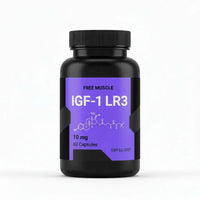
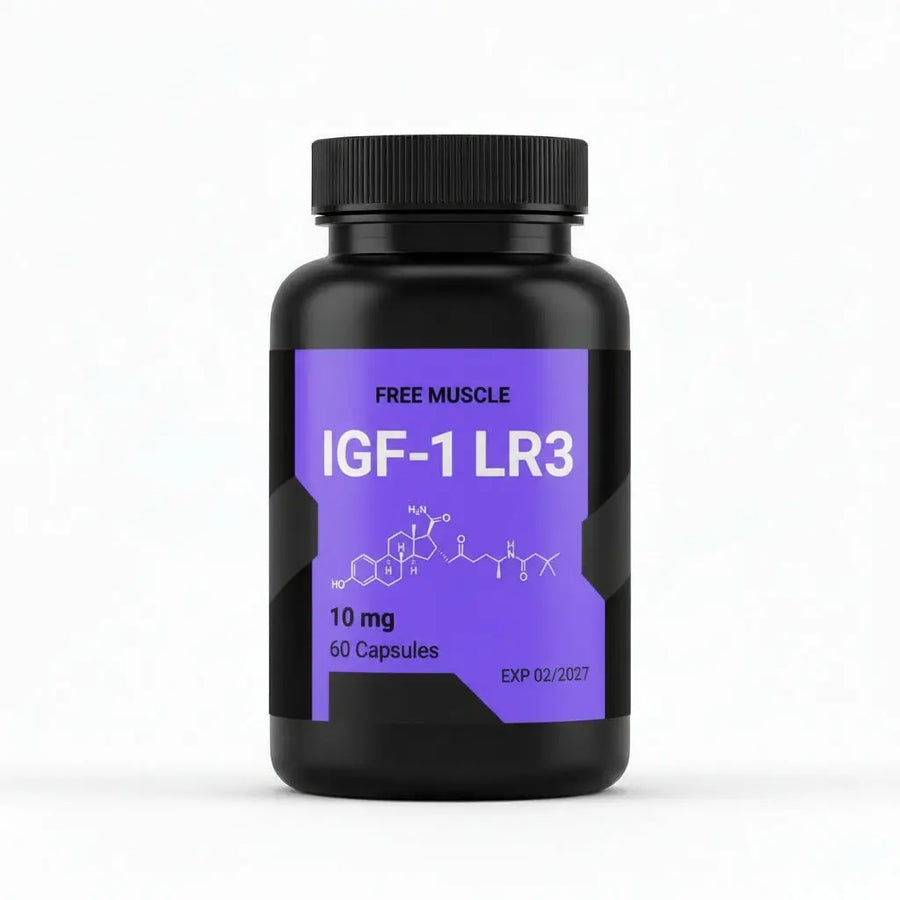
RESEARCH IGF-1 LR3 60 CAPSULES
A long-arginine-3 analogue of insulin-like growth factor 1. Not authorised as a medicine or a food supplement in the UK or EU. Supplied for laboratory research use only — read the evidence section below before you decide.
WHAT IS
ACTUALLY KNOWN
We would rather you bought with your eyes open than not at all. Here is the state of the evidence, including the parts that do not help us.
What it is
This is a modified growth factor. A long-arginine-3 analogue of insulin-like growth factor 1.
State of the evidence
Used as a laboratory reagent in cell culture. Not studied as a consumer product.
Known risks
IGF-1 signalling is implicated in tumour growth. This is not a benign molecule, and it is sold here as a reagent.
Regulatory status
Not authorised as a medicine or a food supplement in the UK or EU.
Status in sport
IGF-1 and its analogues are on the WADA Prohibited List.
What we verify
Identity and purity, per batch, by a laboratory we do not own. We verify what is in the capsule — nothing about what it does.
SPEC SHEET
What is in the bottle, and what is on the certificate.
IGF-1 LR3
The long-arginine-3 analogue of insulin-like growth factor 1, as stated on the certificate of analysis.
Bottle contents
Each bottle contains 60 capsules.
Research use only
We do not publish a human dosing schedule for this compound.
Independently assayed
Each batch is assayed by Janoshik Analytical, an independent laboratory. The Certificate of Analysis for your batch is available on request.
This product is supplied for laboratory research use only. We do not provide dosing instructions, cycle lengths or post-cycle protocols for human use.
IGF-1 LR3
Tax included · assayed per batch
WHAT WE CAN
PROVE
We don't have customer reviews to show you yet, and we're not going to invent any. Here is what we can actually put in front of you instead.
Assayed by a lab we don't own
Batches go to Janoshik Analytical, an independent testing laboratory. We don't choose the result.
Tested per batch, not per year
A certificate from a batch made two years ago says nothing about the pack in your hand.
Batch number on the pack
Email it to us with the product name and we'll send the Certificate of Analysis for that batch.
QUESTIONS, ANSWERED
A long-arginine-3 analogue of insulin-like growth factor 1. Used as a laboratory reagent in cell culture. Not studied as a consumer product.
This product is supplied for laboratory research use only. We do not provide dosing instructions, cycle lengths or post-cycle protocols for human use.
Largely, no. Peptides are broken down by digestive enzymes before absorption, which is why clinical work on this class uses injection. We are not going to claim a capsule matches that.
Yes — identity and purity, per batch, by Janoshik Analytical. Email us the batch number from your pack and we will send that batch's Certificate of Analysis. You do not need to have bought anything to ask.
Sold as a research compound for laboratory and educational use. Not a medicine; not evaluated by the MHRA, EMA or FDA; not intended to diagnose, treat, cure or prevent any disease. Not for human consumption. Not for use by anyone under 18 or by women who are pregnant or breastfeeding.
COMPOUND MONOGRAPH
IGF-1 LR3 in the UK: buying, legal status and what to check
Is IGF-1 LR3 legal to buy in the UK? IGF-1 LR3 (Long R3 IGF-1) is not listed as a controlled drug in the UK, unlike growth hormone itself, but it is not a licensed medicine and holds no MHRA marketing authorisation. It is not an authorised food supplement or novel food, so it cannot lawfully be sold for human consumption. A listing that presents it as a supplement, a nasal spray for personal use or a product with promised results is not describing a research reagent. Free Muscle supplies IGF-1 LR3 as a laboratory reagent to adults aged 18 or over, for research use only. The licensed IGF-1 medicine is mecasermin, recombinant native IGF-1 given by injection to children with severe primary IGF-1 deficiency under specialist supervision. LR3 is a different molecule and has never been approved as a medicine anywhere.
Judging a UK listing on evidence means looking for the compound name and analogue designation, the quantity per capsule as assayed rather than as printed, the capsule count, a batch number that also appears on the pack, a batch-specific certificate of analysis from an independent laboratory, plain tracked shipping from a named UK company, and an absence of dosing or "when to take" guidance. This listing states 60 capsules per bottle, every Free Muscle batch is assayed by Janoshik Analytical, the certificate for the batch in hand is sent on request by email, and UK delivery is free, tracked and plain-packaged.
Capsules compared with vials, sprays and other forms
Every laboratory and animal study of LR3 IGF-1 used the protein in solution, added to cell culture medium or infused into animals. IGF-1 LR3 is an 83-amino-acid protein of about 9 kDa, far larger than the short peptides for which oral absorption has even been attempted. Swallowed, it meets stomach acid and digestive proteases that cleave it into fragments with no receptor activity. Drucker's 2020 review of oral peptide therapeutics documents how difficult oral delivery is even for much smaller molecules such as insulin and semaglutide, which needed permeation enhancers and protective formulations. Nasal sprays are a route with no published data for LR3 at all. Lyophilised vials are the conventional research presentation, but they require reconstitution in buffered solution, cold-chain storage and precise volumetric handling, and protein in solution is less stable than dry material. A capsule offers a fixed, assayed quantity of dry material in a sealed container, which is simple to keep dry and to log by batch. It changes nothing about oral absorption, and no efficacy is claimed for it.
IGF-1 LR3 compared with HGH, MK-677 and ipamorelin
These compounds share one hormonal axis but act at different points. Somatropin (HGH) is recombinant growth hormone itself, a 191-amino-acid protein that acts on the growth hormone receptor and causes the liver to secrete IGF-1; it is a prescription-only medicine and a Class C controlled drug in the UK. MK-677 and ipamorelin act one step further upstream at the ghrelin receptor, stimulating the pituitary to release the body's own growth hormone, so any IGF-1 rise remains subject to normal feedback. IGF-1 LR3 acts at the end of the chain, directly on the type 1 IGF receptor, bypassing the pituitary and liver and, because of its Arg3 substitution and 13-residue N-terminal extension, largely escaping the binding proteins that normally buffer IGF-1 in blood. Francis and colleagues (1992) showed that this binding-protein evasion, not stronger receptor binding, explained its higher potency in cell culture. The evidence bases differ sharply: somatropin has decades of clinical data, MK-677 has randomised trials in older adults, ipamorelin reached patient trials without gaining approval, and LR3 has only cell and rodent studies. All four are prohibited at all times under section S2 of the WADA list.
What the published research reports
Francis and colleagues (1992) expressed a series of IGF-1 fusion analogues in E. coli and compared them in rat L6 myoblasts, H35 hepatoma cells and chicken embryo fibroblasts. Long [Arg3]-IGF-I was among the most potent analogues in cells that secrete IGF-binding proteins, but less potent than native IGF-1 in cells that do not, showing that its advantage comes from evading binding proteins. Tomas and colleagues (1992) infused native IGF-1 and its variants into rats made catabolic with dexamethasone; LR3 was about 2.5 times as potent as IGF-1 on body weight and nitrogen retention despite binding the receptor three-fold less well, but fractional carcass weights stayed low and the IGF peptides increased gut weight by up to 45 per cent. Rosenbloom (2009), reviewing mecasermin, lists hypoglycaemia as its most frequent adverse effect together with lymphoid tissue hyperplasia sometimes requiring tonsillectomy, fat accumulation and coarsening of facial features, and raises the anti-apoptotic action of IGF-1 as a concern for cancer in long-term therapy. Pollak (2008) reviews the evidence that insulin and IGF signalling drive neoplasia to the point where blocking the IGF-1 receptor is itself a cancer-treatment strategy. Kohler and colleagues (2010), reporting from the Cologne doping control laboratory, found unpurified Long R3 IGF-1 among confiscated black-market products in 2009, and Mongongu and colleagues (2021) found abundant oxidised forms in black-market LR3. The potency data are from cells and rats, the safety data are from a different molecule injected under medical supervision, and none of it is a claim about the capsules listed here.
Reading the certificate of analysis for this product
For a protein of this size, identity is normally established by mass spectrometry, matching the measured mass to the expected mass of the 83-residue analogue; this distinguishes LR3 from native IGF-1, from the DES(1-3) variant and from unrelated peptides. Purity is a percentage by HPLC showing how much of the protein content is the intact chain rather than truncated, aggregated or oxidised material, which matters because unpurified and oxidised LR3 has been found in seized products. Quantity per capsule is the figure to check against the label, and the batch number and test date connect the document to the bottle in hand. A certificate with no batch number, no date, or a product name only, is not a batch record. Request the certificate by email quoting the batch number on your pack. See how to read a certificate of analysis for a worked example.
Detection, sport and testing
Insulin-like growth factor 1 and its analogues, LR3 included, are named in section S2 of the WADA Prohibited List and are banned at all times. Anti-doping laboratories detect LR3 IGF-1 directly by immunopurification and high-resolution mass spectrometry, since its modified sequence makes it distinguishable from the body's own IGF-1. In a validated method study, Mongongu and colleagues (2021) gave rats a single intramuscular injection and found intact LR3 disappeared rapidly after 4 hours, while breakdown fragments remained detectable for up to 16 hours. No human administration study reports a detection window, so the accurate statement is that it is detectable and the human window is not established.
Storage, stability and handling
In dry form LR3 IGF-1 is reasonably stable, but heat, moisture, light and repeated temperature cycling promote aggregation, oxidation and deamidation. Keep the bottle sealed in a cool, dry, dark place, do not decant, and avoid taking a cold bottle into a warm room repeatedly because condensation introduces moisture. If a capsule's contents are dissolved for laboratory work, use buffered solution, keep it cold and use it promptly. Wear gloves, record the batch number on any sub-sample, dispose of unused material as laboratory waste and keep the product out of reach of children and pets.
Glossary
- IGF-1: insulin-like growth factor 1, a 70-amino-acid hormone made mainly by the liver in response to growth hormone.
- LR3: Long Arg3, an analogue with arginine replacing glutamate at position 3 and a 13-residue extension at the N-terminus.
- IGF-binding proteins: blood proteins that carry and buffer IGF-1; LR3 binds them poorly, which is the source of its potency in culture.
- Type 1 IGF receptor: the tyrosine-kinase receptor through which IGF-1 acts on cells.
- Mecasermin: recombinant native IGF-1, a licensed medicine for severe IGF-1 deficiency.
- Anti-apoptotic: preventing programmed cell death, a property relevant to cancer risk.
- LC-MS/MS: liquid chromatography with tandem mass spectrometry, used to identify peptides by mass and fragment pattern.
- Section S2: the WADA category covering peptide hormones, growth factors and related substances.
Related compounds and reading
- IGF-1 LR3 collection
- HGH (somatropin)
- MK-677 (ibutamoren)
- Ipamorelin
- Research peptides
- Do oral peptides actually work?
- Growth hormone research uses
- Insulin Grow research guide
- SARMs vs peptides
- What is Janoshik Analytical?
- How we test
IGF-1 LR3 is not a licensed medicine and not a food supplement. It has not been evaluated by the MHRA, EMA or FDA. This product is supplied as a laboratory reagent for research only, is not for human consumption, and is sold to adults aged 18 or over. Nothing on this page is medical or dosing advice.
References
- Francis GL, et al. Novel recombinant fusion protein analogues of insulin-like growth factor (IGF)-I indicate the relative importance of IGF-binding protein and receptor binding for enhanced biological potency. J Mol Endocrinol. 1992;8(3):213-223. PMID: 1378742.
- Tomas FM, et al. Insulin-like growth factor-I (IGF-I) and especially IGF-I variants are anabolic in dexamethasone-treated rats. Biochem J. 1992;282(Pt 1):91-97. PMID: 1371669.
- Rosenbloom AL. Mecasermin (recombinant human insulin-like growth factor I). Adv Ther. 2009;26(1):40-54. PMID: 19198769.
- Pollak M. Insulin and insulin-like growth factor signalling in neoplasia. Nat Rev Cancer. 2008;8(12):915-928. PMID: 19029956.
- Kohler M, et al. Confiscated black market products and nutritional supplements with non-approved ingredients analyzed in the Cologne Doping Control Laboratory 2009. Drug Test Anal. 2010;2(11-12):533-537. PMID: 21204286.
- Drucker DJ. Advances in oral peptide therapeutics. Nat Rev Drug Discov. 2020;19(4):277-289. PMID: 31848464.
- Mongongu C, et al. Detection of LongR3-IGF-I, Des(1-3)-IGF-I, and R3-IGF-I using immunopurification and high resolution mass spectrometry for antidoping purposes. Drug Test Anal. 2021;13(7):1256-1269. PMID: 33587816.