STIM-FREE NITRAGLYC PUMPS
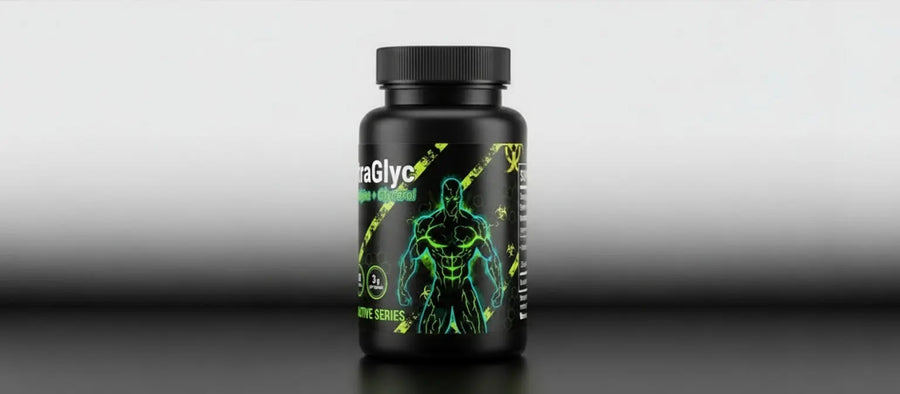
A stimulant-free pump product. NitraGlyc pairs Nitrosigine and glycerol — two ingredients studied for blood flow and cell volumisation. No caffeine, so it stacks with your usual pre-workout or works for evening training. 3g per capsule, 60 capsules.
THE STIM-FREE
PUMP ENGINE
No caffeine to mask anything — just blood flow and cell hydration.
Blood flow
Nitrosigine is an inositol-stabilised arginine silicate, studied for its role in nitric-oxide production.
Cell volumisation
Glycerol draws water into muscle cells, which is what produces the fuller feeling during a session.
Drink water with it
Glycerol needs fluid to work with. Under-hydrating is the usual reason people feel nothing from it.
Not a stimulant
It will not give you energy, and it is not meant to. This is a blood-flow and hydration product.
Stacks with anything
Zero stimulants means you can add it on top of your usual pre-workout, or train late without wrecking sleep.
Two named ingredients
Nitrosigine and glycerol. No proprietary blend, and nothing on the label you cannot look up.
PUMP MATRIX
Two named ingredients, 3g per capsule.
Nitrosigine (inositol-stabilised arginine silicate)
Researched for its role in nitric-oxide production and vasodilation.
Glycerol
Draws water into muscle cells, which produces the fullness and vascularity during training.
Caffeine-free
No jitters, no crash, no effect on sleep if you train in the evening.
60 capsules
No scooping and no mixing — take it before training and go.
Suggested use: take the recommended serving 20–30 minutes before training with plenty of water. Stimulant-free, so it works at any time of day and stacks with any stim pre-workout.
NITRAGLYC PUMP
Tax included · 60 capsules · 3g per capsule · stimulant-free
WHAT WE CAN
PROVE
We don't have customer reviews to show you yet, and we're not going to invent any. Here is what we can actually put in front of you instead.
Assayed by a lab we don't own
Batches go to Janoshik Analytical, an independent testing laboratory. We don't choose the result.
Tested per batch, not per year
A certificate from a batch made two years ago says nothing about the pack in your hand.
Batch number on the pack
Email it to us with the product name and we'll send the Certificate of Analysis for that batch.
QUESTIONS, ANSWERED
No, it is completely stimulant-free. It will not give you energy. It works on blood flow and cell hydration, which is a different thing.
Yes, that is the intended use. Because there is no caffeine in it, it adds to whatever you already take rather than competing with it.
20–30 minutes before training, with plenty of water. Being stim-free, any time of day works.
The most common reason is not drinking enough. Glycerol works by moving water into muscle cells, so it needs fluid to work with.
An inositol-stabilised arginine silicate, researched for its role in nitric-oxide production.
In-stock orders are dispatched the same or next working day, with tracked UK and EU delivery.
Food supplement. Do not exceed the recommended daily dose. A food supplement is not a substitute for a varied, balanced diet and healthy lifestyle. Store out of reach of young children. Not for use by anyone under 18 or by women who are pregnant or breastfeeding.
COMPOUND MONOGRAPH
NitraGlyc in the UK: buying, legal status and what to check
Buyers searching for Nitrosigine or a stimulant-free pre-workout in the UK usually want to know what the product is in law and how to judge a listing. NitraGlyc is a food supplement, regulated under the Food Supplements (England) Regulations 2003 and their equivalents in Scotland, Wales and Northern Ireland, not under medicines law, so the MHRA does not license it. Its wording falls under the nutrition and health claims rules (Regulation (EC) No 1924/2006, as it applies in the UK), which allow only claims on the authorised register. No claim is authorised for inositol-stabilised arginine silicate or for glycerol, so none is made here.
The Bioreactive Series name causes some confusion. MK-777 and RAD-150 in the same line are research compounds sold for laboratory use only; NitraGlyc is a food, labelled and sold for consumption by adults, and the two categories follow different rules.
The label must name each ingredient, state the amount per recommended portion and carry the standard warnings. A trustworthy listing adds a batch number, an independent certificate for that batch and a named UK business. NitraGlyc is sold by FreeMuscle LTD of Scunthorpe, every batch is assayed by Janoshik Analytical, orders placed before 2pm Monday to Friday are processed the same working day, and EU parcels take three to seven working days (see shipping and our guarantee).
Capsules compared with powders and tablets
Nitrosigine is an ingredient rather than a finished product, and it appears in tub pre-workouts, tablets and capsules. Glycerol, also called glycerine, is a thick liquid at room temperature, so dry formats commonly use a glycerol powder in which the liquid is held on a carrier. Two label points follow: the figure that matters is the glycerol content, not the weight of the carrier powder, and glycerol is not glycerol monostearate, an emulsifier with a similar name.
Capsules give a fixed, weighed fill with no measuring or flavouring, and a sealed shell that protects a moisture-sensitive ingredient. Their limit is volume. The glycerol studies discussed below combined glycerol with large volumes of extra fluid, a protocol no capsule product is designed to reproduce, so no effect should be inferred from them. Compare formats on the stated quantity of each ingredient, not on capsule or scoop counts.
Nitrosigine compared with L-arginine and L-citrulline
"Bonded arginine silicate" is the phrase behind many searches. Nitrosigine is the trade name for arginine bonded to silicate and stabilised with inositol. It sits alongside the two amino acids most often used in stimulant-free formulas.
| Point of comparison | Nitrosigine | L-arginine | L-citrulline |
|---|---|---|---|
| What it is | Arginine silicate complex stabilised with inositol | Amino acid; substrate of nitric oxide synthase (CAS 74-79-3, C6H14N4O2) | Amino acid converted to arginine in the kidneys; often sold as citrulline malate |
| Role in the studies cited here | Plasma arginine, serum silicon and salivary nitric oxide markers (Kalman 2015); resting flow-mediated dilation (Rogers 2020) | A main outcome measured after Nitrosigine intake (Kalman 2015) | Active comparator to Nitrosigine, with a similar change in flow-mediated dilation (Rogers 2020) |
| Authorised UK health claim | None | None; claims submitted to EFSA were not authorised | None |
| WADA Prohibited List | Not listed | Not listed | Not listed |
The regulatory position of all three is the same, and the human data on Nitrosigine are small and short. Glycerol is sometimes compared with creatine, since both have been studied for the water the body retains with them, but creatine is stored in muscle, largely as phosphocreatine, and carries an authorised health claim, while glycerol carries none. Free Muscle's creatine product, Creatren, is listed in the creatine collection.
Reading the certificate of analysis for NitraGlyc
NitraGlyc has two named ingredients, so a complete certificate should address both. Janoshik Analytical assays every Free Muscle batch; these are the fields to check.
- Batch number: it must match the number printed on your pack. A certificate for another batch says nothing about yours.
- Identity: the substances the laboratory reports finding, usually by chromatography such as HPLC or GC, set against the ingredient list.
- Quantity: the measured amount per capsule compared with the label claim. For a food supplement this matters more than a purity percentage, because the label promises an amount.
- Date and laboratory reference: when the sample was tested, and any code that lets the document be checked with the laboratory.
If one ingredient is not reported, that part of the label is unverified for the batch, and you can ask us about it. A certificate also covers only what it lists: unless it states microbiological, heavy metal or banned-substance screening, none was performed. See our lab tests page.
Detection, sport and testing
Glycerol has an anti-doping history. The World Anti-Doping Agency prohibited it from 2010 as a plasma expander, reasoning that a larger blood volume could mask the effects of blood doping on haemoglobin and haematocrit (Koehler 2013). A meta-analysis of seven studies then found that glycerol with fluid raised plasma volume only 3.3% more than fluid alone, with no difference in haematocrit, and judged its masking potential very limited. Glycerol was removed from the Prohibited List on 1 January 2018, so older sources calling it banned are out of date. Arginine, citrulline, inositol and silicate are not listed.
Two points still apply to athletes in tested sport. Under strict liability, an athlete is responsible for anything found in their sample, whatever its source. And a batch certificate confirms the labelled ingredients; it is not a screen for prohibited substances. Governing bodies differ on whether they expect supplements to carry a separate sport certification, so check your own rules.
Storage, stability and handling
Glycerol is hygroscopic, meaning it attracts water from the air, and capsule shells change with humidity: they can soften and stick together in damp conditions and turn brittle in very dry heat. Keep the container tightly closed at room temperature, away from direct sunlight, steamy bathrooms and hot cars. Leave any desiccant sachet in place, and avoid decanting capsules into pill organisers for long periods, where they lose that protection. Capsules that have fused, cracked or discoloured should not be used. Keep the container until it is finished, because the batch number and best-before date on the label are what link it to its certificate.
What the published research reports
In a 14-day study of ten healthy men, plasma arginine rose within 30 minutes of the first serving of inositol-stabilised arginine silicate, and serum silicon also rose. Salivary nitric oxide markers did not change significantly after the first serving; after 14 days the resting level had risen in six men and stayed the same in four. The study was small, measured markers rather than exercise, and its authors called for further work; they reported no safety concerns within that protocol (Kalman 2015).
A randomised, double-blind crossover in 24 active young adults compared one serving of Nitrosigine, citrulline malate and a dextrose placebo, a week apart. Flow-mediated dilation of the brachial artery, measured at rest 60 minutes later, rose by 31% after Nitrosigine and 34% after citrulline malate, against a 2% fall with placebo. It was a single-session study of a resting vascular marker; exercise performance was not measured (Rogers 2020).
For glycerol, the evidence concerns hyperhydration: extra fluid taken with an agent that helps retain it before prolonged exercise, often in heat. A systematic review of 38 such studies (403 participants, 361 of them men; agents included glycerol and sodium) found plasma volume increases in ten studies and gastrointestinal symptoms reported in 26, with severity linked to the amount and speed of intake. The reviewers noted that women were underrepresented and blinding was often weak (Jardine 2023).
None of these findings is a claim about NitraGlyc, and no health claim is authorised for either ingredient.
Related compounds and reading
Collections: pre-workout, performance nutrition, creatine and the Bioreactive Series. Reading: Nitrosigine and stimulant-free pre-workouts, Creatine and taurine: what the evidence supports, What is Janoshik Analytical? and How to read a certificate of analysis.
Glossary
- Inositol: a sugar alcohol, used in Nitrosigine to stabilise the arginine silicate complex.
- Nitric oxide synthase: the enzyme that makes nitric oxide from arginine.
- Flow-mediated dilation (FMD): artery widening, measured by ultrasound, after a cuff restricting blood flow is released.
- Glycerol: propane-1,2,3-triol, or glycerine; CAS 56-81-5, C3H8O3, molecular weight 92.09.
- Hyperhydration: raising body water above its normal level before exercise.
- Plasma expander: a substance that increases the fluid volume of blood.
- Hygroscopic: attracting moisture from the air.
- Authorised health claim: a claim on the UK register that a food may lawfully carry.
- Label claim: the quantity per capsule stated on the pack.
- Strict liability: the anti-doping rule that athletes answer for anything in their sample.
NitraGlyc is a food supplement, not a medicine. No health claim is authorised for its ingredients and none is made. Nothing on this page is medical advice.
References
- Kalman DS, et al. A clinical evaluation to determine the safety, pharmacokinetics, and pharmacodynamics of an inositol-stabilized arginine silicate dietary supplement in healthy adult males. Clin Pharmacol. 2015;7:103-109. PMID: 26504409.
- Rogers JM, et al. Acute effects of Nitrosigine and citrulline malate on vasodilation in young adults. J Int Soc Sports Nutr. 2020;17(1):12. PMID: 32093766.
- Jardine WT, et al. The effect of pre-exercise hyperhydration on exercise performance, physiological outcomes and gastrointestinal symptoms: a systematic review. Sports Med. 2023;53(11):2111-2134. PMID: 37490269.
- Koehler K, et al. Meta-analysis: effects of glycerol administration on plasma volume, haemoglobin, and haematocrit. Drug Test Anal. 2013;5(11-12):896-899. PMID: 24353192.