Thoroughbred Labs 5-Amino-1MQ is supplied as 60 capsules per pack; the manufacturer does not state a strength per capsule on the label. It is supplied through the Muscle Market range for laboratory research only, is not for human consumption, and is sold to adults aged 18 and over. Below: what the published research on 5-Amino-1MQ reports, what the label documents, how batch certificates are handled for Thoroughbred Labs products, and the questions most often asked about buying 5-Amino-1MQ in the UK.
About 5-Amino-1MQ
5-Amino-1MQ (5-amino-1-methylquinolinium) is a small-molecule inhibitor of nicotinamide N-methyltransferase (NNMT), an enzyme expressed in fat tissue and liver that methylates nicotinamide and in doing so influences the cellular availability of NAD+ precursors and S-adenosylmethionine. It was developed by a group at the University of Texas Medical Branch as a membrane-permeable, selective NNMT inhibitor. It is not a SARM and not a peptide.
Interest in the enzyme came first. A 2014 Nature paper found that NNMT expression was raised in the white fat and liver of obese and diabetic mice, and that lowering NNMT in those tissues with an antisense oligonucleotide protected mice against diet-induced obesity, with higher energy expenditure and higher fat-tissue levels of S-adenosylmethionine and NAD+ (Kraus et al., 2014). That work used a genetic tool, not a drug, but it made NNMT a target, and small-molecule inhibitors such as 5-Amino-1MQ followed.
In a 2018 study, diet-induced obese mice given an NNMT inhibitor from this series showed lower body weight and white fat mass and lower plasma cholesterol than vehicle-treated animals over the treatment period (Neelakantan et al., 2018). A 2019 study in aged mice reported that the inhibitor increased muscle stem cell activity and larger muscle fibres after an experimental injury (Neelakantan et al., 2019). Both studies used subcutaneous injection in mice over a few weeks, the same laboratory produced both, and neither was designed to assess long-term toxicity. A 2021 study from a collaborating team developed an assay for the compound in rat plasma and urine and measured its behaviour in rats after intravenous and oral administration (Awosemo et al., 2021). There are no human trials, no human pharmacokinetic data and no safety data in people, and the compound has never been approved as a medicine. It is frequently sold alongside claims that nothing published supports. Nothing above is a claim about this product.
In chemical terms, PubChem (CID 950107) records 5-amino-1-methylquinolinium under CAS number 685079-15-6, with the formula C10H11N2+ and a mass of 159.21 for the ion. The plus sign matters: the ring nitrogen carries a permanent positive charge, so the substance cannot exist on its own as a neutral powder and is always supplied as a salt paired with a negative counter-ion. Its systematic name is 1-methylquinolin-1-ium-5-amine.
This listing
- Manufacturer: Thoroughbred Labs
- Compound: 5-Amino-1MQ
- Form: Capsules
- Pack size: 60 capsules
- Strength: the manufacturer does not state the amount per capsule on the label, so we do not list one
- Batch certificate of analysis: shown where Thoroughbred Labs supplies one for the batch we hold
5-Amino-1MQ in the UK: buying, legal status and what to check
Searches such as "5-Amino-1MQ UK" and "5 amino 1mq UK buy" ask whether a UK shop may sell it and how to judge a listing. 5-Amino-1MQ is not a licensed medicine in the UK, has not been assessed by the MHRA, and is not an authorised food supplement. It is not a controlled drug. It is sold for laboratory research to adults aged 18 and over and is not for human consumption. Whether or not it is named on the WADA Prohibited List, a substance with no current approval for human therapeutic use falls under section S0 (non-approved substances) and is prohibited at all times in sport. Anyone subject to anti-doping rules should consult the current list.
A research listing that publishes instructions for use or promised results contradicts the terms it sells under. What it should publish is information a researcher can check against the pack and a laboratory report. The table sets out those checks for 5-Amino-1MQ and how this listing answers each.
| What to look for | Why it matters for 5-Amino-1MQ | This listing |
|---|---|---|
| Strength per capsule | Without it, total content per pack cannot be calculated | Not stated by Thoroughbred Labs, and we do not invent a figure |
| Salt form | The compound is a charged ion, so the counter-ion changes the weight of each milligram of powder | Not stated on the label; check any certificate supplied |
| Batch number and matching certificate | Connects an analysis to the stock actually shipped | Certificate shown only where the manufacturer supplies one for the batch we hold |
| Identifiable UK seller | Gives an age check, a contact and a returns route | FreeMuscle LTD, Scunthorpe; 18+ only; 30-day returns on unopened items |
| Delivery | Traceable, discreet transit | Free tracked UK delivery in plain packaging; EU delivery 3-7 working days |
Orders placed before 2pm Monday to Friday are processed the same working day. The full terms are on our shipping and guarantee pages, and the UK supplier checklist sets out the same tests for any shop. Our research guide covers the wider legal picture for compounds sold on this basis.
Reading the certificate of analysis for this product
Testing works differently here than on our own label. Free Muscle-brand batches are each assayed by Janoshik Analytical, an independent laboratory, and the certificate is emailed on request. Thoroughbred Labs is a third-party Muscle Market brand, so for this 5-Amino-1MQ we can show a certificate only if Thoroughbred Labs supplies one for the exact batch in stock. We do not pass off an undated or batchless PDF as a batch certificate. You can contact us to ask whether a certificate is held for the current batch. Where a certificate exists, the charged structure of 5-Amino-1MQ makes some fields more telling than usual.
- Identity: HPLC compares the sample with a reference standard by retention time; LC-MS adds a mass. Because the molecule is already charged, it appears in positive-mode mass spectrometry at about m/z 159 without needing to pick up a proton, and the published rat assay monitored a transition from m/z 159.1 to a fragment at m/z 90 (Awosemo et al., 2021). A reported mass far from 159 points to a different substance.
- Purity: the percentage of detected material that is 5-Amino-1MQ, usually from HPLC peak areas. It describes the powder, not the quantity in each capsule.
- Salt form and content: a content figure should say whether it is expressed as the salt or as the ion alone. The same weighed powder gives a smaller number when only the 159.21 ion is counted, so two honest certificates can report different milligrams for identical capsules.
- Batch number: must match the number printed on the pack you hold.
- Test date and laboratory: identify when and by whom the analysis was done.
Missing fields should be read at face value. Since the label on this product gives no strength per capsule, a certificate with purity but no content figure confirms what the molecule is while leaving the amount per capsule unknown. A certificate without a batch number cannot be tied to this stock. If Thoroughbred Labs has supplied nothing for the current batch, this listing makes no analytical claim. Our lab tests page and the guide on how to read a certificate of analysis go further.
Capsules compared with other forms
Search terms such as "5 amino 1mq capsules UK", "5 amino 1mq tablets UK", "5 amino 1mq oral" and "5-amino-1mq subcutaneous" show that the compound circulates as capsules, tablets, loose powder and injectable solutions. The published record for each route is thin and should be read carefully.
The two mouse efficacy papers gave the compound by subcutaneous injection, so they say nothing direct about capsules. The only published oral data come from the 2021 rat study, which found the compound in plasma after oral administration and reported an oral bioavailability of about 38 per cent in rats, meaning a sizeable fraction of the orally administered amount reached the circulation in those animals (Awosemo et al., 2021). Rat figures cannot be converted into human figures, and no study has measured oral absorption in people.
Because 5-Amino-1MQ is a small molecule rather than a chain of amino acids, it is not broken down by stomach and gut proteases in the way oral peptides are, which is why the "peptide" label sometimes attached to it in search results is misleading. Its permanent charge is a different consideration, since charged molecules often cross gut membranes less readily than neutral ones.
Otherwise the formats differ in measurement. A capsule holds a weighed blend of active powder and filler, so consistency depends on even mixing; a solution depends on the compound staying dissolved and intact. With no stated strength on this label, only a content assay could show what each capsule holds. None of this is a claim about effect.
5-Amino-1MQ compared with SLU-PP-332
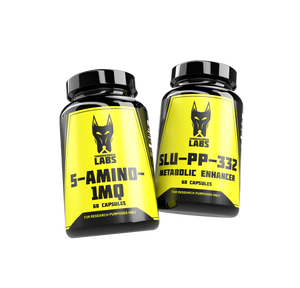
The compound most often searched alongside 5-Amino-1MQ is SLU-PP-332, and Thoroughbred Labs also lists the two in a single research pack. They are grouped together because both are recent small molecules discussed in metabolic research, but they act at different points in the cell and have different histories.
5-Amino-1MQ blocks an enzyme. By inhibiting NNMT it reduces the methylation of nicotinamide, which in animal and cell work was linked to changes in NAD+ and S-adenosylmethionine levels. SLU-PP-332 activates receptors: it is a pan-agonist of the oestrogen-related receptors ERR alpha, beta and gamma, nuclear receptors that switch on genes for mitochondrial energy production. One works by taking an enzyme out of play, the other by turning on a transcription programme. Neither acts at the androgen receptor, and neither is a peptide or a hormone.
The evidence bases are alike in shape. The published mouse studies of SLU-PP-332, looking at endurance and metabolic measures, are recent and come mainly from the group that developed it as an ERR agonist, just as the 5-Amino-1MQ work comes mainly from the group that developed that compound. Neither compound has been given to people in a published study.
| Point of comparison | 5-Amino-1MQ | SLU-PP-332 |
|---|---|---|
| Type of action | Enzyme inhibitor (NNMT) | Receptor agonist (ERR alpha, beta, gamma) |
| Chemistry | Quinolinium cation, supplied as a salt | Neutral acylhydrazone, C18H14N2O2 |
| Animal evidence | Mouse studies from one laboratory | Recent mouse studies, mainly from one laboratory |
| Oral data | Rat pharmacokinetics only | None published |
| Human data | None | None |
| WADA position | Prohibited at all times under S0 (non-approved substances) | Prohibited at all times under S0 (non-approved substances) |
| UK status | Unlicensed; research use only | Unlicensed; research use only |
This comparison is pharmacological and regulatory only. Nothing here suggests that the two compounds act together or should be used together, and the SLU-PP-332 and 5-Amino-1MQ research guide covers each in more depth.
Detection, sport and testing
For anyone bound by an anti-doping code, 5-Amino-1MQ is prohibited at all times. Section S0 of the WADA Prohibited List covers any pharmacological substance not approved for human therapeutic use, and this compound has never been approved anywhere, so it is caught whether or not it is named. A compound missing from the named examples is therefore not permitted.
On detection, the published evidence is limited but clear in one respect. The 2021 rat study validated a liquid chromatography tandem mass spectrometry method that quantified 5-Amino-1MQ in both plasma and urine, the two sample types used in sport testing (Awosemo et al., 2021). What is missing is any excretion study in people, so there is no established detection window in human urine or blood. Any figure quoted online for how long it remains detectable is unsupported. The accurate position is that it is detectable in principle and the window has not been established.
Storage, stability and handling
With no published stability data for these capsules, storage guidance rests on the compound's chemistry and laboratory practice. The amino group on the aromatic ring is the kind of structure that can slowly oxidise and discolour with air and light, and organic salts in powder form often take up moisture from humid air, which can cause clumping and soften gelatin or plant-based capsule shells. Heat speeds both processes.
- Keep the capsules sealed in the original container, closing it promptly after opening and leaving any desiccant sachet inside.
- Store at room temperature or below, away from radiators, windowsills and direct sunlight.
- Avoid damp rooms such as bathrooms and kitchens.
- Keep the pack and its label together, since the batch number is the link to any certificate of analysis.
- Keep out of reach of children and separate from food and drink.
Capsules that have stuck together, changed colour or developed an unusual smell should be set aside and not used for research. Standard laboratory rules on gloves, labelling and disposal of unwanted material apply.
Glossary
- NNMT (nicotinamide N-methyltransferase): the enzyme 5-Amino-1MQ inhibits; it transfers a methyl group to nicotinamide.
- Nicotinamide: a form of vitamin B3 and a precursor of NAD+.
- NAD+: nicotinamide adenine dinucleotide, a coenzyme central to energy metabolism in cells.
- S-adenosylmethionine (SAM): the methyl donor NNMT uses; it also supplies methyl groups to DNA and histones.
- Quinolinium: a quinoline ring with a positively charged nitrogen, the core of 5-Amino-1MQ.
- Counter-ion: the negatively charged partner that turns a charged molecule into a stable salt.
- Oral bioavailability: the fraction of an amount given by mouth that reaches the bloodstream unchanged.
- Pharmacokinetics: the study of how a substance is absorbed, distributed, broken down and eliminated.
- LC-MS/MS: liquid chromatography with tandem mass spectrometry, used to identify and measure a compound by mass and fragments.
- Section S0: the WADA category covering substances with no current approval for human therapeutic use.
- Certificate of analysis (COA): a laboratory report of identity, purity and content for a named batch.
Related
- All brands of 5-Amino-1MQ we stock, compared
- All Thoroughbred Labs products
- Thoroughbred Labs SLU-PP-332 and the Thoroughbred Labs research pack listing both compounds
- Metabolic research compounds
- Batch testing and certificates of analysis
- Delivery and returns
This product is supplied for laboratory research use only. It has not been evaluated by the MHRA, EMA or FDA. It is not a medicine, not a food supplement and not for human consumption. Sold only to adults aged 18 and over. Nothing on this page is medical, dosing or usage advice, and descriptions of published studies are not claims about this product.
References
- Kraus D, et al. Nicotinamide N-methyltransferase knockdown protects against diet-induced obesity. Nature. 2014;508(7495):258-262. PMID: 24717514.
- Neelakantan H, et al. Selective and membrane-permeable small molecule inhibitors of nicotinamide N-methyltransferase reverse high fat diet-induced obesity in mice. Biochem Pharmacol. 2018;147:141-152. PMID: 29155147.
- Neelakantan H, et al. Small molecule nicotinamide N-methyltransferase inhibitor activates senescent muscle stem cells and improves regenerative capacity of aged skeletal muscle. Biochem Pharmacol. 2019;163:481-492. PMID: 30753815.
- Awosemo O, et al. Development & validation of LC-MS/MS assay for 5-amino-1-methyl quinolinium in rat plasma: Application to pharmacokinetic and oral bioavailability studies. J Pharm Biomed Anal. 2021;204:114255. PMID: 34304009.
Frequently asked questions
Is 5-Amino-1MQ legal in the UK?
5-Amino-1MQ is not a licensed medicine in the UK and is not an authorised food supplement. It is not a controlled drug. It may be sold to adults for laboratory research, which is the only basis for this listing. It is not for human consumption and nothing on this page is medical or dosing advice.
How is 5-Amino-1MQ shipped in the UK and can I return it?
Every UK order ships free by tracked delivery in plain packaging, and orders placed before 2pm Monday to Friday are processed the same working day. EU delivery takes 3 to 7 working days. Unopened items can be returned within 30 days under our guarantee. Orders are accepted only from adults aged 18 and over, and the product is sold for laboratory research only.
Has 5-Amino-1MQ been tested in humans?
No. The published data are from cell cultures, mice and rats, produced by the laboratory that developed the compound and its collaborators. There is no human trial, no human pharmacokinetic study and no safety study in people. It has never been approved as a medicine anywhere. Marketing that implies a proven human result is not supported.
Does this listing state the strength per capsule?
No. The manufacturer does not print a strength per capsule on the label of this product, so we do not list one. We publish only what the manufacturer documents. Where a batch certificate of analysis is supplied for the batch we hold, it will state what was measured, and you can contact us to ask whether one is held.
Is 5-Amino-1MQ detectable in sport drug tests?
5-Amino-1MQ has never been approved for human therapeutic use, so it falls under section S0 of the WADA Prohibited List and is prohibited at all times, whether or not it is named. A published LC-MS/MS method measured it in rat plasma and urine, but no human excretion study exists, so no detection window has been established. Anyone subject to anti-doping rules should consult the current list.
Is 5-Amino-1MQ a peptide?
No, despite often being listed and searched for as one. 5-Amino-1MQ is a small quinolinium ion with a mass of about 159 and contains no amino acids. The name refers to an amino group on its ring, not to a peptide chain. It is analysed with small-molecule methods such as HPLC and LC-MS rather than by peptide sequencing.
Is this a 50 mg 5-Amino-1MQ capsule?
We cannot say, because Thoroughbred Labs does not print a strength per capsule for this product. We do not infer or estimate one from other brands or from search results. If the manufacturer supplies a certificate of analysis with a content figure for the batch we hold, that document is the only reliable source for what each capsule contains.
Are 5-Amino-1MQ capsules different from injectable versions?
The format changes how the amount per unit is fixed, not the molecule. The mouse studies used injection, while the only oral data come from rats, where part of an oral amount reached the bloodstream. No study has measured absorption in people. We make no claims about the effect of any format, and this listing is for research only.
What side effects or benefits have been reported for 5-Amino-1MQ?
No human data exist, so no side effects or benefits in people have been established. Published work reports changes in body weight, fat mass and muscle stem cells in mice, from the laboratory that developed the compound, and none of it studied long-term toxicity. An absence of reported harms reflects an absence of research, not evidence of tolerability.
What 5-Amino-1MQ dosage, protocol or results should I expect?
We do not publish dosing, protocol, cycle or results information for 5-Amino-1MQ and make no claims about outcomes. It is sold for laboratory research only and is not for human consumption. Reviews and before-and-after pictures online concern products of unknown content and cannot show what a capsule contained or what caused any change.
Related research and listings
- Related collections: Cardarine (GW-501516), SR9009 (Stenabolic), Bundles & Stacks
- Research guides: SR9009 (Stenabolic): REV-ERB research and the bioavailability problem; Cardarine (GW-501516): why development stopped and what the data show; Price per milligram: the only honest way to compare SARMs and peptides; What Is Janoshik Analytical? Third-Party Testing Explained
More from Thoroughbred Labs See all 9 →
Supplied for laboratory and research use. Not for human consumption. Not an approved medicine, and nothing above is dosing advice. You must be 18 or over to order.