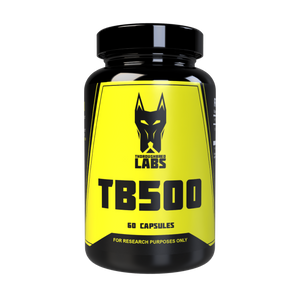
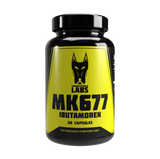
Thoroughbred Labs Cardarine GW-501516 is a Thoroughbred Labs listing of Cardarine, supplied as 60 capsules per pack; the manufacturer does not state a strength per capsule on the label. It is supplied through the Muscle Market range for laboratory research only, is not for human consumption, and is sold to adults aged 18 and over. This page sets out what the published research on Cardarine reports, what the label documents, where the compound stands in UK law and in sport, and how batch certificates are handled for Thoroughbred Labs products.
About Cardarine
Cardarine, also written GW-501516, GW501516, GW1516 or endurobol, is a synthetic agonist of PPAR-delta, a nuclear receptor that regulates genes involved in fatty acid oxidation in skeletal muscle. It was developed by GlaxoSmithKline and Ligand as a candidate for lipid disorders. It is not a SARM, although it is often sold alongside them, and it is not a peptide either: it is a small synthetic molecule built around a thiazole ring.
PubChem lists it as CID 9803963, CAS number 317318-70-0, molecular formula C21H18F3NO3S2, molecular weight 453.5 and InChIKey YDBLKRPLXZNVNB-UHFFFAOYSA-N. The systematic name, 2-[2-methyl-4-[[4-methyl-2-[4-(trifluoromethyl)phenyl]-1,3-thiazol-5-yl]methylsulfanyl]phenoxy]acetic acid, contains a sulphur atom in a thioether link; that sulphur is where the body oxidises the molecule, which matters for drug testing (see below).
What the published research reports
In a 2008 study in mice, GW-501516 given alongside treadmill training increased running endurance compared with training alone, which led the authors to describe the compound as an exercise mimetic; without training it produced no endurance change in that study (Narkar et al., 2008). A 2012 trial in 268 people with low HDL cholesterol reported that, compared with baseline, HDL rose and LDL cholesterol and triglycerides fell over twelve weeks (Olson et al., 2012); the trial was short and not designed to assess long-term safety. Development was abandoned in 2007 after two-year carcinogenicity studies in rats and mice found tumours in multiple organs. Those toxicology results were presented at a conference and are not indexed on PubMed, so they are not cited here, but they are the most important fact about this compound. Nothing in this section is a claim about this product.
This listing
- Manufacturer: Thoroughbred Labs
- Compound: Cardarine (GW-501516)
- Form: Capsules
- Pack size: 60 capsules
- Strength: the manufacturer does not state the amount per capsule on the label, so we do not list one
- Batch certificate of analysis: shown where Thoroughbred Labs supplies one for the batch we hold
- Sold for laboratory research to adults aged 18 and over; not for human consumption
Searches such as "cardarine 10mg" and "cardarine 20mg UK" assume a stated figure per capsule. This pack has none, so it cannot be matched to either number, and the total content per pack cannot be worked out from the label alone. Our guide to comparing by price per milligram explains why that matters when setting listings side by side.
Cardarine in the UK: buying, legal status and what to check
People searching "cardarine UK legal", "cardarine UK buy" or "UK sarms cardarine" usually want two answers: whether a purchase is lawful, and whether a particular seller can be trusted. On the first, Cardarine is not a licensed medicine in the UK, has not been assessed by the MHRA, and is not an authorised food supplement. It is not listed as a controlled drug. This listing is offered only to adults aged 18 and over for laboratory research, not for human consumption. A seller who gives instructions for taking it, or describes what it will do for the buyer, is wrongly presenting it as a medicine or supplement.
In sport, GW-501516 is named on the WADA Prohibited List under section S4 (hormone and metabolic modulators) as a PPAR-delta agonist and is prohibited at all times. WADA issued a specific warning about it in 2013. Anyone subject to anti-doping rules should consult the current list. Our research guide covers the wider legal picture for compounds sold alongside SARMs.
On trust, star ratings and forum threads (the "cardarine UK reviews" and "cardarine reddit" searches) cannot tell you what is in a capsule. Documents can. A UK listing worth relying on should show:
- The manufacturer's name and the compound's identifiers, so any certificate can be matched to GW-501516 rather than something similar. Here: Thoroughbred Labs, with CAS 317318-70-0 given above.
- A stated strength and capsule count. Here: 60 capsules, with the strength stated plainly as not given by the manufacturer rather than guessed.
- A certificate for the batch actually in stock, carrying a batch number. Here: shown only where Thoroughbred Labs supplies one for the batch we hold.
- An identifiable seller with an age requirement and a returns route. Here: FreeMuscle LTD, a UK company in Scunthorpe, selling to adults aged 18 and over, with 30-day returns on unopened items.
- Tracked delivery in plain packaging. Here: free tracked UK delivery on every order in plain packaging, orders placed before 2pm Monday to Friday processed the same working day, and EU delivery in 3-7 working days.
- No usage instructions of any kind. Here: none given.
Delivery and returns terms are on our shipping and guarantee pages. To see the brands of this compound we hold, including listings that do state a strength, use the Cardarine collection. Our UK supplier checklist applies the same questions to any shop.
Reading the certificate of analysis for this product
Thoroughbred Labs is a third-party brand in the Muscle Market range, so the testing position differs from our own label. Every Free Muscle-brand batch is assayed by Janoshik Analytical, an independent laboratory, with the certificate sent on request by email. For Thoroughbred Labs products we show a certificate of analysis only where the manufacturer supplies one for the specific batch we hold. A generic PDF with no batch number is not a batch certificate, and we do not present one as such. Email us with the product name and we will send what we hold, or say plainly that there is none.
When a certificate for this product is available, these are the fields to check:
- Compound name and identity method: the document should name GW-501516 and say how identity was established. HPLC matches the retention time of the sample against a reference standard; LC-MS adds a molecular mass, which for this compound should be consistent with the 453.5 molecular weight above.
- Purity: a percentage, normally from HPLC peak areas, showing how much of what was detected is the named compound. It says nothing about how much compound each capsule holds.
- Content per capsule: the measured milligrams of GW-501516 in one capsule. Because the label here gives no strength, this is the only figure that would allow a per-pack total.
- Batch or lot number: must match the code printed on the pack in your hands.
- Test date and laboratory name: tie the result to a specific analysis of current stock.
What a missing field means for this brand: no certificate at all means this listing makes no claim about identity, purity or content; a certificate with purity but no content confirms the molecule without telling you the amount per capsule; a batch number that differs from your pack means the document describes other stock. Our lab tests page and the article on how to read a COA go further, and you can contact us with any mismatch.
Capsules compared with other forms
Cardarine is sold by other sellers as capsules, tablets and liquid suspensions or solutions. The molecule is the same in each; what differs is how the amount per unit is fixed and what can go wrong on the way. No published study compares these formats for GW-501516, so the points below come from general pharmaceutical practice rather than compound-specific data.
- Capsules hold a weighed powder fill, usually blended with an inert filler. Errors come from uneven blending or variable fill weight. Each capsule is a discrete unit a laboratory can assay, so content per capsule can be measured directly.
- Liquids carry a stated concentration in a solvent that is not always named. The compound has to stay dissolved or evenly suspended, and the amount in any measured volume depends on that as well as on measuring accuracy. A certificate confirms concentration on the test date only.
- Powders sold loose require the researcher to weigh every portion, which moves the accuracy question onto the laboratory's own balance.
The "cardarine peptide" search reflects a common mix-up. Peptides are chains of amino acids that digestive enzymes break apart, which is why research on giving them by mouth is contested (see Do oral peptides work?). GW-501516 has no amino acid chain; it is a small organic molecule, and the human lipid trial cited above used oral administration. That is a statement about the chemistry and the trial design, not about this product. For this pack, the practical value of the capsule format depends on a certificate that reports measured content, since the label does not.
Cardarine compared with SR9009 (stenabolic)
"Stenabolic vs cardarine" is the comparison people search most for this compound, because sellers list the two side by side for similar purposes. Pharmacologically they have little in common. GW-501516 activates PPAR-delta; SR9009 was described in a 2012 paper from the Scripps Research Institute as a synthetic agonist of REV-ERB-alpha and REV-ERB-beta, nuclear receptors that help drive the daily rhythm of clock genes (Solt et al., 2012). In that study, SR9009 was given to mice by intraperitoneal injection; the mice showed altered circadian activity and changes in metabolic gene expression, and diet-induced obese mice lost more fat mass than controls. The authors noted that handling and twice-daily injections themselves caused weight loss in the control animals.
| Point of comparison | Cardarine (GW-501516) | SR9009 (stenabolic) |
|---|---|---|
| Target | PPAR-delta agonist | REV-ERB-alpha and REV-ERB-beta agonist |
| Identifiers | CAS 317318-70-0; C21H18F3NO3S2 | CAS 1379686-30-2; C20H24ClN3O4S |
| Origin | GlaxoSmithKline and Ligand, lipid disorder programme | Academic research compound, Scripps Research Institute |
| Human data | Phase II lipid trials; development stopped in 2007 after rodent carcinogenicity findings | No published human trial |
| Main published evidence | Mouse endurance study; human lipid trial | Mouse studies using injection |
| UK status | Unlicensed; research use only, 18+ | Unlicensed; research use only, 18+ |
| WADA | S4 metabolic modulator, prohibited at all times | S4 metabolic modulator, prohibited at all times |
Neither compound is a SARM, and neither has ever been approved as a medicine. Cardarine has the larger human evidence base but also the toxicology finding that ended its development; SR9009 has no human trial at all, so statements about its effects in people rest on anecdote. We make no claim about either in combination with anything else. The SR9009 collection lists the brands we stock, and our SR9009 research guide covers the 2012 work in more detail.
Detection, sport and testing
GW-501516 has been on the WADA Prohibited List since January 2009, when it was first categorised under gene doping; it now sits in section S4 among metabolic modulators and is banned both in and out of competition. Under the strict liability principle an athlete is responsible for any prohibited substance found in a sample, including one from a mislabelled or contaminated product.
Anti-doping laboratories do not rely only on the parent molecule. A 2010 study from the German Sport University Cologne identified two major urinary metabolites, the sulfoxide and the sulfone formed by oxidation of that thioether sulphur, and validated a routine urine screening method with a limit of detection of 0.1 ng/ml (Thevis et al., 2010). The paper established what to look for and how sensitively; it did not measure how long after exposure the compound or its metabolites remain detectable. For this capsule product the answer is therefore: detectable, window not established. Our article on why Cardarine development stopped covers the history behind the ban.
Storage, stability and handling
We know of no published study on how GW-501516 keeps in capsule form, so the expiry date, where Thoroughbred Labs prints one, is the only product-specific guide. General good practice applies. Store the sealed container somewhere cool and dry, away from direct sunlight and heat sources. Gelatine and plant-based capsule shells both react to humidity: damp air softens them and can let moisture reach the powder, and very dry air can make them brittle.
- Keep capsules in the original container, which carries the batch number that links them to any certificate.
- Record the date received, the date first opened and the batch number in your laboratory log.
- Handle capsules and any spilled powder with nitrile gloves.
- Dispose of expired or surplus material through your organisation's chemical waste route, not household waste.
- Keep out of reach of children and pets, and apart from food and drink.
Glossary
- PPAR-delta: peroxisome proliferator-activated receptor delta, a nuclear receptor that switches on genes for fatty acid use; GW-501516 activates it.
- Nuclear receptor: a protein inside the cell that binds a molecule and then changes which genes are read.
- Agonist: a compound that binds a receptor and activates it.
- Exercise mimetic: a label researchers gave compounds that reproduced some molecular effects of training in animals.
- REV-ERB: a pair of nuclear receptors in the body's clock machinery; SR9009 was designed to activate them.
- Carcinogenicity study: a long-term animal study, often two years in rodents, run to see whether a drug candidate causes tumours.
- HDL cholesterol: high-density lipoprotein cholesterol, the blood lipid measure the 2012 GW-501516 trial tracked.
- Metabolite: a compound the body produces by chemically altering a substance; anti-doping tests for GW-501516 target its sulfoxide and sulfone.
- Limit of detection: the smallest amount per millilitre of urine that a validated screening method picks up consistently, 0.1 ng/ml in the 2010 GW-501516 method.
- Strict liability: under the World Anti-Doping Code, a positive sample is the athlete's responsibility whether the substance came from a deliberate choice or a contaminated product.
Related
- All brands of Cardarine we stock, compared
- All Thoroughbred Labs products
- SR9009 (stenabolic) and the wider SARMs range
- Cardarine (GW-501516): why development stopped and what the data show
- Batch testing and certificates of analysis
- Delivery and returns
This product is supplied for laboratory research use only. It has not been evaluated by the MHRA, EMA or FDA. It is not a medicine, not a food supplement and not for human consumption. Sold only to adults aged 18 and over. Nothing on this page is medical, dosing or usage advice, and descriptions of published studies are not claims about this product.
References
- Narkar VA, et al. AMPK and PPARdelta agonists are exercise mimetics. Cell. 2008;134(3):405-15. PMID: 18674809.
- Olson EJ, et al. Lipid effects of peroxisome proliferator-activated receptor-delta agonist GW501516 in subjects with low high-density lipoprotein cholesterol: characteristics of metabolic syndrome. Arterioscler Thromb Vasc Biol. 2012;32(9):2289-94. PMID: 22814748.
- Thevis M, et al. Characterization of two major urinary metabolites of the PPARdelta-agonist GW1516 and implementation of the drug in routine doping controls. Anal Bioanal Chem. 2010;396(7):2479-91. PMID: 19946680.
- Solt LA, et al. Regulation of circadian behaviour and metabolism by synthetic REV-ERB agonists. Nature. 2012;485(7396):62-8. PMID: 22460951.
Frequently asked questions
Is Cardarine legal in the UK?
Cardarine (GW-501516) is not a licensed medicine in the UK and is not an authorised food supplement. It is not listed as a controlled drug. This listing is sold only to adults aged 18 and over for laboratory research. It is not for human consumption and nothing on this page is medical or dosing advice.
Is Cardarine a SARM?
No. Cardarine is a PPAR-delta agonist, not a selective androgen receptor modulator. It does not act at the androgen receptor. It is grouped with SARMs by many sellers because it was studied for endurance in mice, but its pharmacology is entirely different and so are its published toxicology findings.
Why was Cardarine development stopped?
GlaxoSmithKline halted clinical development in 2007 after two-year studies in rats and mice found tumours in several organs at the doses tested. Those findings were reported at a toxicology conference rather than in a PubMed-indexed paper. No later human trial has been completed, and the compound has never been approved anywhere.
Is Cardarine detectable in sport drug tests?
Yes. GW-501516 is named on the WADA Prohibited List under section S4 as a metabolic modulator and is prohibited at all times. Anti-doping laboratories screen urine for the parent compound and its two main metabolites, but no published detection window has been established. Anyone subject to anti-doping rules should treat it as prohibited.
What strength of Cardarine should I choose?
We do not advise on strength, quantity or use. Muscle Market products are sold for laboratory research only and are not for human consumption. Where the manufacturer states a strength per capsule we list it, and where it does not we say so, so that researchers can compare listings and request batch certificates where available.
Is Cardarine a peptide?
No. Despite searches for "cardarine peptide", GW-501516 is a small synthetic organic molecule with a molecular weight of about 453, not a chain of amino acids. It is also not a SARM. It acts at the PPAR-delta receptor. This listing is supplied for laboratory research only to adults aged 18 and over and is not for human consumption.
What is the difference between Cardarine and stenabolic (SR9009)?
They act on different receptors. Cardarine is a PPAR-delta agonist that reached human lipid trials before development stopped in 2007. SR9009 is a REV-ERB agonist studied in mice by injection, with no published human trial. Both are unlicensed in the UK, sold for research only, and prohibited by WADA under section S4. Neither is a SARM.
Is this Cardarine 10mg or 20mg per capsule?
Neither figure can be given. Thoroughbred Labs does not state an amount per capsule on the label, so we do not list one and will not estimate it. If the manufacturer supplies a certificate for the batch we hold that reports content per capsule, we can send it on request. The Cardarine collection shows brands that do state a strength.
What Cardarine dosage or results do people report?
We do not publish or discuss dosing, cycles, combinations or expected results for Cardarine, including figures quoted on forums. This product is sold for laboratory research only, is not for human consumption, and no claim is made about any outcome from it. Published studies described on this page concern research settings and are not claims about this product.
How is it shipped and can I return it?
Every UK order ships free by tracked delivery in plain packaging, and orders placed before 2pm Monday to Friday are processed the same working day. EU delivery takes 3-7 working days. Unopened items can be returned within 30 days. Buyers must be 18 or over. Full terms are on our shipping and guarantee pages.
Related research and listings
- Related collections: SLU-PP-332, 5-Amino-1MQ, Metabolic Support
- Research guides: SLU-PP-332 and 5-Amino-1MQ: what the mouse data show; What Is Janoshik Analytical? Third-Party Testing Explained
Same compound, other brands See all 4 →
More from Thoroughbred Labs See all 9 →
Supplied for laboratory and research use. Not for human consumption. Not an approved medicine, and nothing above is dosing advice. You must be 18 or over to order.