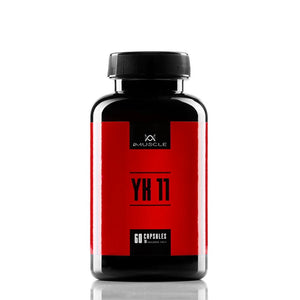
iMuscle Stenabolic SR-9009, 60 caps, 10mg is an iMuscle listing of SR9009, labelled at 10 mg per capsule, 60 capsules per pack. It is supplied through the Muscle Market range for laboratory research only, is not for human consumption, and is sold to adults aged 18 and over. Below: what the published research on SR9009 reports, what the label documents, where the compound stands in UK law and in sport, how to read a batch certificate for it, and how batch certificates are handled for iMuscle products.
About SR9009
SR9009, sold under the name Stenabolic, is a synthetic agonist of REV-ERB alpha and REV-ERB beta, nuclear receptors that connect the circadian clock to the expression of metabolic genes. It was developed at the Scripps Research Institute by Burris and colleagues. It is not a SARM and has no described activity at the androgen receptor.
PubChem records it as CID 57394020, CAS number 1379686-30-2, molecular formula C20H24ClN3O4S and molecular weight 437.9, with InChIKey MMJJNHOIVCGAAP-UHFFFAOYSA-N. Its systematic name is ethyl 3-[[(4-chlorophenyl)methyl-[(5-nitrothiophen-2-yl)methyl]amino]methyl]pyrrolidine-1-carboxylate. These identifiers are what any certificate of analysis should be checked against.
What the published research reports
In a 2012 study published in Nature, mice given SR9009 by injection showed altered circadian behaviour, and the circadian pattern of metabolic gene expression in liver, muscle and fat changed, with increased energy expenditure. Diet-induced obese mice treated with the agonist lost fat mass and showed improved dyslipidaemia and hyperglycaemia (Solt et al., 2012). A 2013 mouse study led from the Institut Pasteur de Lille, with the Scripps group as co-authors, linked REV-ERB alpha to mitochondrial number in skeletal muscle and reported that pharmacological activation of the receptor increased exercise capacity in mice (Woldt et al., 2013). In 2019 a group at the University of Pennsylvania reported that SR9009 changed cell proliferation and metabolism in cells lacking REV-ERB altogether, showing that some of its effects are off-target (Dierickx et al., 2019).
The animal studies used injection, and there are no published human trials or human pharmacokinetic data, so the behaviour of an oral capsule is unknown. It has never been approved as a medicine. Two further papers matter for anyone assessing SR9009 bought online. A Ghent University doping control laboratory confirmed SR9009 in a black market product bought over the internet and described eight metabolites formed by human liver enzymes in the test tube (Geldof et al., 2016). A 2017 analysis of 44 products sold online as SARMs found that 17 contained another unapproved drug, SR9009 among them, and that in only 18 of the 44 (41%) did the amount of active compound match the label (Van Wagoner et al., 2017). Nothing above is a claim about this product.
This listing
- Manufacturer: iMuscle
- Compound: SR9009 (Stenabolic)
- Form: Capsules
- Pack size: 60 capsules
- Strength: 10 mg per capsule, as stated by the manufacturer
- Total in pack: 600 mg (10 mg x 60 capsules)
- Batch certificate of analysis: shown where iMuscle supplies one for the batch we hold
The 600 mg total is a label figure, calculated from the manufacturer's stated strength and capsule count. It becomes a measured figure only when a batch certificate reports content per capsule. Our guide to price per milligram shows how to compare it with other SR9009 listings.
SR9009 in the UK: buying, legal status and what to check
The searches "SR9009 UK", "stenabolic UK" and "SR9009 UK sarms" hide two questions: may it lawfully be sold here, and how do you tell a sound listing from a poor one. SR9009 is not a licensed medicine in the UK, has not been assessed by the MHRA, and is not an authorised food supplement. It is not a controlled drug. It is sold for laboratory research to adults aged 18 and over and is not for human consumption. Any seller offering instructions for taking it is marketing it outside that research basis.
In sport the position is stricter. SR9009 is named on the WADA Prohibited List under section S4 (hormone and metabolic modulators) alongside GW1516 and is prohibited at all times. Anyone subject to anti-doping rules should consult the current list. Our research guide covers the wider legal picture for compounds sold next to SARMs.
The 2017 finding that SR9009 turned up in products labelled as something else is the best reason to judge an SR9009 listing on documents rather than on ratings or forum posts. The points worth checking, and how this listing answers each:
- Named manufacturer and compound identifiers. This listing: iMuscle, with CAS 1379686-30-2 and the molecular formula given above, so a certificate can be matched to SR9009 and not to its sister compound SR9011.
- Strength and count on the label. iMuscle states 10 mg in each of 60 capsules.
- A certificate tied to the stock on sale. This listing: shown only where iMuscle supplies one for the batch we hold, and we say plainly when there is none.
- Who is selling, and to whom. Here the seller is FreeMuscle LTD, registered in the UK and based in Scunthorpe; buyers must be 18 or over, and unopened items may be returned within 30 days.
- How it travels. Every UK order goes out free with tracking, in plain packaging. Anything ordered by 2pm on a weekday is processed that day, and parcels to the EU take 3-7 working days.
- No usage guidance. This listing gives none, and neither does anything else on this site.
Delivery and returns terms are set out on our shipping and guarantee pages. The UK supplier checklist applies the same tests to any shop, including this one.
Capsules compared with other forms
SR9009 is offered in three formats across the market: filled capsules like these, liquids in which the compound is dissolved or suspended, and loose powder. None of them has been studied for SR9009 in people. The published mouse studies used injected solutions prepared in the laboratory, so no commercial format, capsule or liquid, reproduces the conditions of that research. What differs is how each fixes the amount per unit.
- Capsule fill. The stated 10 mg is blended with an inert filler and dosed into each shell by weight. Variation comes from blend uniformity and fill weight, and a laboratory can open and assay individual capsules to check both.
- Liquid. The label states a concentration, often in a carrier that is not identified. The figure holds only while the compound stays evenly dissolved or suspended, and any volume drawn off depends on how accurately it is measured.
- Powder. Accuracy moves entirely to the researcher's balance and technique, and a certificate describes the bulk material only.
The search "SR9009 peptide" reflects a common confusion. SR9009 is not a peptide: it has no amino acid chain for digestive enzymes to cut, which is the main obstacle for peptides given by mouth (see Do oral peptides work?). That does not mean oral SR9009 is well absorbed. With no human pharmacokinetic study published, the fraction of an oral amount reaching the circulation in people is simply unknown, and we do not suggest otherwise. For this pack, the useful property of the capsule format is that it gives a countable unit that a laboratory can test.
SR9009 compared with Cardarine
"Stenabolic vs cardarine" is a frequent search, because the two are sold next to each other and both appear in section S4 of the WADA list. The overlap largely ends there. The table sets out where they differ.
| Question | SR9009 (Stenabolic) | Cardarine (GW-501516) |
|---|---|---|
| Receptor it was designed for | REV-ERB alpha and beta, circadian clock receptors | PPAR-delta, a fatty acid metabolism receptor |
| Who made it and why | An academic research tool for probing the clock | A pharmaceutical candidate for blood lipid disorders |
| Highest level of evidence | Mouse and cell studies only | Short human lipid trials |
| Known specificity problem | Effects in cells with no REV-ERB (2019) | Development halted over rodent tumour findings |
| Oral data in people | None published | Given by mouth in human trials |
| UK position | Unlicensed, research use only, 18+ | Unlicensed, research use only, 18+ |
| Sport | WADA S4, prohibited at all times | WADA S4, prohibited at all times |
Put in plain terms, Cardarine is a failed drug candidate with some human data and a serious toxicology history, while SR9009 is a laboratory probe that was never taken into people at all. Neither is a SARM. The 2019 off-target finding also means that effects attributed to REV-ERB in SR9009 studies may partly come from other targets. We make no claim about either compound used together with any other. The Cardarine collection lists the brands we hold, and our article on why Cardarine development stopped gives its history. People also search "SR9009 vs SR9011": SR9011 is the sister compound described in the same 2012 paper, with a similar target and no human data either. We do not stock it.
Reading the certificate of analysis for this product
Certificates work differently for our own label and for iMuscle. Every Free Muscle-brand batch goes to Janoshik Analytical, an independent laboratory, and the certificate is emailed on request. iMuscle is an outside manufacturer stocked through Muscle Market, so for this product a certificate of analysis appears only when iMuscle provides one for the particular batch on our shelves. We do not pass off a generic PDF without a batch number as a batch certificate. Send us the product name by email and we will forward whatever we hold for the current batch, or tell you directly that nothing is held.
If an iMuscle certificate is available for this batch, read it in this order:
- Identity: the compound named should be SR9009, not SR9011 or a generic "Stenabolic" with no structure. HPLC identifies it by comparing retention time with a reference standard; LC-MS adds a mass, which should fit the 437.9 molecular weight given above.
- Purity: a percentage from HPLC peak areas. It tells you how much of the detected material is SR9009, not how many milligrams a capsule holds.
- Content per capsule: the measured amount in one capsule, which is the figure to set against the stated 10 mg.
- Batch number: must match the code on the pack you received.
- Laboratory and test date: name the analyst and show whether the result is recent enough to cover this stock.
For this brand, gaps mean specific things. No certificate means this listing makes no documented claim about identity, purity or content beyond the manufacturer's label. Purity with no content figure confirms the molecule but leaves the 10 mg unverified. A batch number that does not match your pack means the certificate describes different stock, and you should contact us. Our lab tests page and the article on how to read a COA cover the methods in more depth.
Detection, sport and testing
For athletes, the regulatory point is simple: SR9009 is in section S4 of the WADA Prohibited List and is banned in and out of competition, and under strict liability a positive sample counts regardless of how the substance got there, including through a mislabelled product. The 2016 Ghent study identified eight human liver metabolites of SR9009 so that screens could look for breakdown products as well as the parent compound, and it recommended adding SR9009 to routine screening. When the authors searched 1,511 stored doping control urine results, they found neither SR9009 nor its metabolites in those routine samples.
No verified study has measured how long SR9009 or its metabolites remain detectable in human urine after exposure. The honest answer for this capsule product is therefore: detectable, window not established. Anyone subject to anti-doping rules should treat it as prohibited.
Storage, stability and handling
No stability study of SR9009 in capsule form has been published, so the manufacturer's expiry date, where iMuscle prints one, is the only product-specific guide. General laboratory practice for small organic compounds applies: protect from heat, moisture and light.
- Leave the capsules in the tub they arrived in: the batch code printed on it is the only link to a certificate.
- Store somewhere cool, dry and dark, away from radiators, windowsills and steamy rooms; capsule shells soften in humid air and turn brittle in very dry air.
- Log the batch number, date received and date opened.
- Wear nitrile gloves when handling opened capsules or spilled powder, and clean surfaces afterwards.
- Surplus or out-of-date capsules belong in a chemical waste stream, never in household bins or down a drain.
- Store on a shelf that children and pets cannot reach, and never in a fridge or cupboard used for food.
Glossary
- REV-ERB alpha and beta: nuclear receptors that repress clock and metabolic genes on a daily cycle; SR9009 was designed to activate them.
- Circadian clock: the internal roughly 24-hour cycle of gene activity found in most cells.
- Agonist: a molecule that binds a receptor and switches it on.
- Off-target effect: an action of a compound that does not go through its intended receptor, as shown for SR9009 in 2019.
- SR9011: a closely related REV-ERB agonist described alongside SR9009 in 2012; not stocked here.
- Pharmacokinetics: the study of what the body does to a substance over time, from uptake to elimination; no human data exist for SR9009.
- Liver microsomes: fractions of liver cells holding drug-metabolising enzymes, used in the test tube to predict metabolites.
- Metabolite: a product the body forms by altering a substance, often the target of anti-doping tests.
- Reference standard: a highly characterised sample of a compound that a laboratory uses to confirm identity and quantity.
- Retention time: the point at which a compound emerges from an HPLC column; a sample and a standard of the same substance should emerge together.
- Strict liability: under anti-doping rules, a finding in a sample stands against the athlete whether or not they knew the substance was there.
Related
- All brands of SR9009 we stock, compared
- All iMuscle products
- SR9009 (Stenabolic): REV-ERB agonist research and the bioavailability problem
- Cardarine and the wider SARMs range
- Batch testing and certificates of analysis
- Delivery and returns
This product is supplied for laboratory research use only. It has not been evaluated by the MHRA, EMA or FDA. It is not a medicine, not a food supplement and not for human consumption. Sold only to adults aged 18 and over. Nothing on this page is medical, dosing or usage advice, and descriptions of published studies are not claims about this product.
References
- Solt LA, et al. Regulation of circadian behaviour and metabolism by synthetic REV-ERB agonists. Nature. 2012;485(7396):62-8. PMID: 22460951.
- Woldt E, et al. Rev-erb-α modulates skeletal muscle oxidative capacity by regulating mitochondrial biogenesis and autophagy. Nat Med. 2013;19(8):1039-46. PMID: 23852339.
- Dierickx P, et al. SR9009 has REV-ERB-independent effects on cell proliferation and metabolism. Proc Natl Acad Sci U S A. 2019;116(25):12147-12152. PMID: 31127047.
- Geldof L, et al. In Vitro Metabolic Studies of REV-ERB Agonists SR9009 and SR9011. Int J Mol Sci. 2016;17(10):1676. PMID: 27706103.
- Van Wagoner RM, et al. Chemical Composition and Labeling of Substances Marketed as Selective Androgen Receptor Modulators and Sold via the Internet. JAMA. 2017;318(20):2004-2010. PMID: 29183075.
Frequently asked questions
Is SR9009 legal in the UK?
SR9009 is not a licensed medicine in the UK and is not an authorised food supplement. It is not a controlled drug. It is sold to adults for laboratory research only, which is the sole basis for this listing. It is not for human consumption and nothing on this page is medical or dosing advice.
Is SR9009 a SARM?
No. SR9009 is a REV-ERB agonist acting on circadian clock receptors, not a selective androgen receptor modulator. It is sold by many of the same vendors, which causes the confusion. Its published data are in mice and cells only, and a 2019 study showed it also acts on targets other than REV-ERB.
What is the difference between SR9009 and Cardarine?
Both are sold for endurance research and both are metabolic modulators prohibited by WADA, but they act on different receptors. Cardarine is a PPAR-delta agonist that reached short human trials before being abandoned over animal cancer findings. SR9009 is a REV-ERB agonist with mouse data only and no human trials at all.
Is SR9009 detectable in sport drug tests?
Yes. SR9009 is named on the WADA Prohibited List under section S4 and is prohibited at all times. Anti-doping laboratories have published detection methods for it and its metabolites. Anyone subject to anti-doping rules should treat it as prohibited and consult the current list.
Does an oral SR9009 capsule reflect the published research?
The published endurance and metabolic findings came from mice injected with the compound. No human pharmacokinetic study has been published, so it is not known how much of an oral dose reaches the bloodstream in people. We state this plainly rather than imply that a capsule reproduces the mouse results.
What does SR9009 do?
In published research, SR9009 activated REV-ERB receptors in mice and cells, which shifted circadian activity and the expression of metabolic genes, and obese mice given it by injection lost fat mass. A 2019 study found it also acted in cells lacking REV-ERB. There are no human trials, so nothing is known about its effects in people, and nothing here is a claim about this product.
What side effects have been reported for SR9009?
No human trial of SR9009 has been published, so there is no clinical record of adverse effects or long-term safety in people. The evidence is limited to mice and cell cultures, and the 2019 finding that it acts on targets other than REV-ERB means its full range of actions is not understood. It is sold for laboratory research only and is not for human consumption.
What SR9009 dosage, results or before and after photos do you publish?
None. We do not publish or discuss dosing, cycles, combinations, timing, how long anything takes to work, or before and after results for SR9009, including figures quoted on forums. This product is sold for laboratory research only, is not for human consumption, and no claim is made about any outcome from it.
Is SR9009 a peptide?
No. SR9009 is a small synthetic organic molecule with a molecular weight of about 438, not a chain of amino acids, and it is not a SARM either. It is a REV-ERB agonist. Being a non-peptide does not show that it is absorbed by mouth, because no human pharmacokinetic study has been published.
What is the difference between SR9009 and SR9011?
They are sister compounds described together in the same 2012 Scripps paper, both designed to activate REV-ERB receptors, and both studied only in mice and cells. They differ slightly in structure, so a certificate of analysis must name the right one. We stock SR9009 only. Neither has human trial data and both are prohibited in sport under WADA section S4.
Related research and listings
- Related collections: SLU-PP-332, 5-Amino-1MQ, Metabolic Support
- Research guides: SLU-PP-332 and 5-Amino-1MQ: what the mouse data show; SARMs vs Peptides: Choosing by Goal; What Is Janoshik Analytical? Third-Party Testing Explained
More from iMuscle See all 17 →
Supplied for laboratory and research use. Not for human consumption. Not an approved medicine, and nothing above is dosing advice. You must be 18 or over to order.