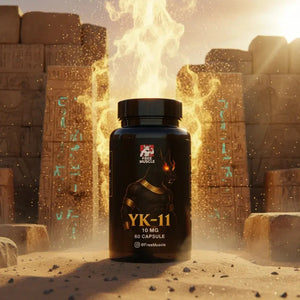
iMuscle YK-11 is supplied as 60 capsules stated at 10 mg each, giving 600 mg of YK-11 per pack. YK-11 is a steroidal partial agonist of the androgen receptor that is commonly sold alongside SARMs and is described in cell studies as a follistatin inducer. iMuscle manufactures it and Free Muscle stocks it in the Muscle Market range for laboratory research by adults only.
This listing
- Compound: YK-11
- Brand: iMuscle
- Form: capsules
- Pack size: 60 capsules
- Stated strength: 10 mg per capsule (manufacturer's label claim)
- Stated total per pack: 600 mg
- Intended use: laboratory research only, not for human consumption
- Sold to adults aged 18 and over
The strength is the manufacturer's label claim; only a batch certificate confirms it. To compare brands of YK-11, use total milligrams per pack: dividing the listed price by the 600 mg stated here gives the cost per stated milligram, as explained in price per milligram.
About YK-11
YK-11 is often grouped with SARMs, but it is a steroidal molecule: a 19-nor-pregnane derivative with a methyl ester side chain. It was described in 2011 by a group at Toho University in Japan, who showed in cell assays that it acts as a partial agonist at the androgen receptor, activating the receptor less fully than DHT (Kanno 2011).
The claim that YK-11 is a myostatin inhibitor comes from a 2013 study in C2C12 mouse myoblast cells, in which YK-11 increased expression of follistatin, a protein that binds myostatin, and promoted myogenic differentiation more than DHT did in that model (Kanno 2013). Both papers are cell-culture work. No human clinical trial of YK-11 has been published, so its pharmacokinetics, hormonal effects and liver tolerance in people are unknown.
| Identifier | YK-11 |
|---|---|
| CAS number | 1370003-76-1 |
| Molecular formula | C25H34O6 |
| Molecular weight | 430.5 g/mol |
| InChIKey | KCQHQCDHFVGNMK-PQUNLUOYSA-N |
| PubChem CID | 119058028 |
Animal and metabolism studies
Work in living animals is recent and sparse, and much of the published in vivo work concerns metabolism for doping control (Piper 2018). One study followed rats for five weeks, with and without swimming exercise, to look for unwanted effects in the brain (Dahleh 2024). Animals given YK-11 retained an aversive memory task less well, showed weaker BDNF signalling in the hippocampus, had a cytokine balance tilted towards inflammation and showed activation of proteins that drive programmed cell death. Exercise offset part of this. One rat study cannot say what happens in people, but its findings point towards harm rather than benefit.
The cell and animal findings summarised here are not claims about this product.
YK-11 in the UK: buying, legal status and what to check
YK-11 is not a licensed medicine in the UK, and it has never been licensed in any other country: it has no MHRA marketing authorisation, is not an authorised food supplement, and cannot lawfully be sold for human consumption. Free Muscle supplies it to adults aged 18 or over for laboratory research only. Because it is a synthetic steroid, its status under the Misuse of Drugs Act is less clear-cut than that of non-steroidal SARMs, and buyers should take their own advice. It is prohibited at all times in sport, as the detection section below explains. Buyers are responsible for the rules that apply to them, including any anti-doping code. Background on the class is in What are SARMs? The 2026 research guide.
What a trustworthy UK listing shows
- The compound named precisely, ideally with its CAS number, not a nickname.
- A stated strength per capsule and a capsule count, so total content can be worked out.
- A batch number on the pack, and a certificate of analysis carrying that number from a named laboratory.
- A plain statement when no certificate exists for the batch in stock, instead of a generic PDF.
- A named UK company, an 18+ restriction, plain packaging and tracked delivery.
- No instructions for human use and no outcome promises.
How this listing measures up
The 10 mg and 60-capsule figures are iMuscle's label claim, not a figure we have assayed. A certificate is shown only where iMuscle supplies one for the batch we hold, and we tell you when there is none. Testing is the real difference from Free Muscle's own-brand YK-11 10 mg, which carries the same label strength and capsule count but is assayed batch by batch at Janoshik Analytical. Orders ship from FreeMuscle LTD in Scunthorpe by free tracked UK delivery in plain packaging; orders placed before 2pm Monday to Friday are processed the same working day, EU delivery takes 3 to 7 working days, and unopened items can be returned within 30 days (delivery, returns). Our UK supplier checklist covers each test in more detail.
Capsules compared with other forms
YK-11 is offered as capsules, as solutions in dropper bottles and as loose powder, and injectable versions are widely searched for. No study has compared these forms and none has been evaluated in a clinical trial, so the differences below concern what can be measured and kept stable, not effect. This listing is capsules.
| Form | What fixes the amount per unit | What a certificate can confirm | Main stability concern |
|---|---|---|---|
| Capsule | Fill weight set at manufacture | Content per capsule and purity, if finished capsules are tested | Humidity once the container is opened |
| Solution | Concentration, and whether the compound stays evenly dissolved | Concentration per millilitre on the test date | Constant contact with solvent |
| Powder | Weighing by the researcher | Purity of the bulk material | Humidity and handling losses |
| Injectable | Concentration, carrier and sterility | Usually concentration only; sterility needs separate testing | No published characterisation for YK-11 |
Two points follow from the chemistry. First, the Cologne anti-doping group described the orthoester-derived group on the D-ring of YK-11 as arguably labile and found no unchanged YK-11 in urine after administration (Piper 2018). Groups that break down readily in the body are also exposed to hydrolysis in a solution containing water or acid, one reason a dry fill is the easier form to store and assay. Second, YK-11 is not a peptide but a small steroid, so the argument that peptides are largely digested when swallowed, discussed in Do oral peptides actually work?, does not apply. That is a point about chemistry, not a claim about what a capsule does. Fill accuracy is itself a manufacturing variable, which is why the certificate section below asks whether finished capsules or raw powder were tested.
YK-11 compared with RAD-140
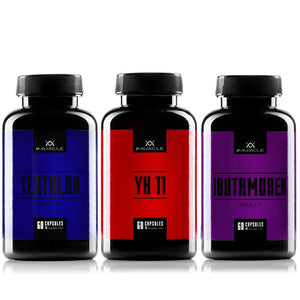
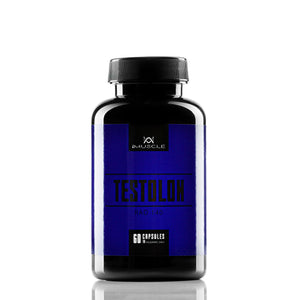
RAD-140 (testolone) is the compound most often set beside YK-11, and iMuscle sells both in the same format: iMuscle Testolone RAD-140 is also labelled 10 mg per capsule, 60 capsules. Identical label arithmetic hides two different molecules with very different evidence bases.
| Point | YK-11 | RAD-140 |
|---|---|---|
| Chemical class | Steroid, 19-nor-pregnane derivative | Non-steroidal SARM |
| Formula and molecular weight | C25H34O6, 430.5 | C20H16ClN5O2, 393.8 |
| Origin | Academic group, Toho University, 2011 | Pharmaceutical programme, Radius Health |
| Action at the androgen receptor | Partial agonist in cell assays; induced follistatin in mouse muscle cells | Agonist designed for tissue selectivity, characterised in rats and monkeys |
| Published human data | No clinical trial | One phase 1 study in 22 women with advanced breast cancer |
| Main adverse findings | Memory, inflammatory and cell-death changes in rat hippocampus | Raised liver enzymes, the most frequent adverse events in the phase 1 study |
| UK status | Not a licensed medicine; steroid structure makes its drugs-law status less clear-cut | Not a licensed medicine; research use only |
| WADA | Section S1, prohibited at all times | Section S1, prohibited at all times |
The evidence gap is the main difference. RAD-140's human data come from one oncology study in patients with advanced disease (LoRusso 2022), yet that study still produced a measured half-life and a documented liver-enzyme signal. YK-11 has neither, so any statement about how it behaves in people rests on nothing published. The regulatory picture differs for a structural reason: a steroid backbone brings YK-11 closer to the anabolic steroids that UK drugs law already controls, whereas RAD-140 is chemically unrelated to them. Neither compound is approved anywhere, both are banned in sport, and nothing here ranks one above the other for any purpose. Brands of RAD-140 are compared on the RAD-140 collection page, and its research is summarised in RAD-140 (Testolone): what the research says.
Reading the certificate of analysis for this product
iMuscle is a third-party brand, so any certificate of analysis is the manufacturer's, not ours. Where iMuscle supplies a COA for the batch we hold, we show it or send it by email on request; where none exists for the batch in stock, we say so rather than show a generic document. Free Muscle-brand compounds are assayed batch by batch at Janoshik Analytical; that programme does not cover iMuscle. When an iMuscle certificate is available, these are the fields to check.
- Batch or lot number: the same number as the one printed on your pack.
- Identity: the method (HPLC against a YK-11 reference standard, LC-MS, or both) and a result consistent with C25H34O6, molecular weight 430.5. YK-11 has a defined E geometry at its side-chain double bond, and an isomer would share its mass, so a retention-time match to a reference standard is stronger evidence than mass alone.
- Purity: the main peak as a percentage of everything the HPLC detected. The remainder may be synthesis by-products or breakdown products.
- Content per capsule: the milligrams found in finished capsules, to set against the stated 10 mg; a raw-powder result is not the same measurement.
- Test date and laboratory: when and by whom the analysis was run.
For this brand, a missing field has a specific meaning. With no certificate for the batch in stock, nothing independent confirms identity, purity or content, and the 10 mg figure stays a label claim. Without a content figure, a certificate confirms what the material is but not the fill; without a batch number, it cannot be tied to your pack; without a named laboratory, it cannot be checked with the lab that issued it. Email us through the contact page with the product name and the batch number on your pack and we will tell you what we hold. See lab tests and how to read a COA.
Detection, sport and testing
YK-11 is prohibited at all times, in and out of competition, under section S1 (anabolic agents) of the WADA Prohibited List, which UK Anti-Doping applies in the UK. Under the strict liability principle of the anti-doping code, an athlete is responsible for any prohibited substance found in their sample, whatever the product label said.
Laboratories can find it. In an elimination study with deuterium-labelled YK-11, the Cologne anti-doping laboratory identified fourteen urinary metabolites and no unchanged YK-11 in urine. Unconjugated metabolites had gone within 24 hours, while glucuronide and sulfate conjugates were still traceable after more than 48 hours, and two glucuronidated metabolites were added to the laboratory's routine screen for anabolic agents (Piper 2018). The study itself was prompted by the detection of YK-11 in a seized black-market product.
Those timings describe how long metabolites were traced in one study; they are not a detection window. With no published human pharmacokinetic study, there is no established half-life for YK-11 in people and the full window is unknown. The reliable statement is that YK-11 is detectable.
Storage, stability and handling
No stability study of YK-11 capsules has been published, so storage practice rests on general chemistry and the manufacturer's label. Water can cleave the ester and orthoester-derived groups in the molecule, and heat and light degrade most organic research materials.
- Keep the capsules in the original closed container, cool, dry and away from direct sunlight and heat.
- Close the lid promptly and leave any desiccant sachet in place; humidity is the main avoidable threat.
- Keep the label intact: the batch number links the capsules to any certificate and to any quality query.
- Record the date of receipt and any printed expiry date; without one, a certificate's test date is the only dated reference.
- Soft, sticky, discoloured or clumped capsules suggest moisture damage; note the batch number and contact us.
- Keep out of reach of children and pets, handle with gloves in a clean area free of food and drink, and dispose of unwanted material under local chemical-waste rules.
If you might return the item, leave it sealed: returns are accepted within 30 days on unopened items only.
Glossary
- Partial agonist: a ligand whose maximum effect at a receptor stays below that of a reference hormone; for YK-11 in cell assays the reference was DHT.
- DHT (dihydrotestosterone): a potent androgen made from testosterone in tissues such as skin and prostate.
- 19-nor steroid: a steroid missing the carbon atom usually found at position 19, the skeleton YK-11 shares with nandrolone.
- Follistatin: a glycoprotein that captures myostatin and activin outside the cell; the 2013 C2C12 study reported a rise in its expression, the basis of the myostatin-inhibitor label.
- C2C12 cells: a mouse muscle precursor line that fuses into muscle-like fibres in culture.
- Hydrolysis: cleavage of a chemical bond by water, the main storage risk for the ester and orthoester-derived groups in YK-11.
- Label claim: the amount a manufacturer prints per capsule, here 10 mg, unconfirmed until a content assay is run.
- Retention time: how long a compound takes to pass through an HPLC column, compared against a reference standard to support identity.
- Conjugated metabolite: a breakdown product linked to glucuronic acid or sulfate for excretion; these were the longest-traced YK-11 markers in the Cologne study.
Related
- All brands of YK-11, compared on strength, pack size and batch testing
- All iMuscle products stocked at Free Muscle
- YK-11: a steroidal compound sold as a SARM, what is actually known
- RAD-140 (testolone) and the full SARMs range
- Delivery and returns
This product is supplied for laboratory research use only. It is not a medicine, has not been evaluated by the MHRA, EMA or FDA, and is not for human consumption. Sold to adults aged 18 and over. Nothing on this page is medical, dosing or usage advice.
References
- Kanno Y, et al. (17alpha,20E)-17,20-[(1-methoxyethylidene)bis(oxy)]-3-oxo-19-norpregna-4,20-diene-21-carboxylic acid methyl ester (YK11) is a partial agonist of the androgen receptor. Biol Pharm Bull. 2011;34(3):318-23. PMID: 21372378.
- Kanno Y, et al. Selective androgen receptor modulator, YK11, regulates myogenic differentiation of C2C12 myoblasts by follistatin expression. Biol Pharm Bull. 2013;36(9):1460-5. PMID: 23995658.
- Piper T, et al. Studies on the in vivo metabolism of the SARM YK11: Identification and characterization of metabolites potentially useful for doping controls. Drug Test Anal. 2018;10(11-12):1646-56. PMID: 30379415.
- Dahleh MMM, et al. From gains to gaps? How Selective Androgen Receptor Modulator (SARM) YK11 impact hippocampal function: In silico, in vivo, and ex vivo perspectives. Chem Biol Interact. 2024;394:110971. PMID: 38521455.
- LoRusso P, et al. A First-in-Human Phase 1 Study of a Novel Selective Androgen Receptor Modulator (SARM), RAD140, in ER+/HER2- Metastatic Breast Cancer. Clin Breast Cancer. 2022;22(1):67-77. PMID: 34565686.
Frequently asked questions
Is YK-11 legal in the UK?
YK-11 is not a licensed medicine and not an authorised food supplement in the UK, so it cannot be sold for human consumption; Free Muscle supplies it to adults for laboratory research only. Because it is a synthetic steroid, its status under the Misuse of Drugs Act is less clear-cut than for non-steroidal SARMs, and buyers should take their own advice. It is WADA-prohibited under section S1.
Is YK-11 a SARM or a steroid?
Chemically it is a steroid: a 19-nor-pregnane derivative with a methyl ester side chain. The 2011 paper that described it called it a selective androgen receptor modulator because it acted as a partial agonist in cell assays, and the name stuck. It is sold beside SARMs, but its steroid backbone sets it apart from ostarine, LGD-4033 or RAD-140.
What strength of YK-11 should I choose?
We do not advise on strength or quantity, because YK-11 is sold for laboratory research and not for human use. The figures on this page are the manufacturer's label details, given so you can compare packs on total milligram content and check them against a batch certificate. Any question about how a compound behaves in people belongs to the published literature, not to a product page.
How do I verify the batch of iMuscle YK-11 I receive?
Compare the batch or lot number printed on the pack with the number on the certificate of analysis. For iMuscle, a COA is shown only where the manufacturer has supplied one for the batch we hold; email us and we will tell you what exists for the current stock. A certificate without a batch number, or with a number that does not match, does not verify your pack.
Is YK-11 a myostatin inhibitor?
The claim comes from a 2013 study in mouse C2C12 muscle cells, where YK-11 increased expression of follistatin, a protein that binds and inhibits myostatin. That is an in vitro observation in a cell line. Later papers, including a 2024 rat study, repeat the label, but no human study has measured myostatin, follistatin or muscle outcomes after YK-11, so the label is a hypothesis rather than a demonstrated effect in people.
Is YK-11 a peptide?
No. Peptides are chains of amino acids, and YK-11 contains none. It is a synthetic steroid, a single small molecule of about 430 daltons with the CAS number 1370003-76-1. It turns up in peptide searches because the same research shops list both classes, so arguments about peptides being digested when swallowed are irrelevant to it. This listing is iMuscle capsules, sold for laboratory research to adults aged 18 and over.
Is YK-11 available as an injectable?
Injectable YK-11 is widely searched for, but no published study has described an injectable preparation, its carrier solvent, its sterility or its stability. The iMuscle product on this page is capsules, labelled at 10 mg each and 60 per pack. We give no guidance on routes of administration or on use of any kind, because YK-11 is sold for laboratory research and is not for human consumption.
What is the half-life of YK-11?
It is not known. No human pharmacokinetic study of YK-11 has been published, so any half-life quoted online lacks a verified source. The closest data come from a Cologne anti-doping elimination study, in which unconjugated metabolites were gone within 24 hours and conjugated metabolites were still traced after 48 hours. Those figures describe metabolite detection in one study, not a half-life, and they are not a guide to use.
What are the side effects of YK-11?
There are no human data, so no side-effect profile in people exists. A five-week study in rats reported impaired memory consolidation, inflammatory changes and activation of cell-death proteins in the hippocampus. Because YK-11 is a steroid, class effects such as suppression of the body's own testosterone cannot be ruled out, but they have not been measured. We make no claim that any research compound is free of risk.
Does YK-11 work, and are there before-and-after results?
We do not publish dosing, cycle or outcome guidance, and we make no claim about what YK-11 does in people. No human study exists to answer the question, and before-and-after posts or forum reviews are unverified reports about products of unknown content. The published evidence consists of cell work, a few rodent studies and anti-doping chemistry. This product is sold for laboratory research to adults aged 18 and over.
Related research and listings
Same compound, other brands See all 2 →
More from iMuscle See all 17 →
Supplied for laboratory and research use. Not for human consumption. Not an approved medicine, and nothing above is dosing advice. You must be 18 or over to order.