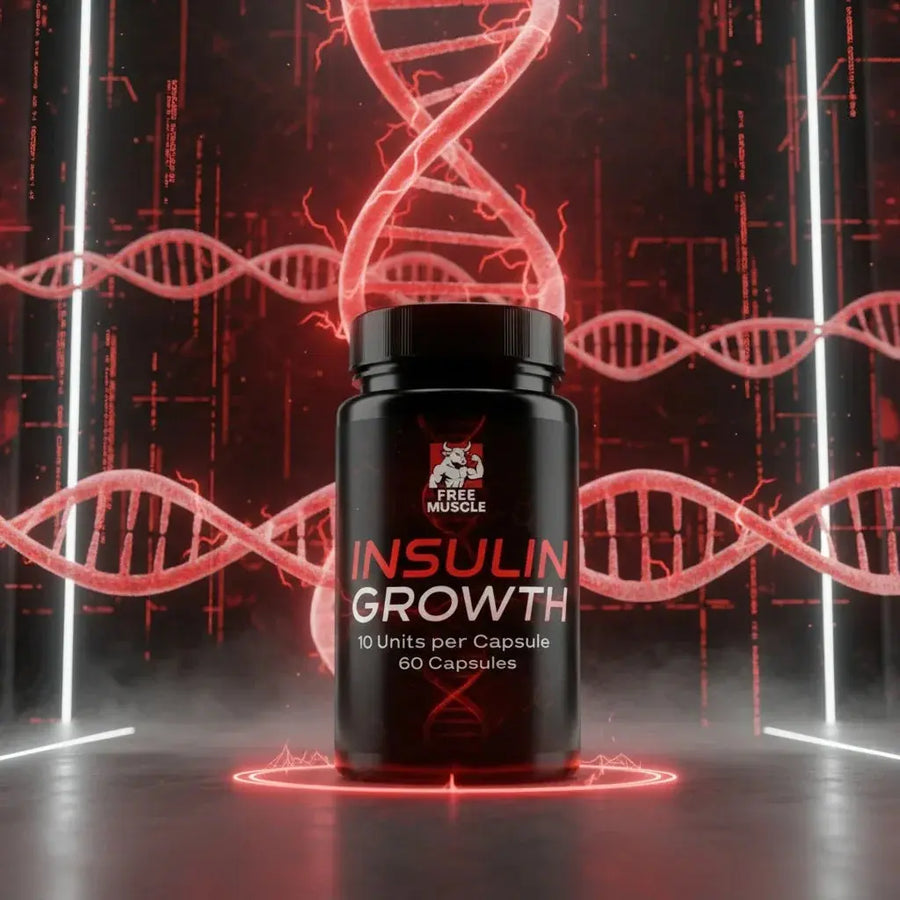
RESEARCH INSULIN GROW 60 CAPSULES
Sold under a product name, not a single established compound. Not authorised as a medicine or a food supplement in the UK or EU. Supplied for laboratory research use only — read the evidence section below before you decide.
WHAT IS
ACTUALLY KNOWN
We would rather you bought with your eyes open than not at all. Here is the state of the evidence, including the parts that do not help us.
What it is
This is a formulated research product. Sold under a product name, not a single established compound.
State of the evidence
There is no clinical literature under this product name.
Known risks
The product name references insulin. Insulin misuse in bodybuilding is a recurring cause of death, and hypoglycaemia can kill within hours.
Regulatory status
Not authorised as a medicine or a food supplement in the UK or EU.
Status in sport
Insulin and insulin-mimetics are on the WADA Prohibited List.
What we verify
Identity and purity, per batch, by a laboratory we do not own. We verify what is in the capsule — nothing about what it does.
SPEC SHEET
What is in the bottle, and what is on the certificate.
Product designation
Sold under a product name rather than a single established compound name.
Bottle contents
Each bottle contains 60 capsules.
Research use only
We do not publish a human dosing schedule for this compound.
Independently assayed
Each batch is assayed by Janoshik Analytical, an independent laboratory. The Certificate of Analysis for your batch is available on request.
This product is supplied for laboratory research use only. We do not provide dosing instructions, cycle lengths or post-cycle protocols for human use.
INSULIN GROW
Tax included · assayed per batch
WHAT WE CAN
PROVE
We don't have customer reviews to show you yet, and we're not going to invent any. Here is what we can actually put in front of you instead.
Assayed by a lab we don't own
Batches go to Janoshik Analytical, an independent testing laboratory. We don't choose the result.
Tested per batch, not per year
A certificate from a batch made two years ago says nothing about the pack in your hand.
Batch number on the pack
Email it to us with the product name and we'll send the Certificate of Analysis for that batch.
QUESTIONS, ANSWERED
Sold under a product name, not a single established compound. There is no clinical literature under this product name.
This product is supplied for laboratory research use only. We do not provide dosing instructions, cycle lengths or post-cycle protocols for human use.
We do not give post-cycle therapy advice. This is a question for a qualified clinician, not for a shop.
The Certificate of Analysis for your batch states what the product contains — ask us for it. If you are considering insulin for body composition, please do not: hypoglycaemia is fast and it is fatal.
Yes — identity and purity, per batch, by Janoshik Analytical. Email us the batch number from your pack and we will send that batch's Certificate of Analysis. You do not need to have bought anything to ask.
Sold as a research compound for laboratory and educational use. Not a medicine; not evaluated by the MHRA, EMA or FDA; not intended to diagnose, treat, cure or prevent any disease. Not for human consumption. Not for use by anyone under 18 or by women who are pregnant or breastfeeding.
COMPOUND MONOGRAPH
Insulin Grow in the UK: buying, legal status and what to check
Insulin Grow is a Free Muscle product designation, not the name of a compound, so "is it legal in the UK" cannot be answered from the name alone. Insulin itself is a licensed medicine, prescribed for diabetes under medical supervision; this product is not an insulin medicine, holds no MHRA marketing authorisation and is not a substitute for any prescribed treatment. If you have diabetes, nothing on this page relates to your care. Free Muscle supplies it to adults aged 18 or over for laboratory research only.
Warning. Insulin used outside medical care to change body composition has put bodybuilders into hypoglycaemic coma. Hypoglycaemia, a fall in blood glucose, can progress from sweating and confusion to seizures, coma and death within hours. Insulin should only ever be used as prescribed, under medical supervision.
A product sold under a trade name deserves more scrutiny than a named molecule, because the label cannot tell you what is inside. A trustworthy UK listing shows a named seller with a UK address (here FreeMuscle LTD, Scunthorpe), a batch number on the bottle matching a certificate of analysis from an independent laboratory, the capsule count (60), no dosing or results claims, and plain, tracked delivery. Every Free Muscle batch is assayed by Janoshik Analytical, and the certificate for your batch is emailed on request. Orders placed before 2pm Monday to Friday are processed the same working day, EU delivery takes three to seven working days, and unopened items can be returned within 30 days; see shipping and guarantee.
Capsules compared with other forms
Insulin for diabetes is given by injection or pump infusion under the skin; no insulin medicine in the UK is a tablet or capsule. Insulin is a peptide hormone of 51 amino acids in two chains joined by disulphide bonds, and a swallowed peptide of that kind is cut into fragments by stomach acid and digestive enzymes before much of it can cross the gut wall. The same barrier applies to the wider "peptide capsules" category, as Do oral peptides actually work? explains.
None of this makes a capsule harmless or inert, and none of it describes this product, whose contents are stated by its batch certificate rather than its name. What a capsule offers a laboratory is practical: a fixed fill that can be assayed against the label, and a dry, sealed format less prone to degradation than a liquid, with no weighing step of the kind a loose powder needs.
Insulin Grow compared with IGF-1 LR3
The obvious comparison is IGF-1 LR3, because both names point to the insulin and IGF-1 hormone family. One is a defined molecule and the other a product designation, so this is mostly a comparison of what can be known.
| Aspect | IGF-1 LR3 | Insulin Grow |
|---|---|---|
| What the name identifies | An 83-amino-acid IGF-1 analogue with arginine at position 3 and an N-terminal extension | A product designation; no molecule |
| Hormone the name refers to | IGF-1, made mainly by the liver in response to growth hormone | Insulin, made by the beta cells of the pancreas |
| Published literature | Cell culture and rodent studies; no human trials | None under this name |
| UK status | Not a licensed medicine; research use only | Not a licensed medicine or food supplement; research use only |
| WADA | Growth factor, section S2, prohibited at all times | Insulins and insulin-mimetics, section S4, prohibited at all times; relevance depends on the certificate |
The two hormones act on separate, structurally similar receptors, and Erotokritou-Mulligan and Holt (2010) describe insulin and IGF-1 working with growth hormone to control the supply of nutrients to tissues in the fasted and fed state. IGF-1 LR3 can be judged against a literature, however thin; Insulin Grow can only be judged against its batch certificate.
Reading the certificate of analysis for this product
For a product sold under a designation, the certificate is the only document that states what the batch contains. Read it in this order:
- Batch number: it must match the bottle. A document naming a product but no batch is a leaflet, not a batch record.
- Components identified: each substance found and the method used. Small molecules are usually identified by HPLC against a reference standard; peptides by LC-MS, which matches measured mass to expected mass. Whether insulin, an insulin analogue or anything else is present is answered here.
- Content per capsule: the measured quantity of each component, to set against the label.
- Purity: the percentage that is the named substance, the rest being impurities or breakdown products.
- Laboratory and test date: the result describes the batch on that date, stored as supplied.
A certificate without a batch number, laboratory name or date is incomplete. It describes composition only, never absorption, effect or tolerability. The lab tests page and our guide to reading a certificate of analysis explain each field.
Detection, sport and testing
Insulins and insulin-mimetics sit under hormone and metabolic modulators (section S4) of the WADA Prohibited List and are banned in and out of competition; UK Anti-Doping applies the list in full. Erotokritou-Mulligan and Holt (2010) describe insulin misuse as challenging to detect but note established mass spectrometry methods for synthetic insulin analogues. Insulin-mimetics activate the insulin receptor without being insulin; Thomas and colleagues (2023) note that such peptides, structurally largely unrelated to insulin, are not explicitly named on the list, and developed a plasma assay for two of them, S597 and S519, with a detection limit of 0.5 ng/mL. No published study gives a detection window applicable to a product defined by its certificate, so detection depends on what the batch contains and the window is not established. Under strict liability, an athlete answers for any prohibited substance in a sample, whatever the bottle was called.
Storage, stability and handling
Keep the bottle sealed in a cool, dry, dark place, away from radiators and bathrooms. If your certificate lists a peptide component, treat the material as fragile: heat, humidity and repeated warming and cooling promote oxidation and breakdown. Let a cold bottle reach room temperature before opening so condensation does not form inside, and do not decant capsules into unlabelled containers. Record the batch number against any sub-sample, dispose of unwanted material as laboratory chemical waste, and keep it locked away from children and pets.
What the published research reports
No study has examined Insulin Grow. The relevant literature concerns insulin, because the name refers to it and its misuse outside medical care is documented. Erotokritou-Mulligan and Holt (2010) note that insulin is believed to be misused by athletes, alone or with growth hormone and anabolic steroids, for its actions on protein anabolism and glucose uptake and storage. Ip and colleagues (2012) described 41 non-diabetic insulin users recruited through an online survey posted between February and June 2009 on fitness, bodybuilding, weightlifting and anabolic steroid websites: 95.1 per cent also used anabolic steroids, 56.8 per cent reported hypoglycaemia, one reported losing consciousness, and 80.6 per cent found insulin easy to obtain. The data were self-reported from a small, self-selected sample. Heidet and colleagues (2019) reported a 30-year-old bodybuilder who reached an emergency department in a coma from severe hypoglycaemia, needing repeated glucose infusions, later traced to undisclosed insulin injections; the authors urge emergency doctors to consider insulin misuse in bodybuilders with reduced consciousness and treatment-resistant hypoglycaemia. None of these findings is a claim about the capsules on this page.
Glossary
- Product designation: a trade name that does not by itself identify any compound.
- Insulin: a 51-amino-acid pancreatic hormone that lowers blood glucose.
- Insulin analogue: an insulin with an altered sequence, designed to change how quickly or how long it acts.
- Insulin-mimetic: a substance that activates the insulin receptor without being insulin.
- Hypoglycaemia: blood glucose below the normal range; when severe it causes seizures, coma and death.
- IGF-1: insulin-like growth factor 1, a related hormone made mainly by the liver.
- HPLC: high-performance liquid chromatography, which separates a sample to measure purity.
- LC-MS: liquid chromatography with mass spectrometry, which confirms identity by mass.
- Strict liability: the anti-doping rule that an athlete is responsible for any prohibited substance in their sample.
Related compounds and reading
- IGF-1 LR3, HGH (somatropin) and MK-677 (ibutamoren)
- Bulk and every Free Muscle-brand product
- Insulin Grow: a guide for lab research
- IGF-1 LR3: a cell-culture reagent, not a supplement
- MK-677 vs ipamorelin vs somatropin
- What is Janoshik Analytical?
Insulin Grow is a product designation, not a licensed medicine and not a food supplement. It has not been evaluated by the MHRA, EMA or FDA, is supplied for laboratory research use only, is not for human consumption and is sold only to adults aged 18 or over. Nothing on this page is medical or dosing advice.
References
- Erotokritou-Mulligan I, Holt RI. Insulin-like growth factor I and insulin and their abuse in sport. Endocrinol Metab Clin North Am. 2010;39(1):33-43. PMID: 20122448.
- Ip EJ, et al. Weightlifting's risky new trend: a case series of 41 insulin users. Curr Sports Med Rep. 2012;11(4):176-179. PMID: 22777326.
- Heidet M, et al. Severe hypoglycemia due to cryptic insulin use in a bodybuilder. J Emerg Med. 2019;56(3):279-281. PMID: 30527564.
- Thomas A, et al. Insulin-mimetic peptides in sports drug testing. Drug Test Anal. 2023;15(11-12):1468-1476. PMID: 37691519.