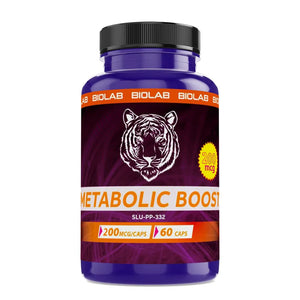
BioLab Metabolic Boost (SLU-PP-332) 500 mcg, 60 caps is a BioLab listing of SLU-PP-332, labelled at 500 mcg (0.5 mg) per capsule, 60 capsules per pack. It is supplied through the Muscle Market range for laboratory research only, is not for human consumption, and is sold to adults aged 18 and over. Below: what the published research on SLU-PP-332 reports, what the label documents, how batch certificates are handled for BioLab products, and how the compound differs from 5-Amino-1MQ.
About SLU-PP-332
SLU-PP-332, also written SLU PP 332, is a synthetic pan-agonist of the oestrogen-related receptors ERR alpha, beta and gamma. These are orphan nuclear receptors, unrelated to the oestrogen receptor despite the name, that regulate mitochondrial biogenesis and oxidative metabolism in muscle and heart. The compound was developed by Burris, Walker and colleagues at Saint Louis University and first published in 2023.
In the 2023 ACS Chemical Biology paper, mice given SLU-PP-332 showed a pattern of gene expression in muscle resembling the acute response to aerobic exercise and showed more oxidative type IIa muscle fibres and greater exercise endurance; the authors reported that ERR alpha activation was critical for the endurance effect (Billon et al., 2023). A 2024 follow-up in diet-induced obese mice and in ob/ob mice reported increased energy expenditure and fatty acid oxidation, less fat mass accumulation and improved insulin sensitivity (Billon et al., 2024). The authors of both papers include stockholders in a company focused on ERR-based therapeutics. There is no human data of any kind, no human pharmacokinetic study, and no safety study in people. Nothing above is a claim about this product.
In structural terms SLU-PP-332 is a compact aromatic molecule rather than a peptide or a steroid. PubChem records it as CID 5338394, CAS 303760-60-3, with the formula C18H14N2O2 and a molecular weight of 290.3 g/mol; its IUPAC name is 4-hydroxy-N-[(E)-naphthalen-2-ylmethylideneamino]benzamide. These are the identifiers any analytical report on this product should agree with.
This listing
- Manufacturer: BioLab
- Compound: SLU-PP-332
- Form: Capsules
- Pack size: 60 capsules
- Strength: 500 mcg (0.5 mg) per capsule, as stated by the manufacturer
- Total in pack: 30 mg (500 mcg x 60 capsules)
- Batch certificate of analysis: shown where BioLab supplies one for the batch we hold
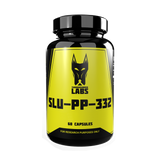
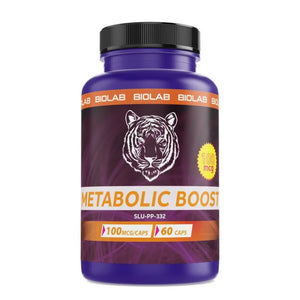
This is the highest per-capsule figure BioLab lists for SLU-PP-332. The same 60-capsule format is also sold at 100 mcg (6 mg per pack) and 200 mcg (12 mg per pack), so this pack holds five times the labelled content of the smallest one. Thoroughbred Labs SLU-PP-332 is a separate 60-capsule listing for which the manufacturer does not state a strength per capsule, so its total per pack cannot be calculated from the label. When comparing listings, divide cost by total milligrams, as set out in our price per milligram guide.
SLU-PP-332 in the UK: buying, legal status and what to check
Search terms like "SLU PP 332 UK buy", "SLU PP 332 UK sale" and "SLU PP 332 UK source" suggest many people assume the compound is an ordinary retail product. It is not, and the legal framework explains why.
Where the law stands
No regulator anywhere has licensed SLU-PP-332. In the UK it is not a licensed medicine, it has never been assessed by the MHRA, and it is not an authorised food supplement or novel food, so it cannot lawfully be marketed as something to swallow. It is not a controlled drug either. The route left open is supply for laboratory research to adults, and that is the only basis on which this listing exists: 18+ only, and not for human consumption. A marketplace page describing it as a supplement, or a "compounding" service offering it as a treatment, is presenting it as something no authority has approved. In sport, SLU-PP-332 is prohibited at all times: as a substance with no current approval for human therapeutic use it is caught by section S0 (non-approved substances) of the WADA Prohibited List, whether or not the list names it.
Questions worth putting to any UK seller
- Who made it? A named manufacturer can be held to its label. Here the manufacturer is BioLab.
- What is the stated content, in which unit? Micrograms and milligrams differ by a factor of a thousand. This pack states 500 mcg per capsule and 60 capsules, 30 mg in total.
- Is there a certificate for the batch actually in stock? For BioLab we show one only where the manufacturer has supplied it for the batch we hold, and say so where it has not.
- Is the seller identifiable? FreeMuscle LTD is a UK company in Scunthorpe, sells only to adults, and accepts returns of unopened items within 30 days.
- How does it travel? Every UK order ships free by tracked delivery in plain packaging; orders placed before 2pm Monday to Friday are processed the same working day, and EU delivery takes 3-7 working days.
- Does the listing tell you how to use it? A research listing should not, and this one does not.
Reviews that describe personal outcomes cannot confirm what a capsule contained, so we do not publish them. Terms are on our shipping and guarantee pages, and the UK supplier checklist applies the same tests to any shop.
Capsules compared with other forms
SLU-PP-332 is offered as capsules, as liquids and as vials marketed for injection, which is why "SLU-PP-332 capsules" and "SLU-PP-332 injectable" are both frequent searches. The literature answers part of that question directly. None of the published animal studies tested a capsule. In a 2026 paper introducing a successor molecule, SLU-PP-915, the same research group stated that SLU-PP-332 improves aerobic performance in mice but lacks oral bioavailability, and presented oral activity as the reason for developing the new compound (Billon et al., 2026). The authors disclose that one of them is an inventor on the university's rights and holds shares in companies developing ERR agonists. No study has measured SLU-PP-332 exposure after oral intake in any species, so this page makes no claim about what a capsule does.
Because SLU-PP-332 is a small molecule, the usual explanation for poor oral uptake of peptides, digestion by stomach and gut enzymes, does not describe its problem; the abstract does not give a cause. Our article do oral peptides work covers the separate peptide case.
The practical differences between forms are about measurement and stability. A capsule fixes the amount at the filling stage: at 500 mcg the active is still well under a milligram per capsule, so its accuracy depends on how evenly the powder blend was mixed before filling. A liquid moves that uncertainty to the solvent and the measuring device, and keeps the acylhydrazone link in contact with water for its whole shelf life. Only a batch content assay can show whether either format matches its label.
SLU-PP-332 compared with 5-Amino-1MQ
5-Amino-1MQ is often discussed alongside SLU-PP-332, and our research guide covers the two together, because both are small molecules studied in obese mice and both are sold under metabolic headings. Their mechanisms are unrelated. SLU-PP-332 switches on transcription factors, the ERR receptors, that drive genes for mitochondrial energy production. 5-Amino-1MQ (5-amino-1-methylquinolinium) works on an enzyme instead: it inhibits nicotinamide N-methyltransferase (NNMT), which methylates nicotinamide and in doing so draws on the cell's pools of NAD+ and the methyl donor SAM.
The key 5-Amino-1MQ paper came from the University of Texas Medical Branch. Methylquinolinium inhibitors of NNMT, the chemical series to which 5-Amino-1MQ belongs, were selective against related methyltransferases, lowered the NNMT product 1-methylnicotinamide, raised intracellular NAD+ and SAM, and suppressed fat formation in cultured fat cells. In diet-induced obese mice, a potent inhibitor from the series given systemically reduced body weight, white fat mass and plasma cholesterol without a change in food intake, and the authors saw no observable adverse effects (Neelakantan et al., 2018). That was a short study in mice, not a toxicology programme, and no human trial has been published for either compound.
| Feature | SLU-PP-332 | 5-Amino-1MQ |
|---|---|---|
| Target type | Nuclear receptors (ERR alpha, beta, gamma) | Enzyme (NNMT) |
| Action | Agonist | Inhibitor |
| PubChem CID and formula | 5338394, C18H14N2O2 (neutral) | 950107, C10H11N2+ (a cation) |
| Molecular weight | 290.3 g/mol | 159.2 g/mol |
| Evidence base | Mouse and cell studies from 2023 onwards | Cell and mouse studies from 2018 onwards |
| Licensed anywhere | No | No |
| WADA position | Prohibited at all times (at least under S0, non-approved substances) | Prohibited at all times (at least under S0, non-approved substances) |
Being charged, 5-Amino-1MQ behaves differently in analysis and in solution from the neutral SLU-PP-332, which is one reason their certificates are not interchangeable. The comparison is chemical and regulatory only. It says nothing about using either compound, singly or alongside any other.
Reading the certificate of analysis for this product
BioLab is a third-party brand in the Muscle Market range, so the testing position differs from our own label. Every Free Muscle-brand batch is assayed by Janoshik Analytical, an independent laboratory, with the certificate sent on request by email. For BioLab products we show a certificate of analysis only where the manufacturer supplies one for the specific batch we hold. A generic PDF with no batch number is not a batch certificate, and we do not present one as such. Email us with the product name and we will send what we hold, or say plainly that there is none.
When a BioLab certificate for this pack is available, read it against the following:
- Identity method. HPLC compares a retention time with a reference standard, which is only as good as that standard; for a compound this new, reference material is scarce. LC-MS adds a measured mass, and for SLU-PP-332 the protonated molecule should appear near m/z 291.1.
- Purity percentage. The proportion of the detected signal attributable to SLU-PP-332. A capsule mostly made of filler can still show high purity, because purity describes the active fraction, not its amount.
- Content per capsule. The result that tests the 500 mcg on the label.
- Batch number. Compare it with the code on the bottle; any difference, even one digit, means the report covers other stock.
- Date and laboratory. A named laboratory and test date place the result in time; a certificate years older than the pack describes earlier stock.
What a gap means is fairly literal. With no content figure, the 500 mcg claim rests on the manufacturer's label alone. With no batch number, the report cannot be linked to this stock. With no certificate at all, this listing makes no analytical claim beyond what BioLab prints. See our lab tests page, the guide on how to read a certificate of analysis, or contact us about a specific batch.
Detection, sport and testing
Under the WADA Code, SLU-PP-332 is caught by section S0, which covers any pharmacological substance without current approval for human therapeutic use, so it is prohibited in and out of competition whether or not the list names it. Anti-doping laboratories have already published in vitro work on its metabolism: the UCLA Olympic Analytical Laboratory incubated SLU-PP-332 with pooled human liver S9 fractions and, using high-resolution LC-MS, identified 22 metabolites, including hydroxylated, glucuronidated and sulfated forms, several of them proposed as targets for doping control (Avliyakulov et al., 2026). The authors note that further work is needed to confirm the structures.
What has not been published is an excretion study in people, so there is no validated detection window in urine or blood. Any number of days quoted online is unsupported. The accurate position is that the compound is detectable in principle and the window has not been established. Competitors in tested sport, including events run under UK Anti-Doping rules, should treat it as prohibited and check the current list, which changes every January.
Storage, stability and handling
BioLab has published no stability study for these capsules, so the sensible approach follows from the chemistry. The weak point of SLU-PP-332 is the acylhydrazone bridge between its two ring systems. Moisture, particularly with any acidity, can split that bond back into its starting fragments, and light can convert the E arrangement of the carbon-nitrogen double bond into the Z form, a different shape. Warmth accelerates both.
In practice that means leaving the capsules in the manufacturer's container with the lid closed and any desiccant in place, stored at or below room temperature in a dark cupboard rather than on a windowsill or near a radiator, kettle or shower. Keep the original label, since the batch number is the only link between the pack and any certificate. Capsules that have stuck together, softened or discoloured should be set aside and disposed of according to local rules rather than examined further. Keep the pack out of reach of children and apart from food, and handle it with the ordinary laboratory precautions of gloves, clear labelling and a clean work surface.
Glossary
- Oestrogen-related receptor (ERR): named for sequence similarity to the oestrogen receptor, the ERR alpha, beta and gamma proteins do not respond to oestrogen and govern energy-producing genes.
- Agonist: a molecule that activates a receptor; SLU-PP-332 activates all three ERRs.
- Nuclear receptor: a protein inside the cell that binds a molecule and then switches sets of genes on or off.
- Oxidative metabolism: energy production that uses oxygen, carried out in mitochondria.
- Oral bioavailability: how much of a compound taken in by mouth survives absorption and first passage through the liver to circulate intact, expressed as a percentage.
- NNMT: nicotinamide N-methyltransferase, the enzyme inhibited by 5-Amino-1MQ.
- NAD+: a coenzyme central to cellular energy reactions.
- Acylhydrazone: a C(=O)-NH-N=C bridge; in SLU-PP-332 it joins the naphthalene and hydroxybenzoyl parts and is the likeliest site of breakdown.
- Label claim: the amount per capsule printed by the manufacturer, here 500 mcg.
- m/z: mass-to-charge ratio, the value a mass spectrometer reports for an ion.
Related
- All brands of SLU-PP-332 we stock, compared
- All BioLab products
- 5-Amino-1MQ and Cardarine (GW-501516)
- SLU-PP-332 and 5-Amino-1MQ research guide
- Research guide to SARMs and related compounds
- Batch testing and certificates of analysis
- Delivery and returns
This product is supplied for laboratory research use only. It has not been evaluated by the MHRA, EMA or FDA. It is not a medicine, not a food supplement and not for human consumption. Sold only to adults aged 18 and over. Nothing on this page is medical, dosing or usage advice, and descriptions of published studies are not claims about this product.
References
- Billon C, et al. Synthetic ERRalpha/beta/gamma Agonist Induces an ERRalpha-Dependent Acute Aerobic Exercise Response and Enhances Exercise Capacity. ACS Chem Biol. 2023;18(4):756-771. PMID: 36988910.
- Billon C, et al. A Synthetic ERR Agonist Alleviates Metabolic Syndrome. J Pharmacol Exp Ther. 2024;388(2):232-240. PMID: 37739806.
- Billon C, et al. An orally active estrogen receptor-related receptor agonist, SLU-PP-915, enhances aerobic exercise capacity. J Pharmacol Exp Ther. 2026;393(1):103787. PMID: 41421047.
- Avliyakulov NK, et al. Analysis and Identification of In Vitro Metabolites of Exercise Mimetic SLU-PP-332 ERRalpha/beta/gamma Agonist for Doping-Control Purposes. Drug Test Anal. 2026;18(3):439-450. PMID: 41688415.
- Neelakantan H, et al. Selective and membrane-permeable small molecule inhibitors of nicotinamide N-methyltransferase reverse high fat diet-induced obesity in mice. Biochem Pharmacol. 2018;147:141-152. PMID: 29155147.
Frequently asked questions
Is SLU-PP-332 legal in the UK?
SLU-PP-332 is not a licensed medicine in the UK and is not an authorised food supplement. It is not a controlled drug. It may be sold to adults for laboratory research, which is the only basis for this listing. It is not for human consumption and nothing on this page is medical or dosing advice.
Is SLU-PP-332 a SARM?
No. SLU-PP-332 is an agonist of the oestrogen-related receptors ERR alpha, beta and gamma. It has no described activity at the androgen receptor and it is not a steroid. It is often listed beside SARMs and metabolic modulators such as Cardarine because it was studied for endurance in mice.
Has SLU-PP-332 been tested in humans?
No. Every published study of SLU-PP-332 is in mice or cells, and the first paper appeared in 2023. There are no human pharmacokinetic, safety or efficacy data, and no published study tested capsules. Any human result claimed for this compound does not come from the published research literature.
Is SLU-PP-332 detectable in sport drug tests?
SLU-PP-332 has no approval for human use, so it is prohibited at all times under section S0 of the WADA Prohibited List whether or not the list names it. Anti-doping laboratories have already published work identifying its metabolites for testing. Anyone subject to anti-doping rules should treat it as prohibited and check the current list.
What strength of SLU-PP-332 should I choose?
We do not advise on strength, quantity or use. Muscle Market products are sold for laboratory research only and are not for human consumption. We list the strength per capsule where the manufacturer prints one and say so where it does not, so that researchers can compare total milligrams per pack between listings.
Is SLU-PP-332 a peptide?
No. Despite often being sold under peptide headings, SLU-PP-332 is a small synthetic organic molecule with the formula C18H14N2O2 and a molecular weight of about 290. It contains no amino acids. That matters for analysis and storage: its identity is confirmed by chromatography and mass spectrometry as for other small molecules, and its sensitive point is the acylhydrazone link rather than peptide bonds.
What is the difference between SLU-PP-332 and MOTS-c?
MOTS-c is a short peptide encoded in mitochondrial DNA, studied in animals for effects on metabolism. SLU-PP-332 is a synthetic small molecule that activates the ERR nuclear receptors. They differ in structure, target and the way each is analysed, and neither is licensed as a medicine. We do not stock MOTS-c. This comparison is descriptive and is not a recommendation of either compound.
What is the half-life of SLU-PP-332?
No human half-life has been published, because SLU-PP-332 has never been given to people in a study. Its developers have reported that it lacks oral bioavailability in their work. Any half-life figure quoted online for humans is therefore unsupported, and we do not publish timing or quantity information for any research compound.
What side effects have been reported for SLU-PP-332?
None in people, because no human study exists. The published mouse papers were short and designed to measure exercise capacity and metabolic markers, not toxicity, and no formal toxicology programme has been published. An absence of reported harms in a few short animal studies is not evidence that a compound is harmless. It is sold for laboratory research only and is not for human consumption.
What SLU-PP-332 dosage should I use, and are there before and after results?
We do not publish dosage, timing or cycle guidance for SLU-PP-332 or any other research compound, and we make no claims about outcomes, so there are no before and after results on this site. This product is sold to adults for laboratory research only and is not for human consumption. Nothing on this page is medical or usage advice.
Related research and listings
Same compound, other brands See all 4 →
More from BioLab See all 4 →
Supplied for laboratory and research use. Not for human consumption. Not an approved medicine, and nothing above is dosing advice. You must be 18 or over to order.