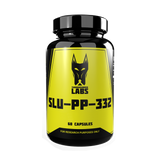
The Thoroughbred Labs Research System pairing SLU-PP-332 and 5-Amino-1MQ places two of the newest and least characterised compounds in this market in one listing. SLU-PP-332 is an oestrogen-related receptor agonist and 5-Amino-1MQ is an NNMT inhibitor. Thoroughbred Labs lists the pack as 60 capsules and does not state a strength per capsule, so we do not quote one. It is part of the Muscle Market range, supplied to adults aged 18 and over for laboratory research only, and not for human consumption.
A bundle is a listing convenience only: it lets separately packaged products from one manufacturer be ordered in a single purchase. Nothing on this page claims that they act together or should be studied together, and Free Muscle publishes no stack or cycle guidance for any product. Each compound is described separately below.
About the compounds in this research system
SLU-PP-332
SLU-PP-332 is a synthetic pan-agonist of the oestrogen-related receptors ERR alpha, beta and gamma. In a 2023 study in mice it induced a gene-expression pattern resembling acute aerobic exercise and increased running endurance (Billon et al., 2023). Every published study is preclinical and most come from the discovering group, led by Thomas Burris and John Walker. There is no human data, no toxicology package and no approval anywhere. Compare brands on the SLU-PP-332 collection page.
5-Amino-1MQ
5-Amino-1MQ (5-amino-1-methylquinolinium) is a small-molecule inhibitor of nicotinamide N-methyltransferase (NNMT), an enzyme more active in fat tissue during obesity. In a 2018 study, diet-induced obese mice treated with the compound had lower body weight and white fat mass than untreated obese controls (Neelakantan et al., 2018). That is the extent of the in vivo literature on which this page relies: no human studies, no safety profile, no approval anywhere. Compare brands on the 5-Amino-1MQ collection page.
Chemical identifiers side by side
| Identifier | SLU-PP-332 | 5-Amino-1MQ |
|---|---|---|
| PubChem CID | 5338394 | 950107 |
| CAS number | 303760-60-3 | 685079-15-6 |
| Formula | C18H14N2O2 (neutral molecule) | C10H11N2+ (cation, sold as a salt) |
| Molecular weight | 290.3 | 159.21 (ion only) |
| Systematic name | 4-hydroxy-N-[(E)-naphthalen-2-ylmethylideneamino]benzamide | 1-methylquinolin-1-ium-5-amine |
One is an uncharged hydrazone, the other a permanently charged ion, so they are analysed and stored with different concerns in mind. Neither is a peptide, a steroid or a SARM.
This listing
- Brand: Thoroughbred Labs (third-party brand, Muscle Market)
- Compounds: SLU-PP-332 and 5-Amino-1MQ
- Form and pack size: 60 capsules, as listed by the manufacturer
- Strength per capsule: not stated by the manufacturer
- COA: only where Thoroughbred Labs supplies one for the batch held
The manufacturer's listing gives a single pack figure of 60 capsules and no strength for either compound, so the quantity of each compound in the order cannot be calculated from the listing. The labels on the packs, and any certificate supplied for the batch, are the only documents that can settle it. Both compounds are also sold on their own by the same brand, as Thoroughbred Labs SLU-PP-332 and Thoroughbred Labs 5-Amino-1MQ.
SLU-PP-332 and 5-Amino-1MQ in the UK: buying, legal status and what to check
Searches such as "SLU PP 332 UK buy" and "5 amino 1mq UK" ask whether a UK shop may sell these compounds and how to judge a listing. A two-compound pack doubles the checks, since each applies to each compound.
The legal position
None of the compounds on this page is a licensed medicine in the United Kingdom, none has been assessed by the MHRA and none is an authorised food supplement. Neither is a controlled drug. No medicine containing either has been approved anywhere, so a listing that presents them as a slimming product, endurance aid or supplement describes something they cannot lawfully be. Free Muscle supplies them to adults aged 18 and over for laboratory research only. They are not for human consumption. Neither compound has been named individually on recent editions of the WADA list, but the list also prohibits any non-approved substance under S0, which covers both, and metabolic modulators are prohibited as a class. Our SARMs research guide has more background on how research compounds are regulated.
What a trustworthy listing for a two-compound pack shows
- Both compounds named, with the manufacturer identified on the page and on each pack.
- A stated strength for each compound, or an open statement that the manufacturer gives none. A figure for one compound says nothing about the other.
- A batch number on each pack, since two products made separately rarely share a lot.
- A certificate per batch, or one certificate that reports both compounds and quotes both batch numbers.
- No directions and no promised outcomes, with research-use and 18+ terms stated plainly.
- A reachable UK seller with published delivery and returns terms.
How this listing measures up
The manufacturer is named, and the absent strength is stated rather than estimated. Certificates depend on what Thoroughbred Labs has supplied for the batches in stock, and we say which applies. FreeMuscle LTD is a UK company based in Scunthorpe. Every UK order goes by free tracked delivery in plain packaging, orders placed before 2pm Monday to Friday are processed the same working day, EU delivery takes 3-7 working days, and unopened items may be returned within 30 days. Details are on the shipping and guarantee pages, and the UK supplier checklist applies the same tests to any shop.
Capsules compared with other forms
Both compounds are searched for as capsules, tablets and injectables, and the question behind those searches is whether the form matters. For each compound the published record answers only part of it.
SLU-PP-332. The published mouse work gave the compound by injection, so no published result describes a swallowed capsule. The same research group has since reported a successor, SLU-PP-915, which it describes as orally active in mice (Billon et al., 2026); that finding concerns a different molecule and cannot be read across to SLU-PP-332. How much of a capsule's content survives the stomach and is absorbed has not been measured in any species.
5-Amino-1MQ. The 2018 mouse study also used injection. The compound carries a fixed positive charge, and charged molecules tend to cross the gut wall less readily than neutral ones, although that is a general rule rather than a measurement in people. No study has measured oral absorption in humans.
Neither is a peptide, so the gut-enzyme argument in our article do oral peptides work does not apply to them.
The measurable differences between forms are practical. A capsule holds a weighed fill of powder blended with filler, so the amount per capsule depends on fill weight and how evenly the blend was mixed. A liquid is measured by volume and relies on the compound staying dissolved and intact, which matters for a hydrazone that water can slowly split. None of this is a claim about effect.
SLU-PP-332 and 5-Amino-1MQ compared with SR9009
The metabolic research compound most often searched in the same breath as these two is SR9009 (Stenabolic), and the comparison has a genuine thread: SR9009 and SLU-PP-332 came out of laboratories led by the same researcher, Thomas Burris, a decade apart. SR9009 was described in 2012 at the Scripps Research Institute as a synthetic agonist of REV-ERB alpha and beta, nuclear receptors that link the body clock to metabolism (Solt et al., 2012).
| Point of comparison | SLU-PP-332 | 5-Amino-1MQ | SR9009 |
|---|---|---|---|
| Target | ERR alpha, beta and gamma (activated) | NNMT enzyme (inhibited) | REV-ERB alpha and beta (activated) |
| First in vivo report | 2023, mice | 2018, mice | 2012, mice |
| Human trials | None | None | None |
| WADA position | Not named; S0 | Not named; S0 | Named in S4, metabolic modulators |
| UK status | Unlicensed; research use only | Unlicensed; research use only | Unlicensed; research use only |
Mechanism. Each acts at a different point. SLU-PP-332 switches on the ERR family, which governs how many mitochondria cells build. SR9009 switches on REV-ERB, which represses clock genes and reshapes their daily rhythm. 5-Amino-1MQ is not a receptor ligand at all: it blocks an enzyme that methylates nicotinamide. None acts at the androgen receptor.
Evidence. The 2012 SR9009 paper reported altered circadian behaviour and clock-gene patterns in mice, and lower fat mass with improved blood lipids and glucose in diet-induced obese mice. SR9009 has since shown what a longer record can reveal. In 2019 an independent group bred mice lacking both REV-ERB proteins and found that SR9009 still reduced cell viability and changed metabolism and gene transcription in their liver cells and stem cells, so its effects cannot all be credited to REV-ERB (Dierickx et al., 2019). SLU-PP-332 and 5-Amino-1MQ have not yet been through that kind of outside scrutiny, so their records are thinner still.
Regulation. All three are unlicensed in the UK and sold only for research. In sport SR9009 is prohibited by name, while the other two are caught by the catch-all S0 section. We do not rank research compounds by effect. The SR9009 research guide covers it in depth, and the iMuscle Stenabolic SR-9009 listing is stocked.
Reading the certificate of analysis for this product
Thoroughbred Labs is a third-party brand sold through Muscle Market. For third-party brands we display a certificate of analysis only where the manufacturer supplies one for the exact batch we hold; if none is shown, none has been supplied and we do not substitute a generic document. Free Muscle-brand products, by contrast, are assayed batch by batch at Janoshik Analytical, with the certificate sent on request by email. For a two-compound pack, check that the paperwork covers both, line by line:
- Which compound it reports. A certificate naming only SLU-PP-332 says nothing about the 5-Amino-1MQ in the same order, and the reverse.
- Identity by mass. HPLC matches a peak to a reference standard by retention time; LC-MS adds a measured mass. SLU-PP-332 should give an ion near m/z 291 after gaining a proton. 5-Amino-1MQ is already charged and should appear near m/z 159 as it is.
- Purity percentage. The share of the chromatogram taken by the main peak. For SLU-PP-332, small extra peaks may be its hydrolysis products or its other geometric isomer. Purity describes the powder, not the amount per capsule.
- Content per capsule. With no strength on the label, this is the only line that states a quantity. For 5-Amino-1MQ, check whether the figure counts the whole salt or the ion alone, since the two give different numbers for the same capsule.
- Batch number, laboratory and test date. The number must match the pack in front of you; the laboratory and date show who tested it and when.
A missing field has a plain meaning: no identity line means nothing confirms the compound, no content line leaves the quantity unknown, and a mismatched batch number means the document describes other stock. Contact us with both lot numbers and we will send what we hold or say there is nothing. Our lab testing page and the guide on how to read a certificate of analysis give worked examples.
Detection, sport and testing
For anyone bound by an anti-doping code, both compounds in this system are prohibited at all times, in and out of competition. Neither has appeared by name on recent editions of the WADA Prohibited List, but section S0 covers any pharmacological substance with no current approval for human therapeutic use, and neither has ever been approved.
Anti-doping laboratories have already published in vitro studies of SLU-PP-332 metabolism, identifying metabolites by mass spectrometry that screening could target; one, from the UCLA Olympic Analytical Laboratory, was written explicitly for doping-control purposes (Avliyakulov et al., 2026). We found no comparable anti-doping study for 5-Amino-1MQ. What is missing for both is any excretion study in people, so no detection window has been established for either. The accurate position is detectable in principle, window not established. Under strict liability an athlete is responsible for any prohibited substance found in a sample, whatever its source.
Storage, stability and handling
Thoroughbred Labs has not published stability data for these capsules and no independent stability study exists for either compound, so the expiry date on each pack is the only stated limit. Chemistry points to different risks for each. The hydrazone bond in SLU-PP-332 can be split by water, faster in acid, and its extended ring system absorbs ultraviolet light. 5-Amino-1MQ, as an organic salt with an aromatic amino group, is prone to taking up moisture and to slow oxidation and discolouration in air and light.
- Leave each compound in the container it arrived in, reseal it straight after opening, and do not remove any drying sachet.
- Choose a shelf that stays cool, dry and dark with little temperature swing; bathrooms, kitchens and sunny sills are poor choices.
- Keep each pack with its own label, because each batch number links to its own certificate.
- Set aside capsules that have clumped or changed colour.
- Store where children and pets cannot reach, apart from anything edible, and treat unwanted capsules as chemical waste under normal laboratory rules.
Glossary
- Oestrogen-related receptors (ERRs): three orphan nuclear receptors, named for their resemblance to the oestrogen receptor, that steer mitochondrial and fuel-use genes.
- Pan-agonist: an activator that works across a whole receptor family rather than one member; SLU-PP-332 is described this way because it reaches all three ERRs.
- NNMT: nicotinamide N-methyltransferase, the enzyme 5-Amino-1MQ inhibits.
- REV-ERB: alpha and beta forms of a clock-controlled nuclear receptor that represses target genes; SR9009 was built to activate them.
- Hydrazone: a carbon-nitrogen double bond joined to a second nitrogen, the link that water can split in SLU-PP-332.
- Quinolinium ion: the positively charged, methylated quinoline skeleton of 5-Amino-1MQ, which is why it is always sold paired with a counter-ion.
- m/z: mass-to-charge ratio, the value a mass spectrometer reports for an ion.
- S0 (non-approved substances): the opening section of the WADA list, catching any drug not approved for human treatment even if it is never named.
- Strict liability: in anti-doping, the athlete answers for what is in the sample; how it got there does not change the finding.
Related
- SLU-PP-332 collection
- 5-Amino-1MQ collection
- SR9009 collection
- Thoroughbred Labs brand page
- Bundles collection
- Metabolic support collection
- SLU-PP-332 and 5-Amino-1MQ research guide
Supplied for laboratory research use only. Not a medicine, not evaluated by the MHRA, EMA or FDA, and not for human consumption. Buyers must be 18 or over. Nothing on this page is medical or dosing advice or a recommendation to use, stack or cycle any compound; research summaries describe findings in study participants or animals, not claims about this product.
References
- Billon C, et al. Synthetic ERRalpha/beta/gamma Agonist Induces an ERRalpha-Dependent Acute Aerobic Exercise Response and Enhances Exercise Capacity. ACS Chem Biol. 2023;18(4):756-771. PMID: 36988910.
- Neelakantan H, et al. Selective and membrane-permeable small molecule inhibitors of nicotinamide N-methyltransferase reverse high fat diet-induced obesity in mice. Biochem Pharmacol. 2018;147:141-152. PMID: 29155147.
- Solt LA, et al. Regulation of circadian behaviour and metabolism by synthetic REV-ERB agonists. Nature. 2012;485(7396):62-68. PMID: 22460951.
- Dierickx P, et al. SR9009 has REV-ERB-independent effects on cell proliferation and metabolism. Proc Natl Acad Sci U S A. 2019;116(25):12147-12152. PMID: 31127047.
- Avliyakulov NK, et al. Analysis and Identification of In Vitro Metabolites of Exercise Mimetic SLU-PP-332 ERRalpha/beta/gamma Agonist for Doping-Control Purposes. Drug Test Anal. 2026;18(3):439-450. PMID: 41688415.
- Billon C, et al. An orally active estrogen receptor-related receptor agonist, SLU-PP-915, enhances aerobic exercise capacity. J Pharmacol Exp Ther. 2026;393(1):103787. PMID: 41421047.
Frequently asked questions
Is there any human research on SLU-PP-332 or 5-Amino-1MQ?
No. Every published study on either compound is in mice or in cells, and most of the SLU-PP-332 work comes from the group that discovered it. Neither has a published toxicology package or has entered a clinical trial. Anyone quoting a human result for these compounds is not citing the literature.
Is this research system legal in the UK?
Neither compound is a controlled substance, a licensed medicine or an authorised food supplement in the UK. We supply them only to adults aged 18 and over for laboratory research. Both fall under the WADA prohibition on non-approved substances (S0), and neither is for human consumption.
Why are the two compounds sold together?
Thoroughbred Labs packages them as a research system so that both can be bought in one order. That is the whole reason. We make no claim that they act together and we do not provide stack or protocol guidance for any product.
Is there a certificate of analysis?
For Thoroughbred Labs we display a certificate of analysis only where the manufacturer supplies one for the batch we hold. If nothing is shown on the page, none has been supplied for the current batch. Email us with the batch number and we will confirm what is available.
What strength is each capsule?
The manufacturer does not state a per-capsule strength on this listing and we will not guess. If the pack label or a batch certificate gives a figure, use that. We do not advise on strength selection because the products are sold for research only.
Are SLU-PP-332 and 5-Amino-1MQ peptides?
Neither is, although both are often searched for and listed as peptides. SLU-PP-332 is a small synthetic hydrazone of about 290 g/mol and 5-Amino-1MQ is a quinolinium ion of about 159. Neither contains amino acids; the word amino in 5-Amino-1MQ refers to one chemical group on its ring. Both are identified by chromatography and mass spectrometry, not peptide sequencing.
What side effects are reported for SLU-PP-332 and 5-Amino-1MQ?
None have been established in people, because neither compound has been given to humans in a published study. The mouse and cell papers were short and designed to measure metabolic or exercise changes, not toxicity, and no long-term safety work exists for either. The absence of reported harms reflects how little research exists, not evidence of tolerability. We make no claims about effects of any kind.
Are these capsules the same as injectable SLU-PP-332 or 5-Amino-1MQ?
The molecule is the same in any form, but the published mouse studies of both compounds used injection, and no study has measured how much of either is absorbed from a capsule in people. The differences we can describe are practical: how the amount per unit is fixed and how stable each compound is. We make no comparison of effect between forms.
Will SLU-PP-332 or 5-Amino-1MQ show up in a sports drug test?
Both are prohibited at all times under WADA section S0, which covers substances with no approval for human use, even though neither is named on the list. Anti-doping laboratories have published work on SLU-PP-332 metabolites, while no comparable study was found for 5-Amino-1MQ. No human detection window has been established for either compound.
What dosage, protocol or before and after results apply to this research system?
We do not publish dosage, timing, cycle, stacking, protocol or results information for any research compound, and we share no before and after reports. This system is sold for laboratory research only and is not for human consumption. There are no human studies of either compound from which any such figure could come, and nothing on this page is a claim about outcomes.
Related research and listings
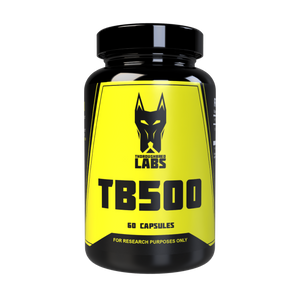
More from Thoroughbred Labs See all 9 →
Supplied for laboratory and research use. Not for human consumption. Not an approved medicine, and nothing above is dosing advice. You must be 18 or over to order.