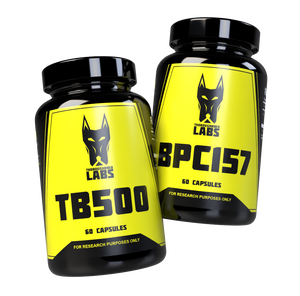
Thoroughbred Labs TB-500 Peptide Capsules is a listing of TB-500, a peptide based on thymosin beta-4, supplied as 60 capsules per pack; the manufacturer does not state a strength per capsule on the label. It is supplied through the Muscle Market range for laboratory research only, is not for human consumption, and is sold to adults aged 18 and over. Below: what the published research on TB-500 and thymosin beta-4 reports, what the label documents, the UK legal and anti-doping position, how capsules differ from other formats, and how batch certificates are handled for Thoroughbred Labs products.
About TB-500
TB-500 is the name used in the research-compound market for synthetic peptides based on thymosin beta-4, a 43-amino-acid protein present in most human cells. Products sold as TB-500 may contain the full sequence or a shorter fragment around the actin-binding region; the label on this listing does not say which. Thymosin beta-4 binds monomeric actin and has been studied in cell migration, angiogenesis and wound repair models. It is a peptide, not a steroid and not a SARM: it has no steroid ring structure and does not act on the androgen receptor.
| Identifier | Thymosin beta-4 (parent protein) |
|---|---|
| Length | 43 amino acids |
| Molecular formula | C212H350N56O78S |
| Molecular weight | about 4,963 g/mol |
| PubChem CID | 45382195 |
| InChIKey | UGPMCIBIHRSCBV-UHFFFAOYSA-N |
| Actin-binding segment | residues 17 to 23, LKKTETQ |
What the published research reports
A 2012 review by Goldstein and colleagues summarised the peptide's properties and the clinical programmes then under way in wounds, the cornea and cardiac repair. A 2010 randomised, placebo-controlled study gave intravenous pharmaceutical-grade thymosin beta-4 to healthy volunteers as single and repeated doses and reported no serious adverse events across the range tested; it was a tolerability study, not an efficacy study, and it used injection rather than a capsule. None of those programmes has produced an approved medicine, and no published human work shows that a peptide of this size survives oral administration.
Two analytical papers from 2012 describe what TB-500 products have actually contained. The doping control laboratory at Ghent University examined a TB-500 formulation by high-resolution mass spectrometry and identified the N-terminally acetylated 17-23 fragment of thymosin beta-4 in it. In the same year the racing laboratory of the Hong Kong Jockey Club described TB-500 as a veterinary preparation whose key ingredient was that acetylated seven-residue peptide, and published a method for finding it and its metabolites in horse urine and plasma. Both studies concern other products and animals, not this pack. Nothing above is a claim about this product.
This listing
- Manufacturer: Thoroughbred Labs
- Compound: TB-500 (Thymosin Beta-4)
- Form: Capsules
- Pack size: 60 capsules
- Strength: the manufacturer does not state the amount per capsule on the label, so we do not list one
- Total per pack: cannot be calculated without a stated strength
- Batch certificate of analysis: shown where Thoroughbred Labs supplies one for the batch we hold
Without a per-capsule figure this pack cannot be compared on milligrams with any other TB-500 listing. Our article on price per milligram explains why that comparison matters when a label does give a number.
TB-500 in the UK: buying, legal status and what to check
Searches for "buy TB 500 UK" and "TB 500 legal UK" ask two things: may it be sold here, and how to tell a documented listing from an undocumented one.
The legal position
TB-500 is not a licensed medicine in the UK, has not been assessed by the MHRA, and is not an authorised food supplement. It is not a controlled drug either. UK law turns on how a product is presented: anything offered to treat or prevent a condition is regulated as a medicine, and anything offered to be eaten must meet food law. TB-500 meets neither framework, so the only basis for this listing is supply for laboratory research to adults aged 18 and over, not for human consumption. No thymosin beta-4 medicine holds a UK marketing authorisation. Thymosin beta-4 and its derivatives, with TB-500 named as an example, are listed under section S2 (peptide hormones, growth factors and related substances) of the WADA Prohibited List and are prohibited at all times in sport. Anyone subject to anti-doping rules should consult the current list. Our research guide covers the wider legal picture.
What a documented UK listing shows
- A named maker and a named seller, so there is someone accountable for the label and someone to contact about the order.
- A batch or lot number on the container. Analytical results belong to a batch, never to a product name.
- A certificate of analysis for that batch, issued by a named laboratory, with a matching lot number.
- A stated strength, or a plain statement that the manufacturer gives none.
- Research-only wording: sale to adults only, with no usage directions and nothing promising a result.
- Tracked delivery in plain packaging and a written returns policy.
Where this Thoroughbred Labs pack stands
FreeMuscle LTD is a UK company based in Scunthorpe. The manufacturer is named, sale is limited to adults and this page contains no directions for use. Every order ships with free tracked UK delivery in plain packaging, orders placed before 2pm Monday to Friday are processed the same working day, EU delivery takes 3 to 7 working days, and unopened items can be returned within 30 days. Two checks depend on Thoroughbred Labs rather than on us. The label states no strength, so the fourth point is not met, and a batch certificate exists only where the manufacturer has supplied one for the lot we hold. The full set of checks is in our UK supplier checklist.
Capsules compared with other forms
TB-500 is offered as capsules and tablets, as freeze-dried powder in sealed vials, and occasionally as ready-mixed solution. The published work on thymosin beta-4 used routes that bypass digestion: intravenous infusion in the healthy-volunteer study, eye drops and topical gels in the corneal and skin programmes, and injection in most animal models. No study has measured whether any intact TB-500 peptide reaches the blood of a person after a capsule is swallowed.
The reason is digestive chemistry. The stomach's pepsin and the pancreatic and brush-border peptidases of the small intestine exist to break peptide bonds, and a short linear chain such as LKKTETQ, rich in lysine residues that trypsin cleaves next to, is an ordinary substrate. Crossing the gut wall would be a second, separate hurdle.
As materials, the formats differ in two practical ways. Stability: dry powder, whether in a capsule or a vial, keeps better than peptide dissolved in water, where hydrolysis and microbial growth begin. Uniformity: a capsule's content depends on how evenly a small amount of peptide was blended with filler before filling, while a solution's depends on how accurately it was made up and measured out. None of this implies that any format produces an effect. The wider question is covered in do oral peptides actually work and, for a related peptide, BPC-157 capsules vs injection.
TB-500 compared with BPC-157
"TB 500 vs BPC 157" is the most searched comparison for this compound, and Thoroughbred Labs makes both, but the molecules have nothing in common beyond being peptides sold for repair research.
| Point | TB-500 (thymosin beta-4 based) | BPC-157 |
|---|---|---|
| Parent | Thymosin beta-4, an intracellular actin-binding protein | A protein isolated from gastric juice |
| Size | Full protein 43 residues; products analysed in 2012 held a 7-residue acetylated fragment | 15 residues, 1419.5 g/mol |
| Proposed mechanism | Sequestering monomeric actin, which influences cell migration | Growth factor, nitric oxide and cell-signalling pathways in rodent tissue |
| Human data | Small early trials of the full protein by infusion or local application; none on the fragment | No randomised controlled trial published |
| UK status | Unlicensed research compound | Unlicensed research compound |
| WADA section | S2, named among growth factor related substances | S0, non-approved substances |
Thymosin beta-4 has been studied by many independent groups and taken into industry-sponsored clinical programmes, although none reached approval. BPC-157 research comes largely from one university network and remains almost entirely preclinical. Neither body of work concerns capsules, and no study has compared the two peptides directly, so neither can be ranked above the other. Their different WADA sections carry the same practical result: both are banned at all times.
Thoroughbred Labs also sells BPC-157 capsules and a research system containing BPC-157 and TB-500. That listing is a packaging convenience; we publish no guidance on combining the two and make no claim that they interact. Every BPC-157 brand we hold is on the BPC-157 collection page, with background in BPC-157: what the research shows.
Reading the certificate of analysis for this product
Thoroughbred Labs is a third-party brand in the Muscle Market range, so the testing position differs from our own label. Every Free Muscle-brand batch is assayed by Janoshik Analytical, an independent laboratory, with the certificate sent on request by email. For Thoroughbred Labs products we show a certificate of analysis only where the manufacturer supplies one for the specific batch we hold. A generic PDF with no batch number is not a batch certificate, and we do not present one as such. Where no batch certificate has been supplied, the listing does not show one.
For TB-500 the identity line is where a certificate earns its keep, because the name covers two very different molecules. Read each field against the pack:
- Identity method. HPLC shows a peak at the retention time of a reference standard. LC-MS adds a measured mass, and here the mass decides what is in the capsule: a result near 4.96 kDa points to full-length thymosin beta-4, while a result under 1 kDa fits the acetylated seven-residue fragment. A certificate naming "TB-500" with no mass leaves that question open.
- Purity percentage. The share of the chromatogram taken by the main peak. It says how clean the peptide is, not how much is in each capsule.
- Content per capsule. The one field that could supply the strength this label omits. It should say whether finished capsules or raw powder were tested.
- Lot reference and analysis date. The lot on the report should be the one printed on the tub; the date tells you whether the result is current.
- Laboratory name. So the result can be checked with whoever issued it.
For this brand a missing field has direct consequences: with no mass the molecule is unconfirmed, with no content line the strength stays unknown, and with no batch number the report cannot be linked to the capsules in hand. Questions about current stock can go through our contact page. Our lab tests page and the guide on how to read a certificate of analysis go further.
Detection, sport and testing
Thymosin beta-4 and its derivatives sit in section S2 of the WADA Prohibited List, with TB-500 named, and are prohibited in and out of competition. UK Anti-Doping applies the World Anti-Doping Code in the UK, and strict liability means an athlete is responsible for any prohibited substance in a sample regardless of what a label said. Equine anti-doping laboratories test for it too.
Methods exist. The Ghent laboratory synthesised the acetylated fragment and proposed a strategy for detecting it in plasma and urine. The Hong Kong Jockey Club laboratory identified its metabolites in vitro, then confirmed the parent peptide at 0.02 ng/mL in equine plasma and 0.01 ng/mL in equine urine, and found it and its metabolites in samples from horses given the preparation. That work was in horses; no published study sets out how long TB-500 remains detectable in people. The accurate position is: detectable, window not established.
Storage, stability and handling
No stability study of TB-500 capsules has been published, so the manufacturer's expiry or best-before date, if printed, is the limit to work to. Thymosin beta-4 contains a methionine residue, which can oxidise, so the practical threats to dry peptide powder are moisture, heat, air and light. Damp also softens capsule shells and makes contents clump.
- Close the lid firmly and store the tub in a dark cupboard, well away from heat sources, steam and direct sun.
- Leave any desiccant sachet in the tub. If the pack is kept in a fridge, let it reach room temperature before opening so condensation does not form inside.
- Do not decant capsules into another pot: the printed lot number is what links them to any certificate. Only unopened packs qualify for the 30-day return.
- Treat the contents as laboratory reagents: gloves for opened capsules, away from food and drink, out of reach of children and animals, and disposal as chemical waste.
Glossary
- Thymosin beta-4: a 43-amino-acid protein found inside most cells, the parent of the peptides sold as TB-500.
- Actin sequestration: binding of unpolymerised actin so it is held in reserve rather than built into filaments.
- Angiogenesis: formation of new blood vessels, one of the processes studied in thymosin beta-4 models.
- N-terminal acetylation: an acetyl group added to the start of a peptide chain, written "Ac-" before the sequence.
- Peptidase: an enzyme that cuts peptide bonds; the digestive tract contains many.
- Metabolite: a breakdown product that testing laboratories can look for alongside the parent peptide.
- kDa: kilodalton, a unit of molecular mass equal to 1,000 g/mol.
- Net peptide content: the share of a powder that is peptide, after water, salts and filler are excluded.
- S2: the part of WADA's list covering peptide hormones and growth factors, under which thymosin beta-4 derivatives are banned.
- Strict liability: the principle under which a positive sample counts against the athlete whatever its source or intent.
Related
- All brands of TB-500 we stock, compared, including Yakka Strength TB-500 capsules
- All Thoroughbred Labs products
- Research peptides
- TB-500 and thymosin beta-4 research guide
- Batch testing and certificates of analysis
- Delivery and returns
This product is supplied for laboratory research use only. It has not been evaluated by the MHRA, EMA or FDA. It is not a medicine, not a food supplement and not for human consumption. Sold only to adults aged 18 and over. Nothing on this page is medical, dosing or usage advice, and descriptions of published studies are not claims about this product.
References
- Goldstein AL, et al. Thymosin beta4: a multi-functional regenerative peptide. Basic properties and clinical applications. Expert Opin Biol Ther. 2012;12(1):37-51. PMID: 22074294.
- Ruff D, et al. A randomized, placebo-controlled, single and multiple dose study of intravenous thymosin beta4 in healthy volunteers. Ann N Y Acad Sci. 2010;1194:223-9. PMID: 20536472.
- Esposito S, et al. Synthesis and characterization of the N-terminal acetylated 17-23 fragment of thymosin beta 4 identified in TB-500, a product suspected to possess doping potential. Drug Test Anal. 2012;4(9):733-8. PMID: 22962027.
- Ho EN, et al. Doping control analysis of TB-500, a synthetic version of an active region of thymosin β4, in equine urine and plasma by liquid chromatography-mass spectrometry. J Chromatogr A. 2012;1265:57-69. PMID: 23084823.
Frequently asked questions
Is TB-500 legal in the UK?
TB-500 is not a licensed medicine in the UK and it is not an authorised food supplement. It is not a controlled drug. It may be sold to adults for laboratory research, which is the only basis for this listing. It is not for human consumption and nothing on this page is medical or dosing advice.
What is the difference between TB-500 and BPC-157?
Both are peptides sold for tissue repair research, but they are unrelated molecules. TB-500 is based on thymosin beta-4, a 43-amino-acid actin-binding protein. BPC-157 is a fifteen-amino-acid fragment of a gastric protein. Thymosin beta-4 has been through early human safety trials; BPC-157 has not. Neither is an approved medicine anywhere.
Is TB-500 banned in sport?
Yes. Thymosin beta-4 and its derivatives, with TB-500 given as an example, are named under section S2 of the WADA Prohibited List and are prohibited at all times. Anti-doping laboratories have published methods for detecting the peptide and its fragments. Anyone subject to testing should treat it as prohibited.
Does this listing state the strength per capsule?
No. The manufacturer does not state the amount of peptide per capsule on the label, so we do not list one. We publish only what the manufacturer documents. If a batch certificate of analysis is supplied for the batch we hold it is shown on the listing and states what was measured.
How is TB-500 shipped and can I return it?
Every order ships in plain packaging with free tracked UK delivery. Orders placed before 2pm Monday to Friday are processed the same working day, and EU delivery takes three to seven working days. Unopened items can be returned within 30 days. Customers must be 18 or over.
Is TB-500 the same as thymosin beta-4?
Not exactly. Thymosin beta-4 is a 43-amino-acid protein found in most human cells. TB-500 is a market name for synthetic peptides based on it, and products analysed by anti-doping laboratories in 2012 contained a short acetylated fragment, residues 17 to 23, rather than the whole protein. This label does not say which form it contains, so only a batch certificate with a measured mass could show it.
Is thymosin beta-4 a steroid?
No. Thymosin beta-4 is a peptide, a chain of amino acids, and TB-500 is based on it. It has no steroid ring structure and does not act on the androgen receptor, so it is neither an anabolic steroid nor a SARM. WADA lists it separately, under section S2 with peptide hormones and growth factors, and it is prohibited in sport at all times.
What is the TB-500 dosage, and what results or benefits does it give?
We do not publish dosage, cycle or stacking guidance, or before-and-after results, for TB-500 or any other research compound, and we make no claims about outcomes. This product is supplied for laboratory research only, is not for human consumption and is sold to adults aged 18 and over. Published studies on thymosin beta-4 are summarised on this page as research findings only.
Are TB-500 capsules the same as injections?
The molecule may be the same, but the published thymosin beta-4 research used infusion, injection or local application, never capsules. No study has shown that intact TB-500 reaches the blood after a capsule is swallowed, because digestive enzymes break down peptide bonds. Capsules hold dry powder, which is generally more stable than peptide in solution. None of this is a claim that any format produces an effect.
What side effects has research reported for TB-500?
There are no published human studies of TB-500 itself. A 2010 placebo-controlled study of intravenous pharmaceutical thymosin beta-4 in healthy volunteers reported no serious adverse events in the range tested, but it was small, short and used injection, not capsules. That finding says nothing about this product, which is for laboratory research only and not for human consumption.
Related research and listings
- Related collections: BPC-150, Retatrutide, Bundles & Stacks
- Research guides: SARMs vs Peptides: Choosing by Goal; What Is Janoshik Analytical? Third-Party Testing Explained
Same compound, other brands See all 3 →
More from Thoroughbred Labs See all 9 →
Supplied for laboratory and research use. Not for human consumption. Not an approved medicine, and nothing above is dosing advice. You must be 18 or over to order.