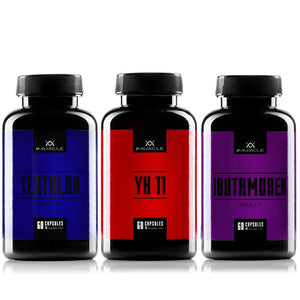
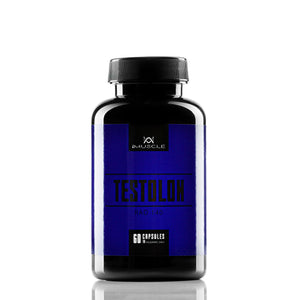
The iMuscle Cardarine and Testolone bundle pairs two research compounds from iMuscle in one listing: cardarine (GW-501516, endurobol), a PPAR-delta agonist, and testolone (RAD-140, vosilasarm), a selective androgen receptor modulator. iMuscle lists the pack as 60 capsules. The manufacturer does not state a strength per capsule on this listing, so we do not quote one. Supplied to adults aged 18 and over for laboratory research only, and not for human consumption.
A bundle is a listing convenience only: it groups two compounds from one manufacturer under a single product listing. Nothing on this page claims that they act together or should be studied together, and Free Muscle publishes no stack or cycle guidance for any product. Each section below therefore treats cardarine first and RAD-140 second, as two unrelated substances that simply share a listing.
About the compounds in this bundle
Cardarine (GW-501516)
Cardarine is not a SARM but an agonist at the PPAR-delta nuclear receptor, which regulates genes for fatty-acid oxidation. GlaxoSmithKline developed it with Ligand as a candidate for lipid disorders. The first published study in people was a two-week 2007 trial in healthy volunteers kept in hospital and sedentary: HDL cholesterol was higher than with placebo, fasting triglycerides trended downwards without reaching statistical significance, and fat from a test meal was cleared faster (Sprecher et al., 2007). With 6 people on placebo and 18 on the compound, it could say nothing about long-term tolerability. Development was then discontinued after long-term rodent toxicology studies found tumours in several organs, a sponsor-reported finding that ended further human work. Cardarine has never been approved as a medicine. Compare brands on the Cardarine (GW-501516) collection page.
Testolone (RAD-140)
Testolone (RAD-140) is a non-steroidal SARM designed by Radius Health and described in 2011 as potent and orally bioavailable, with its early characterisation carried out in rats and non-human primates (Miller et al., 2011). Human data are limited to a small early oncology study: 22 postmenopausal women with advanced ER-positive, HER2-negative breast cancer (LoRusso et al., 2022). Raised liver enzymes were the most frequent adverse events, AST in 59.1% of patients and ALT in 45.5%, alongside raised bilirubin, vomiting, dehydration and weight loss, and 16 of the 22 had at least one grade 3 or 4 event. The measured half-life was 44.7 hours. Published case reports describe drug-induced liver injury in adults who had taken products labelled as containing RAD-140; in one, a 52-year-old man's liver enzymes took about three months to return to normal (Barbara et al., 2020). It remains investigational and has never been approved as a medicine. Compare brands on the Testolone (RAD-140) collection page.
These findings describe study participants and animals under trial conditions. None of them is a claim about the capsules in this bundle.
This listing
- Brand: iMuscle (third-party brand, Muscle Market)
- Compounds: cardarine (GW-501516), testolone (RAD-140)
- Form and pack size: 60 capsules, as listed by the manufacturer
- Strength per capsule: not stated by the manufacturer
- COA: only where iMuscle supplies one for the batch held
- Terms: laboratory research only, adults aged 18 and over
Because no strength is printed, the usual comparison of total milligrams per pack, and of cost per milligram, cannot be made for this bundle. The method, for listings that do state a strength, is in price per milligram.
Cardarine and RAD-140 in the UK: buying, legal status and what to check
Behind "cardarine UK legal", "cardarine UK buy" and "testolone RAD 140 UK" sit two questions: is the sale lawful, and how can a credible seller be told from a doubtful one.
The legal position
None of the compounds on this page is a licensed medicine in the United Kingdom, none has been assessed by the MHRA and none is an authorised food supplement. Cardarine and RAD-140 are not controlled substances in the UK, so they can be supplied to adults for laboratory research, which is the only basis on which Free Muscle sells them. The position in sport is stricter: RAD-140 falls under WADA section S1 (anabolic agents) and cardarine under S4 (hormone and metabolic modulators), and both are banned at all times, in and out of competition. Background: our SARMs research guide.
What a credible UK listing shows, and where this one stands
| Check | Why it matters | This listing |
|---|---|---|
| Named manufacturer and UK seller | Someone accountable for what is in the pack and for the sale | Made by iMuscle; sold and posted by FreeMuscle LTD of Scunthorpe, a UK company |
| Stated strength for each compound | Without it, a certificate has no label figure to test | Not stated by iMuscle, so not quoted by us |
| Certificate tied to a batch number | Only a batch-specific result says anything about the pack you receive | Shown only where iMuscle supplies one for the batch we hold |
| Research-only wording | A seller giving amounts or promising outcomes is marketing a product for people to take | No amounts, schedules or outcome claims; 18 and over only |
| Discreet, traceable delivery | A tracked parcel can be followed and a plain one draws no attention | Sent free by tracked UK post in unmarked packaging; weekday orders placed by 2pm processed that day; 3-7 working days to the EU |
| A returns route | Shows the seller stands behind the order | Unopened items within 30 days, under our delivery and guarantee terms |
Reviews and "cardarine UK reviews" threads tell you how a parcel arrived, not what the capsules hold. A fuller supplier checklist is in how to choose a SARMs supplier in the UK.
Capsules compared with other forms
Both molecules are also sold as liquids, loose powder and occasionally injectables. The chemical is the same; what differs is how the quantity per unit is fixed and how well it holds.
In a capsule the amount is decided once, when powder is blended and filled into shells, so the figure can be checked by assaying a sample of capsules. The weak point is mixing: an assay reports an average, so a poorly blended batch can vary between shells. A liquid is sold as a concentration, so every measured portion depends on the accuracy of the volume drawn, and a solution that is opened repeatedly can lose solvent and become more concentrated, while a compound near its solubility limit can settle out in the cold. Powder has no preset portion; accuracy rests on the balance. As for injectable versions, both human studies cited here gave the compounds by mouth, and we know of no published injection study.
Neither compound is a peptide. At molecular weights of 453.5 (cardarine) and 393.8 (RAD-140) they are small synthetic molecules, so the debate over whether stomach enzymes break down swallowed peptides, covered in do oral peptides work, does not apply to them in the same way. For this particular bundle, the main advantage of capsules, a printed figure per capsule that a laboratory can confirm, is missing because iMuscle prints none.
Each compound compared with its most-searched counterpart
Searchers pair each compound here with a different neighbour, "stenabolic vs cardarine" and "RAD 140 vs RAD 150", so the pairings are taken in turn.
Cardarine compared with SR9009 (stenabolic)
They are often shelved together, but share neither receptor nor chemical family. Cardarine binds PPAR-delta; SR9009 (C20H24ClN3O4S, CAS 1379686-30-2) binds REV-ERB alpha and beta, nuclear receptors that form part of the body clock. Cardarine went through industry clinical trials for lipid disorders before its tumour findings in rodents; SR9009 came out of academic research at the Scripps Research Institute and has never been given to people in a published trial. So SR9009 has no human data and no long-term carcinogenicity data, a gap in knowledge rather than a reassurance. Neither is licensed anywhere, and WADA lists both under S4 as metabolic modulators. SR9009 brands are in the SR9009 (Stenabolic) collection, with background in the SR9009 research guide.
RAD-140 compared with RAD-150 (TLB-150)
RAD-150, also sold as TLB-150, is marketed as an ester of RAD-140: the same core molecule with a benzoate group attached. Closely related chemically, they differ sharply in evidence: RAD-140 has a peer-reviewed preclinical paper, a published first-in-human study and anti-doping research. RAD-150 has no peer-reviewed journal studies and no published data in people, so any claim that it is longer-lasting, milder or stronger than RAD-140 is untested. Neither has ever been approved as a medicine. RAD-140 is named in WADA section S1; RAD-150 is not named individually, but S1 also covers substances with a similar chemical structure or biological effect, so it is prohibited in sport as well. RAD-150 brands are in the RAD-150 (TLB-150) collection, with more in RAD-140 vs RAD-150 (TLB-150).
Reading the certificate of analysis for this product
iMuscle is a third-party brand sold through Muscle Market. For third-party brands we display a certificate of analysis only where the manufacturer supplies one for the exact batch we hold; if none is shown, none has been supplied and we do not substitute a generic document. Free Muscle-brand products, by contrast, are assayed batch by batch at Janoshik Analytical, with the certificate sent on request by email; that programme does not extend to iMuscle. Our lab testing page explains what a certificate shows.
Two compounds need two identity results. Read each certificate field by field:
- Compound name and CAS number. Cardarine is CAS 317318-70-0 and RAD-140 is CAS 1182367-47-0.
- Identity test. HPLC matches the sample against a reference standard by retention time; LC-MS also measures mass, which should correspond to 453.5 for cardarine (C21H18F3NO3S2) and 393.8 for RAD-140 (C20H16ClN5O2).
- Stereochemistry, for RAD-140. RAD-140 has two stereocentres, written (1R,2S) in its systematic name, so other isomers share its formula and mass. A mass match alone does not show the correct isomer. Cardarine has no stereocentre, so the question does not arise.
- Purity. A percentage, usually from chromatogram peak areas, of how much detected material is the named compound; other peaks are impurities. It is not a content per capsule.
- Measured content. iMuscle prints no strength, so any milligram figure on a certificate would be new information about the pack, with no label value to hold it against.
- Lot code, date and issuer. Match the lot code to the one on your container, see how long ago the analysis was run, and note who ran it, since a named laboratory can be asked about its own report.
Treat a blank field as an open question rather than a pass, and get in touch quoting the lot codes printed on the pack to learn what paperwork iMuscle has provided. See how to read a COA.
Detection, sport and testing
For anyone under anti-doping rules, both compounds are prohibited at all times. Under strict liability, a mislabelled or contaminated product is no defence.
Cardarine was added to the WADA list in January 2009, first classed as gene doping. The Cologne anti-doping laboratory then used human liver microsomes to reproduce its breakdown, synthesised the two main urinary metabolites, a sulfoxide and a sulfone, and validated a routine urine screening method able to detect 0.1 ng/ml (Thevis et al., 2010). Testing therefore targets what the body makes from cardarine, not only the parent compound.
RAD-140 is named in section S1, and anti-doping laboratories screen urine for SARMs. Its half-life in the 2022 cancer study was 44.7 hours, but a half-life describes how blood levels fall, not how long a laboratory can find traces in urine. We know of no verified study giving a detection window after capsule quantities of either compound, so for both the accurate statement is: detectable, window not established.
Storage, stability and handling
We are not aware of any published shelf-life study for cardarine or RAD-140 capsules, so no shelf life is quoted here. Treat the expiry date printed by iMuscle as the limit, and remember that a certificate describes the batch only as it stood on the day it was tested.
Both are solids held in capsule shells, and the main threats to them are moisture, heat and light. Humid air softens gelatin and lets the powder inside clump, so store the containers tightly closed in a cool, dark cupboard, well away from radiators, cookers, bathrooms and sunny windowsills. Keep capsules in their original labelled containers: loose capsules of similar appearance cannot be told apart afterwards, and once separated from the label they can no longer be linked to a batch number or certificate.
Log each batch number with the date its seal was first broken. Handle opened capsules with gloves, away from food and drink, keep everything out of reach of children and pets, and dispose of unwanted material as chemical waste under local rules, never in household bins or drains. Opening a container also ends the 30-day return option, which covers unopened items only.
Glossary
- PPAR-delta: a nuclear receptor, full name peroxisome proliferator-activated receptor delta, switched on by cardarine.
- SARM: a non-steroidal molecule built to act on the androgen receptor, such as RAD-140; cardarine belongs to a different class.
- REV-ERB alpha and beta: clock-linked nuclear receptors bound by SR9009, unrelated to PPAR-delta.
- Ester: a molecule made by joining an acid to an alcohol; RAD-150 is sold as RAD-140 joined to benzoic acid.
- ER-positive, HER2-negative: a breast cancer type defined by oestrogen receptor presence and absence of HER2 protein excess, the population in the RAD-140 trial.
- AST and ALT: enzymes released from liver cells; blood levels above normal point to liver injury or stress.
- Carcinogenicity study: lifelong animal exposure to a substance, run to see whether tumour rates rise.
- Sulfoxide and sulfone: oxidised forms of cardarine made in the body and used as targets in doping tests.
- Retention time: the moment a substance emerges from a chromatography column; a sample emerging alongside its reference standard supports its identity.
Related
- Cardarine (GW-501516) collection
- RAD-140 (Testolone) collection
- iMuscle brand page
- Bundles collection
- Cardarine (GW-501516): what happened in development
- RAD-140 (testolone): what the research says
- What are SARMs? The 2026 research guide
Supplied for laboratory research use only. Not a medicine, not evaluated by the MHRA, EMA or FDA, not a food supplement and not for human consumption. Buyers must be 18 or over. Nothing on this page is medical or dosing advice or a recommendation to use, stack or cycle any compound; research summaries describe findings in study participants or animals, not claims about this product.
References
- Sprecher DL, et al. Triglyceride:high-density lipoprotein cholesterol effects in healthy subjects administered a peroxisome proliferator activated receptor delta agonist. Arterioscler Thromb Vasc Biol. 2007;27(2):359-65. PMID: 17110604.
- Miller CP, et al. Design, Synthesis, and Preclinical Characterization of the Selective Androgen Receptor Modulator (SARM) RAD140. ACS Med Chem Lett. 2011;2(2):124-9. PMID: 24900290.
- LoRusso P, et al. A First-in-Human Phase 1 Study of a Novel Selective Androgen Receptor Modulator (SARM), RAD140, in ER+/HER2- Metastatic Breast Cancer. Clin Breast Cancer. 2022;22(1):67-77. PMID: 34565686.
- Thevis M, et al. Characterization of two major urinary metabolites of the PPARdelta-agonist GW1516 and implementation of the drug in routine doping controls. Anal Bioanal Chem. 2010;396(7):2479-91. PMID: 19946680.
- Barbara M, et al. Drug-Induced Liver Injury Associated With Alpha Bolic (RAD-140) and Alpha Elite (RAD-140 and LGD-4033). ACG Case Rep J. 2020;7(6):e00409. PMID: 33062783.
Frequently asked questions
Is cardarine a SARM?
No. Cardarine (GW-501516) is a PPAR-delta agonist, a metabolic modulator that acts on a nuclear receptor involved in fat oxidation. RAD-140 in this bundle is a SARM. They are sold together by iMuscle as a bundle listing, not because they share a mechanism or are meant to be studied together.
Why was cardarine's development stopped?
GlaxoSmithKline and Ligand ended clinical development of GW-501516 after long-term rodent toxicology studies found tumours in multiple organs. Those findings were reported by the sponsor rather than published in full. No later human trial has been run and no regulator has approved it. Cardarine is also prohibited in sport at all times under WADA section S4.
Is it legal to buy this bundle in the UK?
Cardarine and RAD-140 are not controlled substances in the UK, but neither is a licensed medicine or a food supplement. They can be supplied to adults for laboratory research, which is the only basis on which we sell them. Both are prohibited in sport by WADA, RAD-140 under S1 and cardarine under S4.
How do I check the batch?
Email us with the batch number printed on the pack. For iMuscle we show a certificate of analysis only when the manufacturer supplies one for the exact batch we hold. If there is none, we will tell you. A generic PDF from a different batch is not a batch certificate.
What is the returns policy?
Unopened items can be returned within 30 days under our guarantee terms; opened items cannot. UK delivery is free and tracked, in plain packaging, and weekday orders placed before 2pm are processed the same working day. EU delivery usually takes 3 to 7 working days. Full details are on our shipping and guarantee pages.
What strength are the capsules in this bundle?
iMuscle does not state a strength per capsule for this listing, so we do not quote one and will not estimate it. Only the pack size, 60 capsules, is given. If a batch certificate is supplied by the manufacturer and reports a measured content, we can share it. The single-compound iMuscle listings do carry a stated strength.
What is the difference between RAD-140 and RAD-150?
RAD-150, also sold as TLB-150, is marketed as a benzoate ester of RAD-140. RAD-140 has a peer-reviewed preclinical paper and a published phase 1 study in women with advanced breast cancer. RAD-150 has no peer-reviewed studies and no published human data, so claims comparing their strength or duration are untested. Both are prohibited in sport.
Is cardarine the same as SR9009 (stenabolic)?
No. Cardarine activates PPAR-delta, a receptor controlling fat-oxidation genes, and reached human lipid trials before tumours in rodent studies stopped its development. SR9009 targets REV-ERB receptors in the body clock and has never been tested in a published human trial. They are different molecules with different evidence gaps, although WADA lists both as metabolic modulators.
What is the half-life of RAD-140?
In the only published human study, a 2022 phase 1 trial in 22 women with advanced breast cancer, the measured half-life of RAD-140 was 44.7 hours. That figure comes from patients under trial conditions, is not a claim about this product, and is not the same as how long RAD-140 remains detectable in a drug test.
Do you publish dosage, cycle or before-and-after results for cardarine or RAD-140?
No. We do not publish dosing, cycle or stacking guidance, or before-and-after results, for any product, and we make no claims about outcomes. This bundle is sold only to adults for laboratory research and is not for human consumption. Research findings on this page describe study participants or animals, not results anyone should expect.
Related research and listings
- Related collections: LGD-4033 (Ligandrol), SLU-PP-332, YK-11
- Research guides: SARMs Explained: How Selective Androgen Receptor Modulators Work; LGD-4033 (Ligandrol): trials, findings and UK status; Ostarine (MK-2866): what the clinical trials found and UK status; YK-11: a steroidal compound sold as a SARM, what is actually known
More from iMuscle See all 17 →
Supplied for laboratory and research use. Not for human consumption. Not an approved medicine, and nothing above is dosing advice. You must be 18 or over to order.