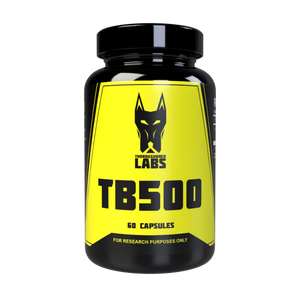
The Thoroughbred Labs Research System pairing BPC-157 and TB-500 groups two capsule-form research peptides in one listing. BPC-157 is a synthetic gastric pentadecapeptide and TB-500 is a synthetic fragment of thymosin beta-4. Thoroughbred Labs states 300 mcg of BPC-157 and 300 mcg of TB500 per capsule in the FACTS panels of the two tubs, and its product images show two tubs, each labelled 60 CAPSULES. Supplied to adults for laboratory research only and not for human consumption. It is sold through Muscle Market.
A bundle is a listing convenience only: it lets two compounds from one manufacturer be ordered in a single purchase. Nothing on this page claims that they act together or should be studied together, and Free Muscle publishes no stack or cycle guidance for any product. "Research System" is the manufacturer's product name, not a description of a method. The sections below take BPC-157 first and TB-500 second, and keep them apart throughout.
About the compounds in this research system
BPC-157
BPC-157 is a synthetic fifteen-amino-acid peptide based on a sequence from a human gastric protein. Its sequence is GEPPPGKPADDAGLV. Almost all published work is rodent and cell research, largely from one Croatian group, covering animal models of gut, tendon, muscle and vascular injury. No controlled human trial has been published, and oral absorption of any peptide is unproven. WADA lists it under S0 (non-approved substances). Compare brands on the BPC-157 collection page.
TB-500 (Thymosin Beta-4 fragment)
TB-500 is the trade name for a synthetic fragment of thymosin beta-4, a 43-amino-acid actin-binding peptide present in most human and animal cells. Reviews of thymosin beta-4 cover preclinical wound, corneal and cardiac repair models and early clinical trials of the full peptide. TB-500 itself has no published human data. WADA names thymosin beta-4 and its derivatives, including TB-500, under S2. Compare brands on the TB-500 (Thymosin Beta-4 fragment) collection page.
| Property | BPC-157 | Thymosin beta-4 and TB-500 |
|---|---|---|
| Chain length | 15 residues | Parent protein 43 residues; the fragment found in TB-500 is 7 residues, Ac-LKKTETQ |
| Molecular formula (PubChem) | C62H98N16O22 | C212H350N56O78S (parent protein) |
| Molecular weight | 1419.5 g/mol | About 4,963 g/mol for the parent; under 1,000 g/mol for the fragment |
| CAS number | 137525-51-0 | None held in our PubChem record |
| PubChem CID | 9941957 | 45382195 (parent) |
What the published research reports
The BPC-157 citation below is a 2016 review written by the Zagreb researchers who first described the peptide. It gathers their rodent work on the gut, brain and blood vessels; independent replication is its main gap. The thymosin beta-4 citation is a 2012 review by Goldstein and colleagues, covering actin binding, cell movement and the skin, eye and heart programmes then in progress. Both reviews concern the peptides in general, delivered by routes other than capsules, and neither is a claim about this product.
Two analytical papers, covered under detection below, describe what products sold under these names actually contained. Both peptides here are in capsule form. Our article Do oral peptides actually work? sets out why oral bioavailability of peptides is an open question and what that means for how this format is studied. Longer reviews are in BPC-157: what the research actually shows and the TB-500 and thymosin beta-4 research guide.
This listing
- Brand: Thoroughbred Labs (third-party brand, Muscle Market)
- Compounds: BPC-157 and TB-500 (thymosin beta-4 fragment)
- Form and pack size: capsules; the brand's images show two tubs, one per peptide, each labelled 60 capsules, while the listing text on the brand's site states no overall count (our stock record says 60, so ask us before ordering if the count matters)
- Peptide content per capsule: BPC-157 300 mcg and TB500 300 mcg, as stated on the FACTS panels
- Total per tub as labelled: 18 mg of each peptide (300 mcg x 60)
- COA: only where Thoroughbred Labs supplies one for the batch held
Thoroughbred Labs also sells each peptide on its own, as Thoroughbred Labs BPC-157 capsules and Thoroughbred Labs TB-500 capsules. All three state 300 mcg per capsule, so the single tubs and the system tubs carry the same labelled content; price per milligram explains why that matters.
BPC-157 and TB-500 in the UK: buying, legal status and what to check
Searches such as "BPC157 TB500 UK" and "BPC 157 UK legal" ask whether the peptides can be sold here, and how to tell a documented listing from an anonymous one.
Where the law stands
None of the compounds on this page is a licensed medicine in the United Kingdom, none has been assessed by the MHRA and none is an authorised food supplement. Neither peptide appears in the controlled drugs legislation. Free Muscle supplies them to adults aged 18 and over for laboratory research only. They are not for human consumption. No medicine licensed in the UK contains either peptide. BPC-157 is listed by WADA under S0 and TB-500 under S2. The TB-500 research guide sets out the regulatory background for that peptide in more detail.
Questions to put to any seller of a two-peptide pack
- Which peptides, in which containers? The listing should name both compounds, not only a product nickname.
- How much of each? A stated amount per capsule for each peptide, or a plain admission that the maker gives none.
- Which batch? A lot number on every container, since analytical results belong to a batch.
- Tested by whom? A certificate for that batch from a named laboratory, with a result for each peptide.
- Sold on what terms? Adults only, research use stated, and no directions for use or promised outcomes.
- Delivered how? Tracked delivery, discreet packaging and written returns terms from a traceable company.
How this Thoroughbred Labs pack answers them
The seller is named: FreeMuscle, registered in Andorra, with UK operations and dispatch in Scunthorpe. The manufacturer and both compounds are named, sales are limited to adults, and this page gives no directions for use. Every order goes by free tracked UK delivery in plain packaging; orders placed before 2pm Monday to Friday are processed the same working day, EU delivery takes 3 to 7 working days, and unopened items can be returned within 30 days. Two answers depend on Thoroughbred Labs: both strengths come from its FACTS panels, 300 mcg each, and a batch certificate exists only where the manufacturer has supplied one for the lot we hold. The UK supplier checklist expands on each question.
Capsules compared with other forms
Both peptides are sold in three broad formats: capsules or tablets, freeze-dried powder in sealed vials, and occasionally ready-made solutions. The published research does not map neatly onto any of them. BPC-157 studies in rats mostly gave the peptide by injection, with some Zagreb experiments adding it to drinking water. Thymosin beta-4 work used intravenous infusion, eye drops, gels applied to skin and injection in animals. Nobody has published a measurement of either peptide in human blood after a capsule was swallowed, so the search "BPC 157 capsules vs injection" has no answer in human data. The routes used in each study are set out in BPC-157 capsules vs injection: what the studies used.
The obstacle for a swallowed peptide is chemical. Stomach acid unfolds proteins and pepsin begins cutting them, then pancreatic enzymes and the peptidases lining the small intestine finish the job, and an intact peptide would still have to cross the gut wall. The Zagreb group reports that BPC-157 withstands human gastric juice in its own tests; nothing comparable has been reported for the TB-500 fragment, whose two adjacent lysine residues are typical cleavage points for trypsin.
As materials, dry powder in a sealed shell or vial generally keeps better than peptide in water, and a capsule's content depends on how evenly the peptide was blended with filler. None of this implies that any format produces an effect.
BPC-157 compared with TB-500
"TB 500 vs BPC 157" is the comparison most often searched for these two. They share a market category and very little else.
Origin and structure
BPC-157 was derived from a protein isolated in gastric juice; its 15 residues are rich in proline and include three aspartate and glutamate residues, which make it acidic. TB-500 is built on residues 17 to 23 of thymosin beta-4, the stretch of the parent protein that binds actin, with an acetyl group capping its start. At under 1,000 g/mol the fragment is smaller than BPC-157 at 1419.5 g/mol.
Evidence base
The two literatures grew in different ways. BPC-157 research is concentrated in one university network and is almost entirely rodent and cell work, with no randomised human trial published. Thymosin beta-4 has been studied by many independent laboratories and taken into sponsored clinical programmes using the full protein, none of which has yet led to an approved medicine. No study has ever compared BPC-157 and TB-500 directly, so neither can be ranked above the other.
Regulation and sport
In the UK both are unlicensed research compounds without MHRA, EMA or FDA approval. Their WADA sections differ: BPC-157 is in S0 because it has no approval for human therapeutic use, while TB-500 falls in S2 because the list names thymosin beta-4 and its derivatives. The practical result is identical, as both are prohibited at all times. Brands are compared on the BPC-157 collection and TB-500 collection pages, and the wider peptide class is discussed in SARMs vs peptides.
Reading the certificate of analysis for this product
Thoroughbred Labs is a third-party brand sold through Muscle Market. For third-party brands we display a certificate of analysis only where the manufacturer supplies one for the exact batch we hold; if none is shown, none has been supplied and we do not substitute a generic document. Free Muscle-brand products, by contrast, are assayed batch by batch at Janoshik Analytical, with the certificate sent on request by email, as for our own Free Muscle TB-500. That testing does not extend to Thoroughbred Labs. Our lab testing page explains what a certificate shows.
A pack with two peptides needs evidence for two identities, so a report that names only one compound covers only half of it. Points to look for:
- Identity for each peptide. HPLC matches a peak to the retention time of a reference standard; LC-MS adds a measured mass. A BPC-157 result should sit at about 1419.5 g/mol. For TB-500 the mass shows which molecule is present: under 1,000 g/mol fits the acetylated fragment, around 4,963 g/mol the full protein.
- Purity percentage. How much of the detected signal belongs to the named peptide rather than synthesis by-products. It says nothing about quantity.
- Content. The field that checks the 300 mcg stated for each peptide, ideally per capsule and stating whether net peptide or total powder was measured.
- Batch number and test date. The lot on the report must match the lot on the container, and the date shows how current the result is.
For this brand a gap has a direct consequence: no mass leaves the TB-500 identity open, no content line leaves both stated strengths unmeasured, and no batch number means the report cannot be tied to the capsules in hand. Contact us with the batch number and we will say what documentation exists for current stock. How to read a certificate of analysis works through a full example.
Detection, sport and testing
Under the World Anti-Doping Code, applied in the UK by UK Anti-Doping, both peptides in this pack are prohibited. BPC-157 sits in S0 and TB-500 in S2, and both classes are banned in and out of competition. Strict liability applies: an athlete answers for whatever a sample contains.
Laboratories have published detection methods for each peptide. For TB-500, the Ghent doping control laboratory identified Ac-LKKTETQ by high-resolution mass spectrometry, synthesised it as a reference material and suggested a plasma and urine detection route. For BPC-157, the Salt Lake City laboratory validated a urine method with a limit of detection of 0.1 ng/mL, showed the peptide remained stable in urine for at least four days, and added a stable metabolite as a second marker to improve specificity. Neither study followed people after exposure, so no human detection window has been established for either peptide. The accurate position is: detectable, window not established.
Storage, stability and handling
No stability study has been published for BPC-157 or TB-500 in capsule form, so the manufacturer's expiry or best-before date, where printed, is the limit to work to. Moisture drives hydrolysis and softens capsule shells, heat speeds degradation, and air and light encourage oxidation. Thymosin beta-4 carries a methionine residue that oxidises readily; the TB-500 fragment does not include it, but its lysine-rich sequence attracts water.
- Keep the container firmly closed in a cool, dark, dry cupboard, away from radiators, steam and sunlight.
- Leave any desiccant in place. A refrigerated container should reach room temperature before it is opened, so condensation does not form on the contents.
- Keep capsules in their original container. The printed lot number is the only link to a certificate, and only unopened packs qualify for the 30-day return.
- Work with opened capsules as you would any laboratory reagent: wear gloves, keep them apart from food and drink and out of reach of children and pets, and send unwanted material for chemical waste disposal.
Glossary
- Pentadecapeptide: a peptide of fifteen amino acids, the class to which BPC-157 belongs.
- Thymosin beta-4: a 43-amino-acid protein that binds actin inside cells; the parent of TB-500.
- Solid-phase peptide synthesis: the standard laboratory method of building a peptide one residue at a time on a resin support.
- Bioavailability: the fraction of a substance that reaches the circulation intact after it is given by a particular route.
- Retention time: the point at which a compound emerges from an HPLC column; matching it to a reference standard is the first identity check.
- LC-MS: liquid chromatography combined with mass spectrometry, which separates compounds and then measures their mass.
- Limit of detection: the smallest amount a test can tell apart from nothing, 0.1 ng/mL for the BPC-157 urine method cited below.
- S0 and S2: the two WADA list sections relevant here, the first catching substances with no approval for human therapy, the second peptide hormones, growth factors and their relatives.
About the Thoroughbred Labs BPC-157 and TB-500 Research System
Research System is the name Thoroughbred Labs gives to its multi-product packs, listed in a menu of their own on thoroughbredlabs.co.uk beside its vials and capsules. The shop is UK-based and online only; the statutory notice on it names 24/7 Billing Limited (14990140 on the Companies House register), active since its incorporation in July 2023 and registered in London. The brand's product page for this system is titled BPC-157 300mcg & TB500 300mcg, in capsule form, and gives no total capsule count; its images show two separate tubs standing side by side, each printed 60 CAPSULES, one marked BPC157 and the other TB500.
The two tubs carry their own FACTS panels. The TB500 panel states 300mcg per capsule with organic rice flour, magnesium stearate and a vegetarian capsule; the BPC-157 panel in the system states 300mcg with the same filler, without the word Arginate that appears on the brand's single BPC157 tub. Those are the brand's stated figures and we record them as such. On documents, the brand's certificate page carries an entry for BPC157 Capsules, batch 0526BP, and nothing for TB500 capsules, as checked on 2 October 2026. A BPC157 report describes whichever tub carries that batch number, not the system as a whole, and no document covers both peptides together.
The same two peptides are sold singly as Thoroughbred Labs BPC-157 and Thoroughbred Labs TB-500, each at the same stated 300 mcg, so the system changes packaging, not labelled content. The Thoroughbred Labs collection explains how the brand labels every tub; the BPC-157 and TB-500 collections compare other brands. On arrival check both seals, note both batch numbers, and ask us which documents exist for each.
Both compounds are unlicensed research peptides: BPC-157 falls under WADA S0 as a non-approved substance and TB-500, a thymosin beta-4 derivative, under S2, each prohibited at all times; neither is a medicine or a food in UK law. Supplied to adults for laboratory research, with no claim made about the two together.
Related
- BPC-157 collection
- TB-500 (Thymosin Beta-4) collection
- Thoroughbred Labs brand page
- Peptides collection
- Bundles collection
- Delivery and returns
Research compounds sold by Free Muscle are supplied for laboratory research use only and are not for human consumption. They are not authorised as medicines by the MHRA, EMA or FDA, are not food supplements, and are sold only to adults aged 18 or over. Nothing on this page is medical or dosing advice. Summaries of published research describe study findings and are not claims about any product.
References
- Sikiric P, et al. Brain-gut Axis and Pentadecapeptide BPC 157: Theoretical and Practical Implications. Curr Neuropharmacol. 2016;14(8):857-865. PMID: 27138887.
- Goldstein AL, et al. Thymosin beta4: a multi-functional regenerative peptide. Basic properties and clinical applications. Expert Opin Biol Ther. 2012;12(1):37-51. PMID: 22074294.
- Esposito S, et al. Synthesis and characterization of the N-terminal acetylated 17-23 fragment of thymosin beta 4 identified in TB-500, a product suspected to possess doping potential. Drug Test Anal. 2012;4(9):733-8. PMID: 22962027.
- Cox HD, et al. Detection and in vitro metabolism of the confiscated peptides BPC 157 and MGF R23H. Drug Test Anal. 2017;9(10):1490-1498. PMID: 28035768.
Frequently asked questions
Where can I buy BPC-157 and TB-500 in the UK?
Free Muscle stocks the Thoroughbred Labs BPC-157 and TB-500 Research System and sells it to adults aged 18 and over for laboratory research only, with free tracked UK delivery. The bundle is one listing for two compounds, and no combined effect is claimed. Whichever seller you use, check: a lot number on each tub; a certificate of analysis for each tub that names the laboratory and carries that lot number; research-use-only labelling with no dosing or health claims; a stated strength per capsule; and a written returns policy. Single-compound listings are compared on each compound's own page, such as freemuscle.co.uk/collections/bpc-157, and multi-compound packs are listed on freemuscle.co.uk/collections/market-bundles. Not for human consumption.
Are BPC-157 and TB-500 legal in the UK?
Neither is a controlled substance in the UK, but neither is a licensed medicine or an authorised supplement. Free Muscle supplies them only to adults aged 18 or over, for laboratory research. Both appear on the WADA prohibited list, BPC-157 under S0 and TB-500 under S2. This is general information, not legal advice.
What strength does Thoroughbred Labs state for each compound in this pack?
The FACTS panel on the TB500 tub states 300 mcg per capsule, and the panel on the BPC-157 tub in this system also states 300 mcg, each listing organic rice flour, magnesium stearate and a vegetarian shell. The brand's own page for the system is titled BPC-157 300mcg & TB500 300mcg. Both are label figures; a report has been published only for BPC157 Capsules, batch 0526BP, and none for TB500 capsules.
Do the peptides in this Thoroughbred Labs Research System survive digestion in capsule form?
That is an unresolved question. Peptides are generally broken down by stomach acid and gut enzymes, and no published human study has measured absorption of oral BPC-157 or TB-500. Our article on oral peptides sets out the evidence. This is a matter for research design, not something we advise on.
Is there a certificate for the capsules in this pack?
In part. Thoroughbred Labs lists a content report for its BPC157 Capsules, batch 0526BP, and had nothing listed for its TB500 capsules when checked on 2 October 2026. That BPC157 report covers only a tub carrying its batch number, so it does not describe the TB500 tub or the pack as a whole. A document is shown only when it corresponds to the batch in stock; email us with the batch numbers on both tubs and we will say what exists.
How is the order shipped?
Free tracked UK delivery on every order, in plain packaging with nothing on the outside to indicate the contents. Orders placed before 2pm Monday to Friday are processed the same working day. EU delivery takes about three to seven working days. Unopened items may be returned within 30 days.
Is the TB-500 in this Thoroughbred Labs Research System the same as thymosin beta-4?
Not quite. Thymosin beta-4 is a 43-amino-acid protein made in most cells. When the Ghent anti-doping laboratory analysed a TB-500 product in 2012, it found a seven-residue acetylated piece of that protein, Ac-LKKTETQ, not the whole molecule. Clinical work on full-length thymosin beta-4 therefore cannot be assumed to apply to TB-500, which has no published human data.
Do you publish BPC-157 and TB-500 dosage, benefits or results?
No. We do not publish dosage, cycle, stacking or combination guidance for any compound, and we make no claims about benefits, results or before-and-after outcomes. This research system is supplied to adults aged 18 and over for laboratory research only and is not for human consumption. The page summarises published studies, with their limitations, and nothing more.
Can BPC-157 or TB-500 be detected in a drug test?
Yes. The Salt Lake City anti-doping laboratory validated a urine test for BPC-157 in 2017, and the Ghent laboratory identified the TB-500 fragment by mass spectrometry and proposed a detection strategy. How long either stays detectable after human exposure has not been established. Both are prohibited at all times under the WADA Code, BPC-157 in S0 and TB-500 in S2.
Is BPC-157 or TB-500 available on the NHS?
No. Research compounds sold by Free Muscle are supplied for laboratory research use only and are not for human consumption. They are not authorised as medicines by the MHRA, EMA or FDA, are not food supplements, and are sold only to adults aged 18 or over. Nothing on this page is medical or dosing advice.
How many tubs and capsules are in this pack?
The brand's images show two tubs, one BPC157 and one TB500, each labelled 60 CAPSULES, and its listing text gives no total figure. Our stock record carries a single figure of 60, so if the count matters to your order, ask us to confirm what ships before you buy. Each tub states 300 mcg per capsule on its FACTS panel.
How fast is UK and EU delivery for the Thoroughbred Labs BPC-157 and TB-500 Research System?
Orders placed before 2pm Monday to Friday are processed the same working day. UK delivery is free and tracked on every order, with no minimum spend, and usually arrives 2-3 working days after dispatch; a faster tracked UK service costs £6 and usually takes 1-2 working days. EU orders, including Romania, go by the paid tracked international service and usually arrive 3-7 working days after dispatch; the rest of the world usually takes 5-14 working days. Sold to adults aged 18 and over for laboratory research only.
Who can buy the Thoroughbred Labs BPC-157 and TB-500 Research System?
Only adults aged 18 or over, and only for laboratory research use. It is not for human consumption, and nothing on this page is medical, dosing or usage advice.
Related research and listings
- Related collections: BPC-150 capsules, Retatrutide capsules
- Research guides: Can I buy BPC-157 in the UK? The regulations, quoted; What is BPC-150, and is it the same as BPC-157?; What Is Janoshik Analytical? Third-Party Testing Explained; TB-500 vs thymosin beta-4: fragment and full protein compared; TB-500 UK status in three parts: the law, WADA and the research
More from Thoroughbred Labs See all 9 →

Research compounds sold by Free Muscle are supplied for laboratory research use only and are not for human consumption. They are not authorised as medicines by the MHRA, EMA or FDA, are not food supplements, and are sold only to adults aged 18 or over. Nothing on this page is medical or dosing advice.