Yakka Strength BPC-157 Peptide Capsules is a 60-capsule pot of the synthetic pentadecapeptide BPC-157, which Yakka Strength Ltd distributes and Free Muscle stocks through the Muscle Market range. The label facts panel states 250 mcg of BPC157 per capsule, 15 mg per pot as labelled; the salt form is not stated. The product is supplied to adults aged 18 and over for laboratory research only. Below: the evidence, the UK and sport rules, and how to judge a certificate for this pack.
About BPC-157
BPC-157 (Body Protection Compound 157, also written BPC157 or PL 14736) is a synthetic 15-amino-acid peptide whose sequence, GEPPPGKPADDAGLV, is derived from a protein found in human gastric juice. It was developed by a research group at the University of Zagreb and has been studied since the early 1990s, almost entirely in rodents. Being a peptide, it belongs to neither the SARM nor the steroid class, although shops often list it beside both.
| Identifier | BPC-157 |
|---|---|
| CAS number | 137525-51-0 |
| Molecular formula | C62H98N16O22 |
| Molecular weight | 1419.5 g/mol |
| Sequence (one-letter code) | GEPPPGKPADDAGLV |
| InChIKey | HEEWEZGQMLZMFE-RKGINYAYSA-N |
| PubChem CID | 9941957 |
What the published research reports
A 2011 study of rat Achilles tendon reported that BPC-157 increased outgrowth of tendon explants and the migration and survival of tendon fibroblasts in culture, and linked this to activation of the FAK-paxillin signalling pathway. That work came from Chang Gung University in Taiwan, one of the few laboratories outside Zagreb to publish on the peptide. A 2016 review by the originating group summarised its own rodent findings on the gut, brain and vascular system. Reviewers have noted as a limitation that most of the evidence comes from that one research network.
The first formal pharmacokinetic study appeared only in 2022, from a group in Xi'an, China, preparing BPC-157 for clinical development. In rats and beagle dogs given the peptide intravenously or by intramuscular injection, the intact peptide had an elimination half-life of under 30 minutes, and absolute bioavailability after intramuscular injection was roughly 14 to 19 per cent in rats and 45 to 51 per cent in dogs. Radiolabelled peptide was broken quickly into small fragments and then single amino acids, excreted mainly in urine and bile. The oral route was not tested.
There are no published, peer-reviewed randomised controlled trials of BPC-157 in humans, and no pharmacokinetic data on oral capsules in people. The animal findings above are not claims about this product. More in BPC-157: what the research actually shows.
This listing
- Compound: BPC-157
- Brand: Yakka Strength
- Form: capsules
- Pack size: 60 capsules
- Strength per capsule: 250 mcg BPC157, taken from the side facts panel (salt form not stated)
- Total per pot: 15 mg, as labelled (250 mcg x 60)
- Label: "Distributed by Yakka Strength Ltd", "Made in the UK"; no manufacturer named
- Certificate of analysis: depends on the batch; displayed only if the brand has provided one for our current stock
- Intended use: laboratory research only, not for human consumption
- Sold to adults aged 18 and over
With 15 mg per pot as labelled, this pot can be compared on cost per milligram with other BPC-157 brands that print a figure, bearing in mind that the label does not say whether 250 mcg refers to a salt or to the net peptide. A batch certificate, if available, may give a measured content. See how to compare by milligram.
BPC-157 in the UK: buying, legal status and what to check
Three kinds of UK search lead here: whether BPC-157 can be bought ("BPC 157 UK buy"), whether that is lawful ("BPC 157 UK legal", "BPC 157 UK NHS"), and how to tell a careful seller from a careless one.
The legal position
BPC-157 is not a licensed medicine in the UK: it has no MHRA marketing authorisation, is not an authorised food supplement, and cannot lawfully be sold for human consumption. It is not a controlled drug under the Misuse of Drugs Act 1971, and it may be supplied only as a research material. Free Muscle supplies it on that basis, to adults aged 18 or over, for laboratory research only. With no licensed product containing it anywhere, the NHS does not prescribe it. In sport it is banned at all times (see detection, below). Buyers are responsible for the rules that apply to them, including any anti-doping code. The same applies across our research peptides range.
What a careful UK listing shows
- A named manufacturer and a traceable seller, meaning a registered company you can contact.
- A printed lot number, without which no test result can be tied to the capsules.
- A certificate for that lot, not one sample report reused for years.
- A stated peptide content per capsule, so packs can be compared.
- Research-only terms: an 18+ restriction, no directions for use and no promised outcomes.
- Tracked delivery in plain packaging, with a written returns policy.
Where this listing stands
The seller is named (FreeMuscle, registered in Andorra, with UK operations and dispatch in Scunthorpe), the distributor is named on the pot, sales are restricted to adults and the page gives no directions for use. Every order goes by free tracked UK delivery in plain packaging; orders placed before 2pm Monday to Friday are processed the same working day, and unopened items can be returned within 30 days. The label settles the strength point with its 250 mcg per capsule. One point rests with the brand: a Yakka Strength certificate is shown only where one has been supplied for the batch we hold, and the brand's own site shows none. "BPC 157 UK reviews" and Reddit threads cannot fill either gap, since a review records one buyer's impression, not what a lot contained. More checks are in our UK supplier checklist.
Capsules compared with other forms
BPC-157 is sold as capsules, tablets, freeze-dried powder in vials and ready-mixed liquids, and "BPC 157 capsules vs injection" is among the most searched comparisons. The molecule is the same in each; what differs is how studies delivered it and how each format behaves as a material.
Most rodent experiments injected BPC-157 into the abdominal cavity, and some from the Zagreb group dissolved it in the animals' drinking water. The 2022 pharmacokinetic study measured only intravenous and intramuscular injection, so no published figure exists for how much intact peptide, if any, reaches the blood after a capsule is swallowed. The general obstacle is digestion: pepsin and the intestinal proteases exist to cut peptide bonds, and a 15-residue chain is a typical substrate. The originating group describes BPC-157 as stable in human gastric juice, a finding from its own laboratory that no published human study has tested.
As materials, the formats differ mainly in handling. A lyophilised vial is dry and comparatively stable until reconstituted; in solution, hydrolysis and microbial growth become concerns, and each measured volume is only as accurate as the mixing and drawing. Ready-mixed liquids carry those issues from the start. A capsule holds a fixed fill of dry powder blended with a filler, so its consistency depends on how evenly the batch was mixed, which only a per-capsule content test can confirm. Searches such as "BPC 157 capsules 1000mcg" reflect labels that state strength in micrograms; none is stated for this pack. None of this suggests that any format produces an effect. Both routes are examined in BPC-157 capsules vs injection: what the studies used and do oral peptides work.
BPC-157 compared with TB-500
TB-500 is the peptide most often searched alongside this one ("TB 500 vs BPC 157", "BPC 157 and TB 500"). The two are often sold side by side, but they are unrelated molecules with different origins, evidence and regulatory treatment.
| Point | BPC-157 | TB-500 |
|---|---|---|
| Origin | 15-residue sequence from a protein in gastric juice | Synthetic peptide derived from thymosin beta-4, a 43-residue actin-binding protein |
| Identity | GEPPPGKPADDAGLV, 1419.5 g/mol | Characterised by anti-doping chemists as the acetylated fragment Ac-LKKTETQ; full thymosin beta-4 is about 4,963 g/mol |
| Main research setting | Rodent gut, tendon, ligament and vascular models, mostly from one Zagreb group | Animal wound, cornea and heart models, mostly using the full protein |
| Human data | No randomised controlled trial | Small early trials of full-length thymosin beta-4 applied to the eye or skin; none of the fragment |
| UK status | Unlicensed research compound | Unlicensed research compound |
| WADA | S0, non-approved substances; banned at all times | S2, where thymosin beta-4 and its derivatives are named among growth factor modulators; banned at all times |
The proposed mechanisms differ too. The Zagreb group's 2016 review lists the FAK-paxillin, Egr-1 and JAK-2 pathways as implicated in BPC-157's animal effects, whereas thymosin beta-4's best-established role is holding a reserve of unpolymerised actin, which governs how cells move. Neither has been confirmed in controlled human studies. No human trial has compared the two, so neither can be ranked above the other, and we publish no guidance on using them together.
Brands held are in the TB-500 collection, including Yakka Strength TB-500 capsules, and the evidence is summarised in the TB-500 and thymosin beta-4 research guide.
Reading the certificate of analysis for this product
The label names Yakka Strength only as distributor, with no manufacturer or laboratory, so any certificate of analysis would reach us through the brand. A COA is shown here only once Yakka Strength has supplied one for the stock on hand, and if there is none, we say so rather than substitute a generic PDF. Free Muscle-brand batches, including our own BPC-150 capsules, are independently assayed at Janoshik Analytical; that does not extend to Yakka Strength. On a peptide capsule certificate, these are the lines to read:
- Identity (HPLC or LC-MS). HPLC matches a peak to a BPC-157 reference standard, which is suggestive rather than conclusive. LC-MS weighs the molecule: C62H98N16O22 has a monoisotopic mass of about 1418.7, usually seen as a doubly charged ion near m/z 710.4 or a singly charged one near m/z 1419.7.
- Purity (%). The BPC-157 peak's share of the chromatogram. It grades how clean the peptide is, not how much each capsule holds; incomplete sequences left from synthesis are the usual impurities.
- Content per capsule. The measured peptide per capsule, to be read against the 250 mcg the label declares. Peptide powders also carry water and counter-ions such as acetate, so a good certificate says whether it reports net peptide or total powder.
- Batch number. Must match the lot printed on the pack in hand.
- Laboratory and test date. Identify who ran the analysis, so the result can be checked with them, and how old it is.
Here a missing field has a direct consequence. Without a content line, the certificate cannot supply the missing strength; without an identity method, a purity figure could describe any peptide; without a matching batch number, the report belongs to other material. Contact us with the lot number and we will say what exists for current stock. More at lab tests and reading a COA.
Detection, sport and testing
BPC-157 is named as an example in section S0 (non-approved substances) of the WADA Prohibited List. S0 covers any pharmacological substance with no current approval for human therapeutic use by a government health authority, and applies at all times, in and out of competition, in every sport bound by the World Anti-Doping Code, UK Anti-Doping testing included. Strict liability applies: an athlete is responsible for any prohibited substance found in their sample, whatever its source or label.
Laboratories have had a validated method since 2017, when the Salt Lake City anti-doping laboratory identified BPC-157 in confiscated vials. Its urine assay reached a limit of detection of 0.1 ng/mL, the peptide stayed stable in urine for at least four days, and measuring a stable metabolite alongside it made the test more specific. No study has published how long after exposure BPC-157 remains detectable in human urine, so the accurate statement is: detectable, window not established. An unpublished window offers a tested athlete no protection, because the method exists and the ban never lapses.
Storage, stability and handling
No stability study of BPC-157 capsules has been published, so the printed expiry or best-before date, where there is one, is the limit to work to. General peptide chemistry still ranks the risks. Moisture comes first: it lets peptide bonds hydrolyse, clumps the powder and softens capsule shells, while very dry heat makes them brittle. Warmth speeds every degradation reaction, and light adds to it. Stability in gastric juice, as the originating group reports it, concerns hours in acid, not months on a shelf.
In practice, keep the tub sealed in a cool, dry place out of direct light, away from radiators, windowsills and steamy rooms. If it is kept in a fridge, let it reach room temperature before opening so condensation does not settle on the capsules, and leave any desiccant sachet in place. Note the date of first opening beside the batch number. Treat the pack as a laboratory reagent: gloves for opened capsules or loose powder, nowhere near food or drink, out of reach of children and animals, and waste disposed of as chemical waste rather than in household bins or drains. Keep capsules in the container that carries the lot number, or they can no longer be matched to a certificate.
Glossary
- Pentadecapeptide: a peptide made of 15 amino acids; BPC-157 is one.
- Peptide bond: the link between neighbouring amino acids, which both digestive enzymes and moisture can break.
- Bioavailability: the share of an administered amount that reaches the bloodstream unchanged.
- Lyophilised: freeze-dried, the usual state of peptide powder supplied in vials.
- HPLC: high-performance liquid chromatography, the separation technique behind most purity percentages; components leave the column at different times.
- LC-MS: chromatography linked to a mass spectrometer, so every separated component is also weighed, which makes an identity result firmer.
- Net peptide content: the proportion of a peptide powder that is peptide once water and counter-ions are excluded.
- Limit of detection: the smallest amount an assay can distinguish from a blank sample.
- Thymosin beta-4: an actin-binding protein 43 amino acids long; TB-500 is sold as a synthetic peptide derived from it.
About Yakka Strength BPC-157 Peptide Capsules
The two peptide pots in the Yakka Strength range share a purple colourway on the brand's black label, and this is the BPC157 one: front text "BPC157", "60 capsules", "for research purposes only"; side facts panel "BPC157 250 mcg" per capsule, 60 capsules per container and "Made in the UK"; back panel "Distributed by Yakka Strength Ltd" with the brand's research-only wording. Sixty capsules at 250 mcg is 15 mg of BPC157 per pot as labelled, and Yakka Strength's listing describes the contents only as a synthetic peptide: no salt (acetate, arginate or hydrochloride) is named, and it is not said whether 250 mcg is net peptide or total powder.
Yakka Strength Ltd is a County Durham company (Companies House 13284431, incorporated 2021) whose main lines are gym equipment and sports nutrition; its capsule research range numbers eleven products, all listed on the Yakka Strength brand page. This pot is one of the five single-compound pots and is also the BPC157 component of three bundles: the Wolverine Stack (with the TB500 pot), the MK677 and BPC157 bundle and the three-pot bundle. The brand's site publishes no certificates and names no manufacturer; quote the lot number from the pot itself (the label design has none) when asking us what has been supplied for the batch.
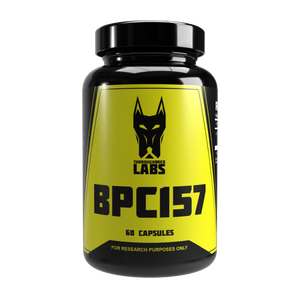
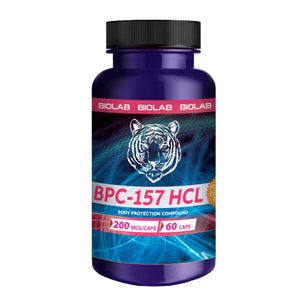
BPC-157 is a fifteen-residue synthetic peptide whose sequence comes from a gastric protein. Almost all published work on it is in rodents and cells; no medicines licence exists for it anywhere, it has no place in a lawful UK food supplement, and WADA places it in section S0 (substances with no current approval), prohibited at all times. On stated label figures, BioLab sells BPC-157 as the hydrochloride at 200 mcg in 60 capsules (12 mg per tub) and Thoroughbred Labs at 300 mcg of the arginate in 60 (18 mg); Yakka Strength's 250 mcg sits between them, with no salt named. Free Muscle has no BPC-157 of its own. The BPC-157 collection lists all three brands without ranking them.
Related
- BPC-157 collection: every brand we hold, set side by side on strength, pack size and testing
- All Yakka Strength products stocked at Free Muscle
- SARMs vs peptides, on how the two classes differ
- Delivery and returns
Research compounds sold by Free Muscle are supplied for laboratory research use only and are not for human consumption. They are not authorised as medicines by the MHRA, EMA or FDA, are not food supplements, and are sold only to adults aged 18 or over. Nothing on this page is medical or dosing advice.
References
- Chang CH, et al. The promoting effect of pentadecapeptide BPC 157 on tendon healing involves tendon outgrowth, cell survival, and cell migration. J Appl Physiol (1985). 2011;110(3):774-80. PMID: 21030672.
- Sikiric P, et al. Brain-gut Axis and Pentadecapeptide BPC 157: Theoretical and Practical Implications. Curr Neuropharmacol. 2016;14(8):857-865. PMID: 27138887.
- He L, et al. Pharmacokinetics, distribution, metabolism, and excretion of body-protective compound 157, a potential drug for treating various wounds, in rats and dogs. Front Pharmacol. 2022;13:1026182. PMID: 36588717.
- Cox HD, et al. Detection and in vitro metabolism of the confiscated peptides BPC 157 and MGF R23H. Drug Test Anal. 2017;9(10):1490-1498. PMID: 28035768.
Frequently asked questions
Where can I buy BPC-157 in the UK?
Free Muscle stocks Yakka Strength BPC-157 and sells it to adults aged 18 and over for laboratory research only, with free tracked UK delivery. Whichever seller you use, check five things: a lot number on the pack; a certificate of analysis that names the laboratory and carries that same lot number; research-use-only labelling with no dosing or health claims; a stated strength per capsule and capsule count; and a written returns policy. Every BPC-157 listing we stock is compared side by side on our BPC-157 page, freemuscle.co.uk/collections/bpc-157. Not for human consumption.
Is Yakka Strength BPC-157 legal in the UK?
Free Muscle supplies it only as a research material. BPC-157 holds no MHRA licence as a medicine and is not an authorised food supplement, so it cannot be sold for human consumption. Free Muscle supplies it only to adults aged 18 or over for laboratory research. In sport it is prohibited: WADA lists it in section S0, non-approved substances, which applies in and out of competition. This is general information, not legal advice.
Does oral BPC-157 in capsule form, such as Yakka Strength's, have any evidence behind it?
Nobody has shown it in people. The group that developed BPC-157 reports that it is stable in gastric juice, and some of its rat studies gave the peptide by mouth, but no published study has measured whether it is absorbed intact in humans or how much reaches tissue. Our article on oral peptides explains what is known and what is not. We make no claim about any effect of this product.
What strength are Yakka Strength BPC-157 capsules, and how do they compare with other brands?
Yakka Strength labels 250 mcg of BPC157 per capsule and 60 capsules per pot, 15 mg per pot as labelled, without naming a salt. Of the other BPC-157 capsules we stock, BioLab states 200 mcg per capsule as the hydrochloride and Thoroughbred Labs 300 mcg, both in 60-capsule tubs. These are declared label figures, not measurements, and we do not advise on strength or quantity because this pot is supplied for laboratory research and nothing else.
Is BPC-157 prescribed on the NHS?
No. BPC-157 has no marketing authorisation as a medicine in the UK or in any other country, and the NHS does not prescribe it. It is not an authorised food supplement either. In the UK it can be sold only as a research material, which is how Free Muscle supplies this Yakka Strength pack, to adults aged 18 and over and not for human consumption.
How does Yakka Strength BPC-157 differ from TB-500?
BPC-157 is a 15-amino-acid peptide based on a sequence from a gastric juice protein, studied mainly in rodent gut, tendon and ligament models. TB-500 is sold as a synthetic peptide derived from thymosin beta-4, an actin-binding protein studied in wound and heart models. No human trial has compared them. Neither is a licensed medicine, and WADA places BPC-157 in section S0 and TB-500 in section S2.
Do you publish BPC-157 dosage, side effects or before-and-after results?
We publish no dosing, cycle or combination guidance and make no claims about benefits or results, because BPC-157 is sold for laboratory research and is not for human consumption. On side effects, no systematic human safety data exist, since the published work is almost entirely in rodents and cells. Before-and-after photos and forum accounts cannot show what a capsule contained or what caused any change.
Is BPC-157 detectable in a drug test?
Yes. WADA names BPC-157 in section S0 of its Prohibited List, banned in and out of competition. A validated anti-doping urine method, published in 2017, has a detection limit of 0.1 ng/mL, and the peptide remained stable in urine for at least four days. How long it stays detectable after exposure has not been published, so the detection window is not established.
Is Yakka Strength BPC-157 legit, and who makes it?
What can be checked: the pot states 250 mcg per capsule and 60 capsules in a printed facts panel, carries a research-only notice, and names Yakka Strength Ltd, a registered County Durham company, as distributor. What cannot: the manufacturer, which neither the label nor the brand's website names, and testing, since the brand's site publishes no certificates. A certificate therefore goes on this listing only when Yakka Strength provides one for the current batch, and we do not rely on review sites or forum threads for any of this.
How do I verify the batch of Yakka Strength BPC-157 I receive?
Find the lot number on the pot itself, since the brand's printed label has no batch field, and check that any certificate of analysis carries exactly that number. We show a Yakka Strength certificate only where the brand has supplied one for the batch we hold, so email us with the number to ask what exists. A certificate for this pot should identify BPC-157, state whether it measured net peptide or powder, and give a content per capsule to set against the 250 mcg on the label.
How is Yakka Strength BPC-157 shipped, and can I return it?
Every UK order travels free by tracked delivery, in plain packaging. If you order before 2pm Monday to Friday, it is processed the same working day; EU deliveries take 3-7 working days. Our guarantee covers returns of unopened items within 30 days. You must be 18 or over to place an order.
How fast is UK and EU delivery for Yakka Strength BPC-157?
Orders placed before 2pm Monday to Friday are processed the same working day. UK delivery is free and tracked on every order, with no minimum spend, and usually arrives 2-3 working days after dispatch; a faster tracked UK service costs £6 and usually takes 1-2 working days. EU orders, including Romania, go by the paid tracked international service and usually arrive 3-7 working days after dispatch; the rest of the world usually takes 5-14 working days. Sold to adults aged 18 and over for laboratory research only.
Who can buy Yakka Strength BPC-157?
Only adults aged 18 or over, and only for laboratory research use. It is not for human consumption, and nothing on this page is medical, dosing or usage advice.
Related research and listings
Same compound, other brands See all 3 →
More from Yakka Strength See all 11 →


Research compounds sold by Free Muscle are supplied for laboratory research use only and are not for human consumption. They are not authorised as medicines by the MHRA, EMA or FDA, are not food supplements, and are sold only to adults aged 18 or over. Nothing on this page is medical or dosing advice.